Vendor-Managed Inventory (VMI) is a supply chain strategy where the upstream supplier, not the buyer, takes full responsibility for maintaining an agreed-upon inventory level at the buyer's location. The supplier receives real-time demand and stock data, typically via EDI or API, and autonomously generates purchase orders to replenish stock without waiting for a manual buyer requisition.

Glossary
Vendor-Managed Inventory (VMI)
A collaborative supply chain strategy where the upstream supplier assumes responsibility for monitoring the buyer's inventory levels and autonomously generating replenishment orders to maintain agreed-upon stock targets.
SUPPLY CHAIN STRATEGY
What is Vendor-Managed Inventory (VMI)?
A collaborative replenishment model where the supplier assumes responsibility for monitoring and managing a buyer's inventory levels.
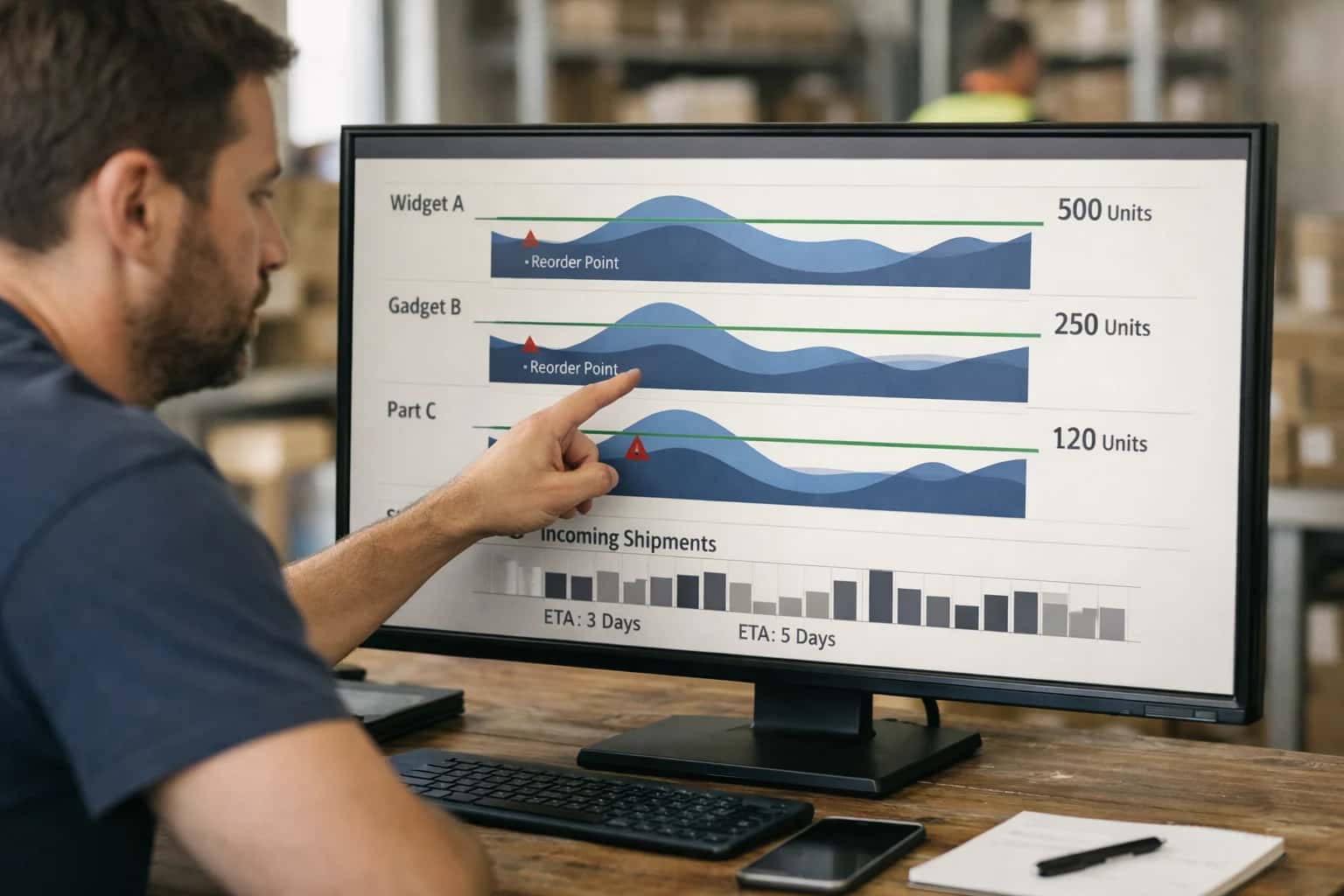
This model shifts the decision-making burden from the buyer to the supplier, enabling a demand-driven supply chain that reduces stockouts and excess buffer stock. By eliminating information asymmetry, VMI directly counteracts the Bullwhip Effect, allowing the supplier to optimize production schedules and transportation loads based on actual consumption patterns rather than distorted, batched purchase orders.
VENDOR-MANAGED INVENTORY
Key Characteristics of VMI
Vendor-Managed Inventory (VMI) is a collaborative supply chain strategy where the upstream supplier assumes responsibility for monitoring the buyer's inventory levels and autonomously generating replenishment orders to maintain agreed-upon stock targets. The following characteristics define its operational and strategic framework.
01
Demand Visibility Transfer
The foundational mechanism of VMI is the real-time transfer of demand data from the buyer to the supplier. Instead of the buyer placing purchase orders, the supplier receives point-of-sale (POS) data, warehouse withdrawals, or current inventory positions directly. This eliminates information asymmetry and the distortion caused by batch ordering, directly countering the Bullwhip Effect. The supplier uses this granular consumption data to generate a more accurate forecast than the buyer could independently, as they see the unedited, actual demand signal rather than a manually adjusted order pattern.
02
Replenishment Decision Rights
In a VMI relationship, the supplier holds the decision-making authority for replenishment timing and quantity within a contractually defined framework. The buyer sets the boundaries through agreed-upon parameters:
- Min/Max Stock Levels: The absolute floor and ceiling for on-hand inventory.
- Target Days of Supply: The desired forward coverage in days.
- Service Level Targets: The required fill rate or cycle service level. The supplier's planning system autonomously generates a suggested order, which is transmitted to the buyer for visibility. This shifts the operational burden of inventory planning from the buyer's procurement team to the supplier's logistics team.
03
Continuous Replenishment Model
VMI replaces the traditional discrete, periodic purchase order cycle with a continuous replenishment or flow-based model. Rather than large, infrequent bulk orders, the supplier generates smaller, more frequent shipments that are synchronized with actual consumption rates. This operational cadence directly reduces the buyer's average on-hand inventory and dampens demand variability. The model is often implemented using a Min-Max or Order-Up-To replenishment logic, where a shipment is triggered whenever the inventory position falls below the reorder point, raising it back to a target level.
04
Contractual Stock Ownership Models
The financial ownership of inventory in a VMI arrangement is a critical legal distinction and is not uniform. Two primary models exist:
- Consignment VMI: The supplier retains legal title to the goods stored at the buyer's location. The buyer only takes ownership upon withdrawal or consumption. This shifts the inventory carrying cost to the supplier.
- Non-Consignment VMI: The buyer takes ownership upon receipt of the goods at their facility, but the supplier still manages the replenishment signal. The buyer bears the carrying cost, but benefits from the reduced administrative burden and optimized stock levels. The choice of model significantly impacts working capital and balance sheet treatment for both parties.
05
Performance-Based Compliance
VMI agreements are governed by strict performance metrics that define success and trigger remediation. The supplier is typically held accountable for:
- Service Level: Achieving a target Fill Rate or On-Time In-Full (OTIF) percentage.
- Inventory Turnover: Maintaining the buyer's stock within the agreed-upon Days of Supply range.
- Stockout Incidence: Minimizing zero-balance events at the point of consumption. Conversely, the buyer is responsible for forecast accuracy if they provide promotional calendars and for ensuring data integrity. Failure to meet these mutually agreed-upon KPIs often results in financial penalties or a reversion to a traditional purchasing model.
06
Integration with Collaborative Planning
While VMI automates the operational replenishment signal, it is most effective when embedded within a broader Collaborative Planning, Forecasting, and Replenishment (CPFR) framework. VMI handles the short-term execution loop, but CPFR adds a strategic layer where both partners jointly develop the long-range demand forecast and align on promotional plans, new product introductions, and capacity constraints. This integration ensures that the VMI algorithm is not optimizing against a flawed baseline. The supplier's Demand Sensing capabilities feed the short-term VMI signal, while the collaborative forecast drives the supplier's raw material and capacity planning.
VENDOR-MANAGED INVENTORY
Frequently Asked Questions
Clear, technical answers to the most common questions about the mechanisms, benefits, and implementation of Vendor-Managed Inventory (VMI) in modern supply chains.
Vendor-Managed Inventory (VMI) is a collaborative supply chain strategy where the upstream supplier assumes full responsibility for monitoring the buyer's inventory levels and autonomously generating replenishment orders to maintain agreed-upon stock targets. The supplier receives daily point-of-sale (POS) data, warehouse withdrawals, or on-hand inventory levels via Electronic Data Interchange (EDI) or API. Using this visibility, the supplier runs replenishment algorithms to calculate order quantities that keep the buyer's stock within a defined min-max range or at a target order-up-to level. The supplier then generates a suggested purchase order, which the buyer typically auto-approves. This shifts the decision-making burden from the buyer's procurement team to the supplier's planning team, eliminating the bullwhip effect caused by distorted demand signals and manual reorder point adjustments. VMI is distinct from Continuous Replenishment Programs (CRP) in that the supplier has full decision rights over order timing and quantity, not just the execution of buyer-generated orders.
Enabling Efficiency, Speed & Accuracy
Intelligent Analysis, Decision & Execution
We build AI systems for teams that need search across company data, workflow automation across tools, or AI features inside products and internal software.
Talk to Us
Search across company data
Give teams answers from docs, tickets, runbooks, and product data with sources and permissions.
Useful when people spend too long searching or get different answers from different systems.
Enterprise searchRAGPermissions
Read more
Automate internal workflows
Use AI to route work, draft outputs, trigger actions, and keep approvals and logs in place.
Useful when repetitive work moves across multiple tools and teams.
AI agentsWorkflow automationGovernance
Read more
Add AI to products and internal tools
Build assistants, guided actions, or decision support into the software your team or customers already use.
Useful when AI needs to be part of the product, not a separate tool.
AI integrationDecision supportModel routing
Read more
About the author
Prasad Kumkar
CEO & MD, Inference Systems
Prasad Kumkar is the CEO & MD of Inference Systems and writes about AI systems architecture, LLM infrastructure, model serving, evaluation, and production deployment. Over 5+ years, he has worked across computer vision models, L5 autonomous vehicle systems, and LLM research, with a focus on taking complex AI ideas into real-world engineering systems.
His work and writing cover AI systems, large language models, AI agents, multimodal systems, autonomous systems, inference optimization, RAG, evaluation, and production AI engineering.
LinkedIn
Limited slotsGet a Free AI Consultation
Partnered with leading AI, data, and software stack.





How We Work
Custom AI workflows for your Business
One-fit-all AI don't work for modern businesses. At Inferensys, we aim to understand your business & custom requirements; which we use to define most efficient agentic workflows, the data, and the tools for your business.
01
Review the use case
We understand the task, the users, and where AI can actually help.
Read more02
Pick the right approach
We define what needs search, automation, or product integration.
Read more03
Build the first useful version
We implement the part that proves the value first.
Read more04
Improve from there
We add the checks and visibility needed to keep it useful.
Read moreThe first call is a practical review of your use case and the right next step.
Talk to Us