Lateral transshipment is a supply chain tactic where inventory is moved between two facilities at the same echelon—such as two retail stores or two regional warehouses—rather than being replenished from a central distribution center. This peer-to-peer redistribution is triggered when one node faces an imminent stockout while another holds excess stock, enabling the network to rebalance itself without altering the total system-wide inventory position.

Glossary
Lateral Transshipment
The proactive or reactive redistribution of stock between peer locations at the same echelon level to fulfill a shortage at one node using excess inventory from another, avoiding a costly emergency order from an upstream supplier.
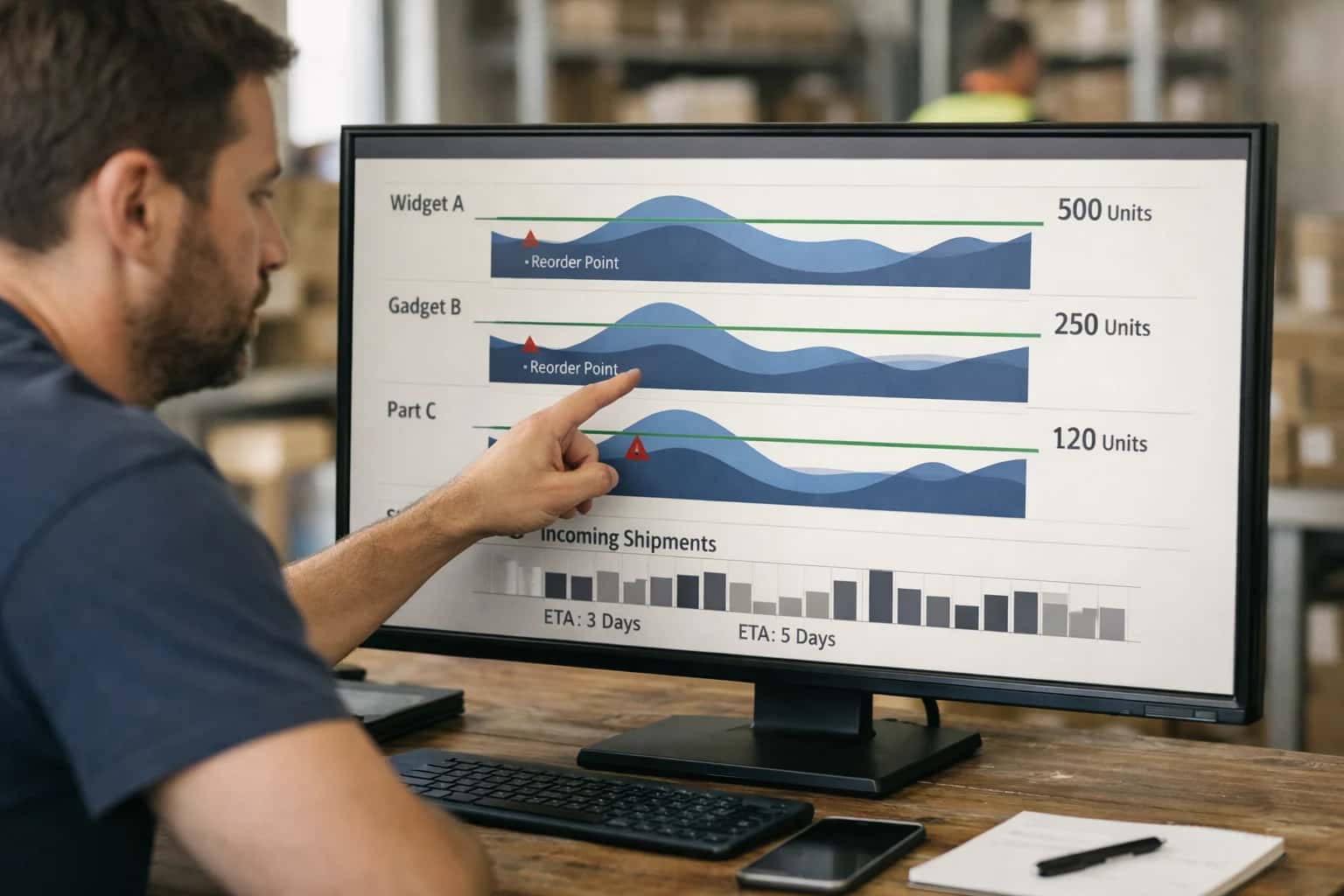
INVENTORY REDISTRIBUTION
What is Lateral Transshipment?
Lateral transshipment is the proactive or reactive redistribution of stock between peer locations at the same echelon level to fulfill a shortage at one node using excess inventory from another, avoiding a costly emergency order from an upstream supplier.
The primary objective is to maximize service levels while minimizing expediting costs. By fulfilling a shortage using a nearby peer's surplus, the organization avoids the high freight premiums and supplier penalties associated with a reactive upstream emergency order. In multi-echelon optimization models, lateral transshipment serves as a critical exception-handling mechanism that complements standard base-stock policies and safety stock calculations.
MECHANICS
Key Characteristics of Lateral Transshipment
Lateral transshipment is a tactical inventory redistribution strategy operating at a single echelon level. It transforms a network of isolated stockpiles into a virtual pooled inventory, allowing a location facing a shortage to be replenished by a peer with excess stock, rather than waiting for an upstream supplier.
01
Peer-to-Peer Redistribution
The defining characteristic of lateral transshipment is the movement of goods between nodes at the same echelon level (e.g., retailer-to-retailer, warehouse-to-warehouse). This bypasses the normal upstream replenishment path.
- Proactive Transshipment: Stock is redistributed before a stockout occurs, based on a risk assessment of future demand and current inventory positions.
- Reactive Transshipment: Stock is redistributed after a stockout has occurred at one location to immediately fill backorders or prevent lost sales.
- Network Dependency: Effectiveness is directly proportional to the physical proximity and transport connectivity between peer nodes.
02
Emergency Order Cost Avoidance
The primary financial driver for lateral transshipment is avoiding the premium freight costs and expedited processing fees associated with an emergency upstream order.
- Cost Differential: The cost of a peer-to-peer transfer is typically limited to standard intra-network transport, versus the 3-10x premium of an emergency air freight order from a supplier.
- Lead Time Reduction: A lateral transfer can often be executed in hours, compared to days or weeks for an upstream emergency order, directly protecting the On-Time In-Full (OTIF) metric.
- Order Consolidation: It prevents the need to break production schedules or minimum order quantities at the supplying plant for a single urgent need.
03
System-Wide Inventory Pooling Effect
Lateral transshipment creates a virtual pooling effect without physically centralizing inventory. The total safety stock required across the network to achieve a target service level is reduced.
- Risk Diversification: The probability that all locations simultaneously face a demand spike is far lower than the probability of a single location facing one. Excess at one node hedges the shortage at another.
- Square Root Law Application: The total system safety stock can be reduced by a factor proportional to the square root of the number of pooling locations, minus a friction coefficient for transport time.
- Component Commonality Synergy: The pooling effect is amplified when multiple end-products share common components, allowing a transshipment to resolve shortages for diverse SKUs.
04
Transshipment Policy Decision Rules
Effective lateral transshipment requires a codified policy to prevent suboptimal decisions, such as transferring stock to prevent a minor backorder while creating a major stockout at the sending location.
- Complete Pooling: Any location with excess stock must fulfill any shortage at a peer, provided the transfer cost is less than the backorder cost.
- Partial Pooling: A location only shares stock if its on-hand inventory exceeds a reservation level or critical ratio, protecting its own future demand.
- No Pooling: Standard policy where each location operates independently, serving as the baseline against which transshipment benefits are measured.
- Optimization Trigger: Modern systems use a dynamic safety stock calculation to continuously update these reservation levels based on real-time demand sensing.
05
Integration with Multi-Echelon Optimization
Lateral transshipment is not a standalone tactic but a critical input into a Multi-Echelon Inventory Optimization (MEIO) model. It changes the effective lead time and demand variance at each node.
- Stochastic Service Model (SSM): Lateral transshipment is a key mechanism within an SSM, where a stockout at one node doesn't immediately fail the customer but triggers a probabilistic delay while a peer source is located.
- Guaranteed Service Model (GSM): In a GSM, lateral transshipment can be modeled as a guaranteed, fixed-duration alternative supply source, allowing for deterministic safety stock placement.
- Reorder Point Adjustment: The existence of a reliable lateral supply source allows a planner to reduce the Reorder Point at each location, as the effective supply lead time variability is dampened by the network.
06
Distinction from Emergency Upstream Orders
It is critical to distinguish lateral transshipment from other exception-based fulfillment strategies. The key differentiator is the echelon of the supply source.
- Lateral Transshipment: Source is a peer at the same echelon (e.g., Warehouse A to Warehouse B).
- Emergency Upstream Order: Source is a node at a higher echelon (e.g., Factory to Warehouse B), breaking the normal planning cycle.
- Drop Shipping: Source is an upstream node shipping directly to the end customer, bypassing the downstream node entirely. Lateral transshipment replenishes the node's stock, not the customer directly.
LATERAL TRANSSHIPMENT EXPLAINED
Frequently Asked Questions
Clear, technically precise answers to the most common questions about redistributing inventory between peer locations to prevent stockouts and reduce emergency replenishment costs.
Lateral transshipment is the redistribution of stock between peer locations at the same echelon level—such as two retail stores or two regional warehouses—to fulfill a shortage at one node using excess inventory from another. Unlike a standard replenishment from an upstream supplier, this peer-to-peer movement avoids costly emergency orders and long lead times. The process is triggered either reactively, when a stockout is imminent, or proactively, when predictive models identify a future imbalance. A centralized inventory management system evaluates the cost of transshipment (transportation, handling) against the cost of a stockout (lost sales, customer dissatisfaction) and authorizes the transfer when the net benefit is positive. This mechanism effectively pools risk across locations, allowing the network to achieve higher service levels with lower aggregate safety stock.
INVENTORY FULFILLMENT COMPARISON
Lateral Transshipment vs. Emergency Replenishment
A feature-by-feature comparison of lateral transshipment between peer locations versus emergency replenishment from an upstream supplier when a stockout occurs at a downstream node.
| Feature | Lateral Transshipment | Emergency Replenishment | Safety Stock Buffer |
|---|---|---|---|
Source of stock | Peer location at same echelon | Upstream supplier or DC | On-hand buffer at same node |
Trigger mechanism | Proactive or reactive shortage signal | Reactive stockout event | Demand during lead time |
Order fulfillment lead time | 1-3 days | 7-21 days | 0 days |
Transportation cost per unit | $5-15 | $50-150 | $0 |
Expediting fees | |||
Risk of lost sale during wait | Low | High | None |
System-wide inventory reduction | |||
Requires inter-node visibility |
Enabling Efficiency, Speed & Accuracy
Intelligent Analysis, Decision & Execution
We build AI systems for teams that need search across company data, workflow automation across tools, or AI features inside products and internal software.
Talk to Us
Search across company data
Give teams answers from docs, tickets, runbooks, and product data with sources and permissions.
Useful when people spend too long searching or get different answers from different systems.
Enterprise searchRAGPermissions
Read more
Automate internal workflows
Use AI to route work, draft outputs, trigger actions, and keep approvals and logs in place.
Useful when repetitive work moves across multiple tools and teams.
AI agentsWorkflow automationGovernance
Read more
Add AI to products and internal tools
Build assistants, guided actions, or decision support into the software your team or customers already use.
Useful when AI needs to be part of the product, not a separate tool.
AI integrationDecision supportModel routing
Read more
About the author
Prasad Kumkar
CEO & MD, Inference Systems
Prasad Kumkar is the CEO & MD of Inference Systems and writes about AI systems architecture, LLM infrastructure, model serving, evaluation, and production deployment. Over 5+ years, he has worked across computer vision models, L5 autonomous vehicle systems, and LLM research, with a focus on taking complex AI ideas into real-world engineering systems.
His work and writing cover AI systems, large language models, AI agents, multimodal systems, autonomous systems, inference optimization, RAG, evaluation, and production AI engineering.
LinkedIn
Limited slotsGet a Free AI Consultation
Partnered with leading AI, data, and software stack.





How We Work
Custom AI workflows for your Business
One-fit-all AI don't work for modern businesses. At Inferensys, we aim to understand your business & custom requirements; which we use to define most efficient agentic workflows, the data, and the tools for your business.
01
Review the use case
We understand the task, the users, and where AI can actually help.
Read more02
Pick the right approach
We define what needs search, automation, or product integration.
Read more03
Build the first useful version
We implement the part that proves the value first.
Read more04
Improve from there
We add the checks and visibility needed to keep it useful.
Read moreThe first call is a practical review of your use case and the right next step.
Talk to Us