A digital twin is a dynamic, real-time synchronized virtual representation of a physical logistics network, asset, or process. It ingests live telemetry from IoT sensors, GPS trackers, and transactional systems to mirror the exact state of the physical world, enabling simulation, prediction, and optimization without disrupting live operations.

Glossary
Digital Twin
A dynamic virtual replica of a physical logistics network that synchronizes in real-time to simulate, predict, and optimize delivery performance.
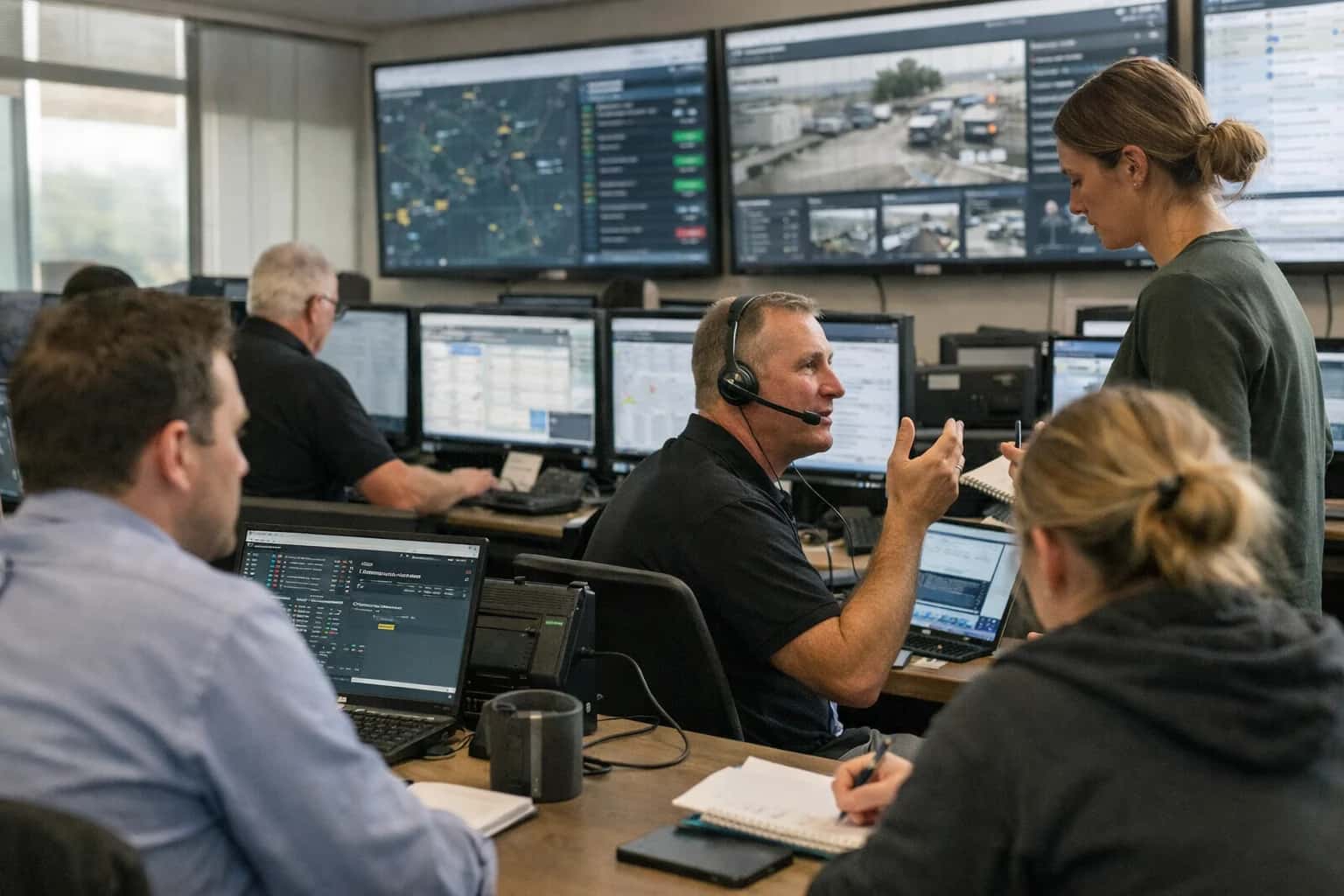
VIRTUAL MIRRORING
What is Digital Twin?
A dynamic virtual replica of a physical logistics network that synchronizes in real-time to simulate, predict, and optimize delivery performance.
Unlike a static model, a digital twin continuously updates its state to reflect current conditions, such as vehicle locations or warehouse throughput. This persistent synchronization allows logistics engineers to stress-test scenarios, predict delivery failures, and autonomously optimize last-mile routes by applying algorithms like Large Neighborhood Search (LNS) within a risk-free virtual environment.
VIRTUAL MIRRORING
Key Features of a Logistics Digital Twin
A logistics digital twin is not a static 3D model; it is a dynamic, data-driven virtual replica that synchronizes in real-time with its physical counterpart to simulate, predict, and optimize delivery network performance.
01
Real-Time Data Synchronization
The twin ingests a continuous stream of telemetry from the physical network. This creates a living model, not a stale snapshot.
- IoT Integration: Connects to GPS trackers, vehicle ECUs, and warehouse sensors.
- Event Streaming: Processes data via Apache Kafka or similar brokers for sub-second latency.
- State Mirroring: Accurately reflects the current location, status, and condition of every asset in the network.
02
Physics-Based Simulation Engine
Unlike simple spreadsheets, the twin uses a discrete-event simulation engine to model the physical constraints and stochastic nature of logistics.
- Stochastic Modeling: Injects real-world randomness like traffic burstiness and weather impact.
- Kinematic Constraints: Models vehicle acceleration, deceleration, and service time distributions.
- What-If Analysis: Safely stress-tests scenarios like a depot closure or a sudden demand spike without disrupting live operations.
03
Predictive & Prescriptive Analytics Layer
The twin moves beyond visualization to actionable intelligence. It forecasts future states and recommends optimal decisions.
- ETA Prediction: Uses gradient-boosted trees to predict arrival times with 95%+ confidence intervals.
- Exception Forecasting: Identifies shipments with a high probability of breaching their SLA before it happens.
- Prescriptive Re-Routing: Recommends specific route adjustments to mitigate predicted delays, optimizing for cost and service level.
04
Geospatial Network Graph
The physical network is modeled as a semantic graph, connecting nodes (depots, hubs, delivery points) with edges (road segments, flight paths).
- Dynamic Edge Weighting: Edge costs update in real-time based on congestion and weather data.
- Geospatial Indexing: Uses H3 or S2 grids for efficient spatial querying of millions of delivery points.
- Map Matching: Aligns raw GPS pings to the correct road segments to reconstruct true travel paths and driver behavior.
05
Closed-Loop Optimization
The digital twin is a cyber-physical system where simulation outputs directly inform physical actions, creating a continuous improvement cycle.
- Plan vs. Actual Analysis: Automatically compares simulated plans against real-world execution to identify model drift.
- Parameter Calibration: Adjusts simulation parameters (e.g., service times) based on observed data to maintain high fidelity.
- Automated Dispatch: Integrates with order management systems to push optimized routes and schedules directly to driver mobile apps.
06
Multi-Agent Behavioral Modeling
The twin models the independent decision-making of heterogeneous entities within the supply chain to capture emergent system behavior.
- Driver Behavior: Models compliance with suggested routes, break schedules, and individual driving styles.
- Customer Availability: Simulates end-customer delivery preferences and failed first-attempt probabilities.
- Carrier Interaction: Replicates the handshake protocols and handoff delays between different logistics service providers in a multi-leg journey.
DIGITAL TWIN FAQ
Frequently Asked Questions
Clear, technically precise answers to the most common questions about digital twin technology in logistics and supply chain management.
A digital twin is a dynamic, real-time virtual replica of a physical logistics network that synchronizes with live operational data to simulate, predict, and optimize delivery performance. It works through a continuous data loop: IoT sensors and telematics systems stream real-world data—vehicle GPS coordinates, warehouse throughput, traffic conditions—into a cloud-based simulation engine. This engine updates the virtual model's state to mirror reality, enabling what-if scenario analysis, bottleneck prediction, and prescriptive recommendations. Unlike static models, a digital twin evolves with its physical counterpart, ingesting streaming data via message brokers like Apache Kafka and persisting state in time-series databases for historical comparison and root cause analysis.
DIGITAL TWIN SIMULATION
Real-World Applications in Last-Mile Delivery
A digital twin synchronizes a virtual logistics network with its physical counterpart in real-time, enabling operators to simulate scenarios, predict failures, and optimize last-mile delivery performance without disrupting live operations.
01
Real-Time Fleet Synchronization
A digital twin ingests live telemetry from GPS, IoT sensors, and traffic APIs to mirror the exact state of every vehicle in the fleet. This dynamic virtual replica allows dispatchers to visualize the entire network at once, identifying geofencing exceptions and ETA drift the moment they occur. Unlike static dashboards, the twin continuously updates vehicle positions, parcel statuses, and driver hours-of-service, providing a single source of truth for operational decision-making.
02
Predictive 'What-If' Scenario Analysis
Operators can stress-test the virtual network against disruptive events before they impact the real world. Common simulations include:
- Vehicle Breakdown: Instantly reassigning a failed vehicle's parcels to neighboring assets and calculating the cascading effect on Service Level Agreement (SLA) Adherence.
- Depot Closure: Modeling the re-origin of all inventory from an alternative hub to measure the impact on On-Time In-Full (OTIF) metrics.
- Demand Surge: Injecting a 300% spike in order volume to test if the current Heterogeneous Fleet VRP (HFVRP) solver can maintain delivery windows.
03
Continuous Route Optimization Feedback Loop
The digital twin closes the gap between planning and execution. A Mixed Integer Programming (MIP) solver generates an initial route plan, which is then executed in the physical world. As deviations occur—such as a driver taking a wrong turn or a customer being unavailable—the twin captures the ground truth. This discrepancy data is fed back into the Adaptive LNS (ALNS) algorithm, allowing the optimization engine to learn and generate progressively more robust plans that anticipate real-world friction.
04
Carbon Footprint Monitoring & Reduction
By simulating the energy consumption of each vehicle based on its make, model, load weight, and real-time elevation data, the digital twin provides a granular Carbon Footprint Optimization layer. It can model the emissions impact of switching a segment of the fleet to electric vehicles or consolidating deliveries into fewer stops. This allows logistics directors to meet Sustainability Officer mandates by quantifying the exact CO2 savings of proposed operational changes before committing capital.
05
Driver Behavior & Safety Modeling
The twin ingests aggressive driving events—harsh acceleration, cornering, and braking—from vehicle ECUs. By correlating this data with route geometry and delivery density, the system identifies high-risk segments. It can then simulate the effect of inserting a mandatory 5-minute rest break or re-sequencing stops to avoid a dangerous left turn across traffic, directly improving the First Attempt Delivery Rate (FADR) by reducing accident-related delays and vehicle downtime.
06
Customer Communication & ETA Precision
A digital twin powers a hyper-accurate ETA Prediction Engine by running multiple parallel simulations of a vehicle's remaining route. It accounts for current traffic, the average dwell time at the next three stops based on historical Proof of Delivery (PoD) data, and even weather micro-cells. When a disruption is detected, the twin can instantly generate a new, validated ETA and trigger proactive notifications, reducing inbound 'Where is my order?' inquiries by up to 40%.
COMPARATIVE ANALYSIS
Digital Twin vs. Traditional Simulation
Key architectural and operational differences between a dynamic digital twin and a static traditional simulation model in a logistics network.
| Feature | Digital Twin | Traditional Simulation |
|---|---|---|
Data Synchronization | Real-time, bidirectional | Batch, unidirectional |
State Persistence | Persistent and evolving | Ephemeral, resets per run |
Operational Role | Operational decision-making | Strategic planning & design |
Feedback Loop | Closed-loop (actuates physical) | Open-loop (analysis only) |
Temporal Fidelity | Mirrors current physical state | Represents a historical snapshot |
Use Case | Real-time exception management | Network stress-testing |
Integration Depth | Direct IoT/API connection | Manual data import/export |
Enabling Efficiency, Speed & Accuracy
Intelligent Analysis, Decision & Execution
We build AI systems for teams that need search across company data, workflow automation across tools, or AI features inside products and internal software.
Talk to Us
Search across company data
Give teams answers from docs, tickets, runbooks, and product data with sources and permissions.
Useful when people spend too long searching or get different answers from different systems.
Enterprise searchRAGPermissions
Read more
Automate internal workflows
Use AI to route work, draft outputs, trigger actions, and keep approvals and logs in place.
Useful when repetitive work moves across multiple tools and teams.
AI agentsWorkflow automationGovernance
Read more
Add AI to products and internal tools
Build assistants, guided actions, or decision support into the software your team or customers already use.
Useful when AI needs to be part of the product, not a separate tool.
AI integrationDecision supportModel routing
Read more
About the author
Prasad Kumkar
CEO & MD, Inference Systems
Prasad Kumkar is the CEO & MD of Inference Systems and writes about AI systems architecture, LLM infrastructure, model serving, evaluation, and production deployment. Over 5+ years, he has worked across computer vision models, L5 autonomous vehicle systems, and LLM research, with a focus on taking complex AI ideas into real-world engineering systems.
His work and writing cover AI systems, large language models, AI agents, multimodal systems, autonomous systems, inference optimization, RAG, evaluation, and production AI engineering.
LinkedIn
Limited slotsGet a Free AI Consultation
Partnered with leading AI, data, and software stack.





How We Work
Custom AI workflows for your Business
One-fit-all AI don't work for modern businesses. At Inferensys, we aim to understand your business & custom requirements; which we use to define most efficient agentic workflows, the data, and the tools for your business.
01
Review the use case
We understand the task, the users, and where AI can actually help.
Read more02
Pick the right approach
We define what needs search, automation, or product integration.
Read more03
Build the first useful version
We implement the part that proves the value first.
Read more04
Improve from there
We add the checks and visibility needed to keep it useful.
Read moreThe first call is a practical review of your use case and the right next step.
Talk to Us