A graph-based routing engine is a computational system that represents a logistics network as a mathematical graph—where nodes represent locations (warehouses, ports, cross-docks) and edges represent transportation links (lanes, roads, routes) with associated costs, transit times, and constraints. Unlike simple point-to-point routing, this engine applies graph traversal algorithms, such as Dijkstra's algorithm or A search*, to efficiently calculate optimal multi-stop paths, identify transshipment hubs, and solve complex vehicle routing problems across thousands of interconnected nodes.

Glossary
Graph-Based Routing Engine
A system that models logistics networks as interconnected nodes and edges to efficiently calculate optimal multi-stop paths and transshipment opportunities.
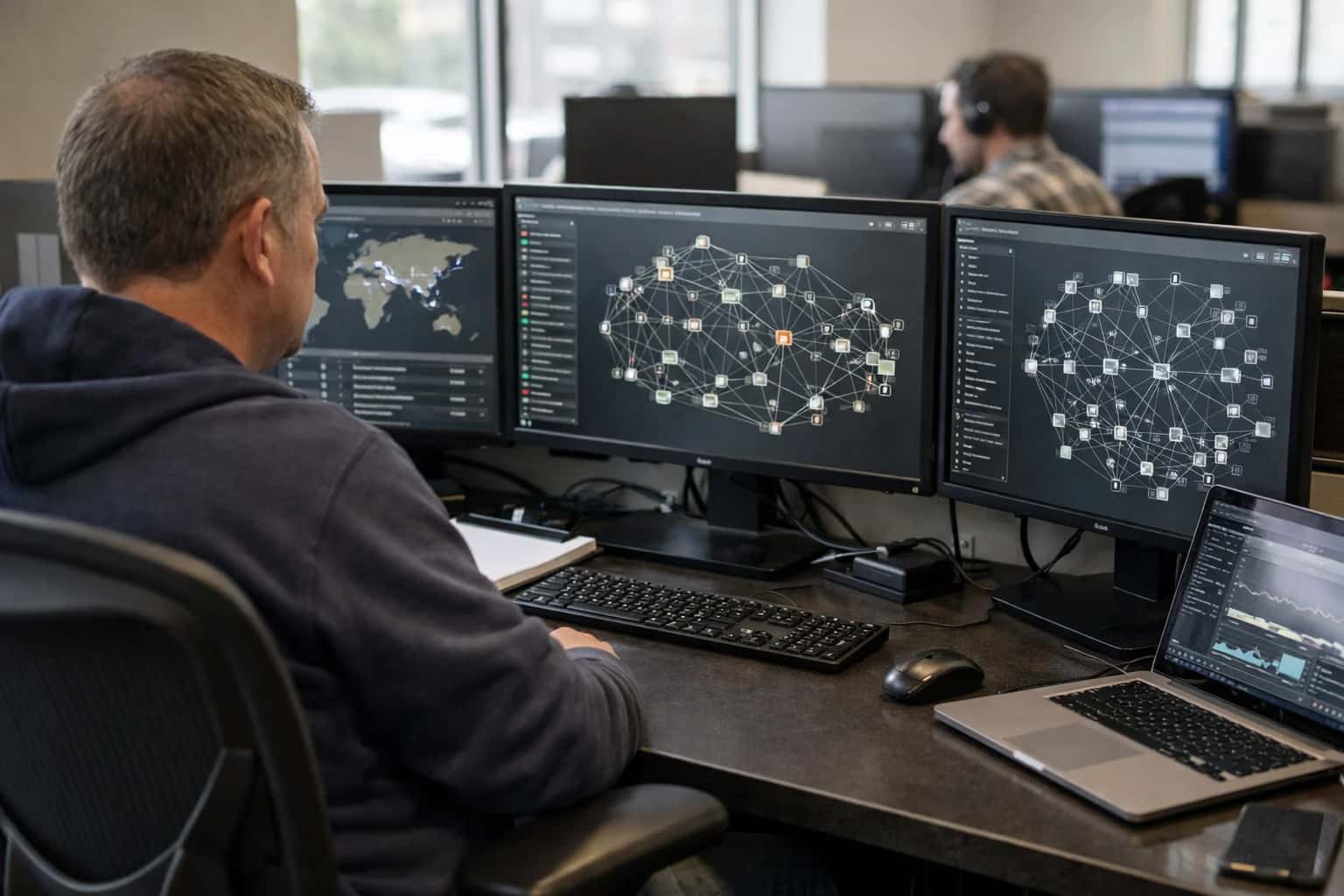
LOGISTICS NETWORK OPTIMIZATION
What is Graph-Based Routing Engine?
A graph-based routing engine models a logistics network as a mathematical graph of nodes and edges to compute optimal multi-stop paths and transshipment opportunities.
The engine dynamically evaluates edge weights—including real-time traffic, fuel costs, carrier rates, and carbon emissions—to find the lowest-cost or fastest path through the network. By leveraging graph neural networks and constraint satisfaction solvers, it can simultaneously optimize for conflicting objectives like minimizing deadhead miles while maximizing on-time delivery probability, making it foundational to autonomous supply chain orchestration and digital freight matching platforms.
ARCHITECTURAL FOUNDATIONS
Core Characteristics of Graph-Based Routing Engines
Graph-based routing engines model logistics networks as interconnected nodes and edges, enabling efficient calculation of optimal multi-stop paths and transshipment opportunities through specialized graph algorithms.
01
Node-Edge Network Representation
The foundational data structure where nodes represent physical locations (warehouses, cross-docks, ports, delivery stops) and edges represent valid transportation connections between them. Each edge carries weighted attributes including distance, transit time, cost, carbon emissions, and capacity constraints. This representation enables the system to model complex real-world logistics networks—including multi-modal transport where a shipment might transition from rail to truck at an intermodal terminal—as a single traversable graph structure.
02
Multi-Constraint Pathfinding
Unlike simple point-to-point routing, graph-based engines solve the constrained shortest path problem by simultaneously evaluating multiple hard and soft constraints. Hard constraints include equipment type requirements (reefer, flatbed), hazardous material restrictions, and time windows. Soft constraints include cost minimization, carbon footprint reduction, and carrier preference alignment. The engine employs algorithms like Dijkstra's algorithm for single-source shortest paths or A search* with domain-specific heuristics to prune the search space and find optimal routes in sub-second timeframes.
03
Transshipment and Hub Optimization
A critical capability of graph-based engines is modeling transshipment nodes—intermediate points where cargo changes vehicles or modes. The engine evaluates whether routing through a hub (cross-dock, consolidation center) reduces total cost despite adding handling complexity. This enables:
- Hub-and-spoke optimization: determining optimal consolidation points
- Cross-dock scheduling: timing arrivals to minimize dwell time
- Mode shift analysis: comparing direct truckload vs. rail-truck intermodal paths
- Pool distribution: aggregating multiple shipments at a hub for final-mile efficiency
04
Dynamic Edge Weight Recalculation
Graph edges are not static—their traversal costs change in real-time based on external conditions. The engine continuously recalculates edge weights using live data streams including traffic congestion indices, weather conditions, road closures, and spot market rate fluctuations. This transforms the graph from a static map into a live digital twin of the logistics network. When a major highway closes, affected edges are temporarily assigned infinite weight, forcing the pathfinding algorithm to discover alternative routes through the remaining graph structure.
05
Multi-Objective Pareto Optimization
Real-world routing rarely has a single objective. The engine employs Pareto frontier analysis to identify non-dominated solutions when optimizing for conflicting goals—such as minimizing cost while simultaneously minimizing carbon emissions. Rather than reducing everything to a single weighted score, the engine surfaces the set of optimal trade-off solutions where no objective can be improved without degrading another. A dispatcher might see three Pareto-optimal routes: the cheapest (but slowest), the fastest (but most expensive), and the lowest-emission (moderate cost and speed).
06
Graph Traversal with Time-Dependent Costs
Edge traversal costs vary by time of day due to predictable patterns like rush hour congestion and port operating hours. The engine models this using time-dependent graphs where edge weights are functions of the departure time rather than constants. This enables the system to answer queries like 'If I depart at 2 PM, what is my ETA?' versus 'What time should I depart to arrive by 8 AM?' The engine may use time-expanded graph representations that duplicate nodes across discrete time intervals to solve these temporally-aware routing problems.
GRAPH-BASED ROUTING ENGINE
Frequently Asked Questions
Explore the core concepts behind graph-based routing engines, the computational backbone that models logistics networks as interconnected nodes and edges to calculate optimal multi-stop paths and transshipment opportunities.
A graph-based routing engine is a computational system that models a logistics network as a mathematical graph—consisting of nodes (locations like warehouses, cross-docks, and delivery stops) and edges (transportation lanes with attributes like distance, cost, time, and capacity)—to efficiently calculate optimal paths. The engine applies graph traversal algorithms, most commonly variants of Dijkstra's algorithm or the A (A-star) search algorithm*, to find the shortest or least-cost path between an origin and destination. Unlike simple point-to-point navigation, these engines handle complex constraints including time windows, vehicle capacities, and multi-stop sequences. The graph structure allows the system to represent transshipment points where freight can be transferred between vehicles, enabling hub-and-spoke optimizations. Modern implementations use contraction hierarchies to pre-process the graph for millisecond-level query responses on continent-scale networks with millions of edges.
Enabling Efficiency, Speed & Accuracy
Intelligent Analysis, Decision & Execution
We build AI systems for teams that need search across company data, workflow automation across tools, or AI features inside products and internal software.
Talk to Us
Search across company data
Give teams answers from docs, tickets, runbooks, and product data with sources and permissions.
Useful when people spend too long searching or get different answers from different systems.
Enterprise searchRAGPermissions
Read more
Automate internal workflows
Use AI to route work, draft outputs, trigger actions, and keep approvals and logs in place.
Useful when repetitive work moves across multiple tools and teams.
AI agentsWorkflow automationGovernance
Read more
Add AI to products and internal tools
Build assistants, guided actions, or decision support into the software your team or customers already use.
Useful when AI needs to be part of the product, not a separate tool.
AI integrationDecision supportModel routing
Read more
About the author
Prasad Kumkar
CEO & MD, Inference Systems
Prasad Kumkar is the CEO & MD of Inference Systems and writes about AI systems architecture, LLM infrastructure, model serving, evaluation, and production deployment. Over 5+ years, he has worked across computer vision models, L5 autonomous vehicle systems, and LLM research, with a focus on taking complex AI ideas into real-world engineering systems.
His work and writing cover AI systems, large language models, AI agents, multimodal systems, autonomous systems, inference optimization, RAG, evaluation, and production AI engineering.
LinkedIn
Limited slotsGet a Free AI Consultation
Partnered with leading AI, data, and software stack.





How We Work
Custom AI workflows for your Business
One-fit-all AI don't work for modern businesses. At Inferensys, we aim to understand your business & custom requirements; which we use to define most efficient agentic workflows, the data, and the tools for your business.
01
Review the use case
We understand the task, the users, and where AI can actually help.
Read more02
Pick the right approach
We define what needs search, automation, or product integration.
Read more03
Build the first useful version
We implement the part that proves the value first.
Read more04
Improve from there
We add the checks and visibility needed to keep it useful.
Read moreThe first call is a practical review of your use case and the right next step.
Talk to Us