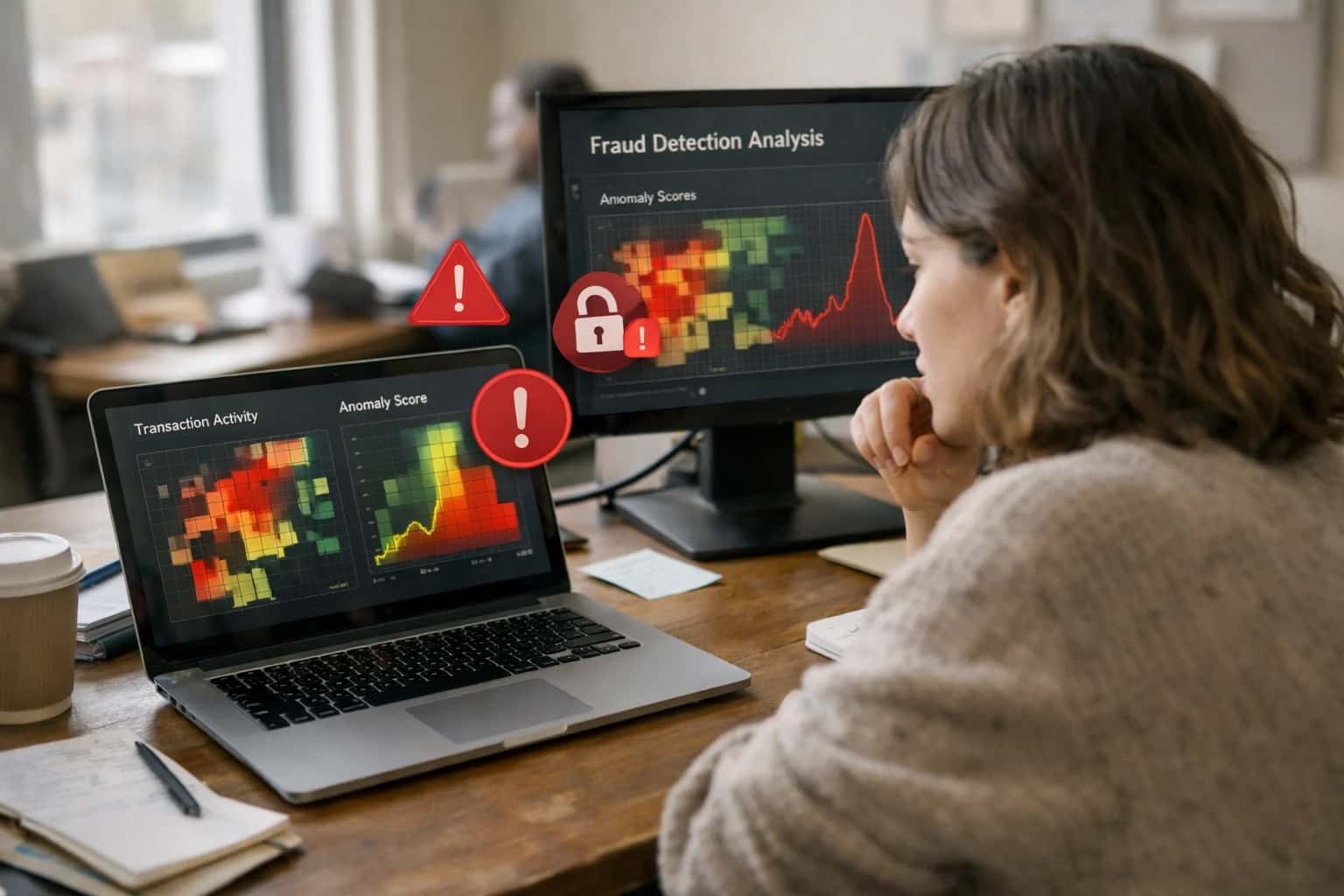
Fraudulent carrier detection is an AI-driven security framework that verifies carrier legitimacy by cross-referencing identity documents, insurance certificates, and operational data against known fraud patterns. It employs machine learning classifiers to flag anomalies in registration details, such as mismatched Department of Transportation numbers or recycled authority credentials, preventing unauthorized entities from accessing freight boards.

Glossary
Fraudulent Carrier Detection
An AI security system that analyzes identity documents, behavioral patterns, and network data to identify and block bad actors attempting double-brokering or cargo theft in digital freight platforms.
CARRIER VERIFICATION
What is Fraudulent Carrier Detection?
An AI security system that analyzes identity documents, behavioral patterns, and network data to identify and block bad actors attempting double-brokering or cargo theft.
Beyond document verification, these systems analyze behavioral telemetry—including login geolocation, rate negotiation patterns, and historical load acceptance—to identify double-brokering schemes. By mapping carrier networks and detecting suspicious relationships between seemingly independent entities, the engine blocks cargo theft rings before they can tender on high-value loads.
SECURITY ARCHITECTURE
Key Features of Fraudulent Carrier Detection Systems
Modern fraudulent carrier detection systems employ a layered defense strategy combining document forensics, behavioral analytics, and network intelligence to identify and block bad actors before cargo is tendered.
01
Identity Document Forensics
Automated analysis of carrier authority (MC number), insurance certificates, and government-issued IDs to detect digital manipulation or synthetic identity fraud. Systems cross-reference FMCSA databases in real-time while applying computer vision to flag:
- Inconsistent fonts or pixel artifacts indicating document tampering
- Mismatched entity names across insurance, authority, and banking records
- Expired or revoked operating authorities
- Deepfake detection on submitted headshots and video verification
This layer prevents bad actors from passing initial onboarding with stolen or fabricated credentials.
< 500ms
Document Verification Speed
02
Behavioral Anomaly Detection
Machine learning models that establish a baseline of normal behavior for legitimate carriers and flag deviations indicative of fraud. Key signals include:
- Velocity checks: Rapid creation of multiple carrier profiles from a single IP or device fingerprint
- Unusual login patterns, such as accessing the platform from geographically impossible locations within short timeframes
- Sudden changes in preferred lanes or equipment types inconsistent with historical operations
- Session replay analysis to detect bot-like or scripted interaction patterns
These models operate continuously, scoring every session and transaction for risk in real-time.
99.7%
Anomaly Detection Recall
03
Carrier Network Graph Analysis
Graph neural networks that map relationships between carriers, brokers, and shippers to uncover fraud rings and double-brokering schemes. The system analyzes:
- Shared phone numbers, email domains, or physical addresses across seemingly unrelated entities
- Payment beneficiary commonality revealing shell company structures
- Co-booking patterns where multiple carriers consistently book and then re-broker the same lanes
- Clustering of entities with identical device fingerprints or banking details
This approach identifies organized fraud networks that individual document checks would miss.
10M+
Entity Relationships Mapped
04
Real-Time Risk Scoring Engine
A composite scoring system that aggregates signals from all detection layers into a single, actionable fraud probability score. The engine applies:
- Weighted ensemble models combining document verification confidence, behavioral risk, and network graph centrality metrics
- Dynamic thresholding that adapts to current threat intelligence and market conditions
- Automated decisioning: low-risk carriers proceed instantly, high-risk flagged for manual review, critical-risk blocked outright
- Explainability outputs providing human-readable reasons for each score to support compliance audits
This ensures consistent, defensible decisions without creating friction for legitimate carriers.
< 2 sec
End-to-End Scoring Latency
05
Continuous Post-Onboarding Monitoring
Surveillance that extends beyond initial vetting to detect account takeover and credential hijacking after a carrier is approved. The system monitors:
- Changes to banking details or remittance information triggering re-verification workflows
- Sudden shifts in operational patterns, such as a regional carrier accepting coast-to-coast loads
- Device and browser fingerprinting to detect unauthorized access to legitimate carrier accounts
- Integration with industry fraud databases and FMCSA safety rating updates
This layer addresses the reality that legitimate carriers can be compromised or sold to bad actors post-approval.
24/7
Continuous Monitoring
06
Industry Data Consortium Integration
Secure, privacy-preserving data sharing with industry fraud prevention networks to leverage collective intelligence against known bad actors. Capabilities include:
- Federated blocklists of confirmed fraudulent MC numbers, VINs, and contact details shared across participating platforms
- Cryptographic matching protocols that allow querying consortium data without exposing proprietary carrier information
- Real-time alerts when a carrier attempting to onboard matches a fraud record from another network member
- Contribution feedback loops that strengthen the entire ecosystem with each confirmed fraud case
This collaborative approach ensures fraudsters cannot simply move from one platform to another.
FRAUDULENT CARRIER DETECTION
Frequently Asked Questions
Clear, technical answers to the most common questions about how AI systems identify and block fraudulent actors in digital freight networks.
Fraudulent carrier detection is an AI-powered security system that analyzes identity documents, behavioral patterns, and network data to identify and block bad actors attempting double-brokering, cargo theft, or fictitious pickups in digital freight marketplaces. The system operates by cross-referencing multiple data signals in real time: it verifies motor carrier (MC) numbers against the FMCSA database, checks for mismatches between a carrier's claimed identity and their digital footprint, and analyzes behavioral anomalies such as sudden lane preference changes or impossible transit times. Modern detection engines employ graph neural networks to map relationships between seemingly unrelated entities, uncovering organized fraud rings that would be invisible to rule-based systems. When a carrier attempts to book a load, the system generates a risk score within milliseconds by evaluating hundreds of features—including IP geolocation, device fingerprinting, document metadata analysis, and historical payment patterns—before the transaction is approved or flagged for manual review.
Enabling Efficiency, Speed & Accuracy
Intelligent Analysis, Decision & Execution
We build AI systems for teams that need search across company data, workflow automation across tools, or AI features inside products and internal software.
Talk to Us
Search across company data
Give teams answers from docs, tickets, runbooks, and product data with sources and permissions.
Useful when people spend too long searching or get different answers from different systems.
Enterprise searchRAGPermissions
Read more
Automate internal workflows
Use AI to route work, draft outputs, trigger actions, and keep approvals and logs in place.
Useful when repetitive work moves across multiple tools and teams.
AI agentsWorkflow automationGovernance
Read more
Add AI to products and internal tools
Build assistants, guided actions, or decision support into the software your team or customers already use.
Useful when AI needs to be part of the product, not a separate tool.
AI integrationDecision supportModel routing
Read more
About the author
Prasad Kumkar
CEO & MD, Inference Systems
Prasad Kumkar is the CEO & MD of Inference Systems and writes about AI systems architecture, LLM infrastructure, model serving, evaluation, and production deployment. Over 5+ years, he has worked across computer vision models, L5 autonomous vehicle systems, and LLM research, with a focus on taking complex AI ideas into real-world engineering systems.
His work and writing cover AI systems, large language models, AI agents, multimodal systems, autonomous systems, inference optimization, RAG, evaluation, and production AI engineering.
LinkedIn
Limited slotsGet a Free AI Consultation
Partnered with leading AI, data, and software stack.





How We Work
Custom AI workflows for your Business
One-fit-all AI don't work for modern businesses. At Inferensys, we aim to understand your business & custom requirements; which we use to define most efficient agentic workflows, the data, and the tools for your business.
01
Review the use case
We understand the task, the users, and where AI can actually help.
Read more02
Pick the right approach
We define what needs search, automation, or product integration.
Read more03
Build the first useful version
We implement the part that proves the value first.
Read more04
Improve from there
We add the checks and visibility needed to keep it useful.
Read moreThe first call is a practical review of your use case and the right next step.
Talk to Us