A dynamic reorder point is a replenishment trigger level that continuously adjusts based on real-time demand signals, lead time fluctuations, and current inventory posture rather than remaining static. Unlike a fixed reorder point calculated from historical averages, this mechanism ingests live data streams—such as point-of-sale transactions, supplier delivery updates, and demand sensing outputs—to recalculate the precise moment a new order must be placed to avoid a stockout while minimizing excess inventory.

Glossary
Dynamic Reorder Point
A replenishment trigger level that continuously adjusts based on real-time demand signals, lead time fluctuations, and current inventory posture rather than remaining static.
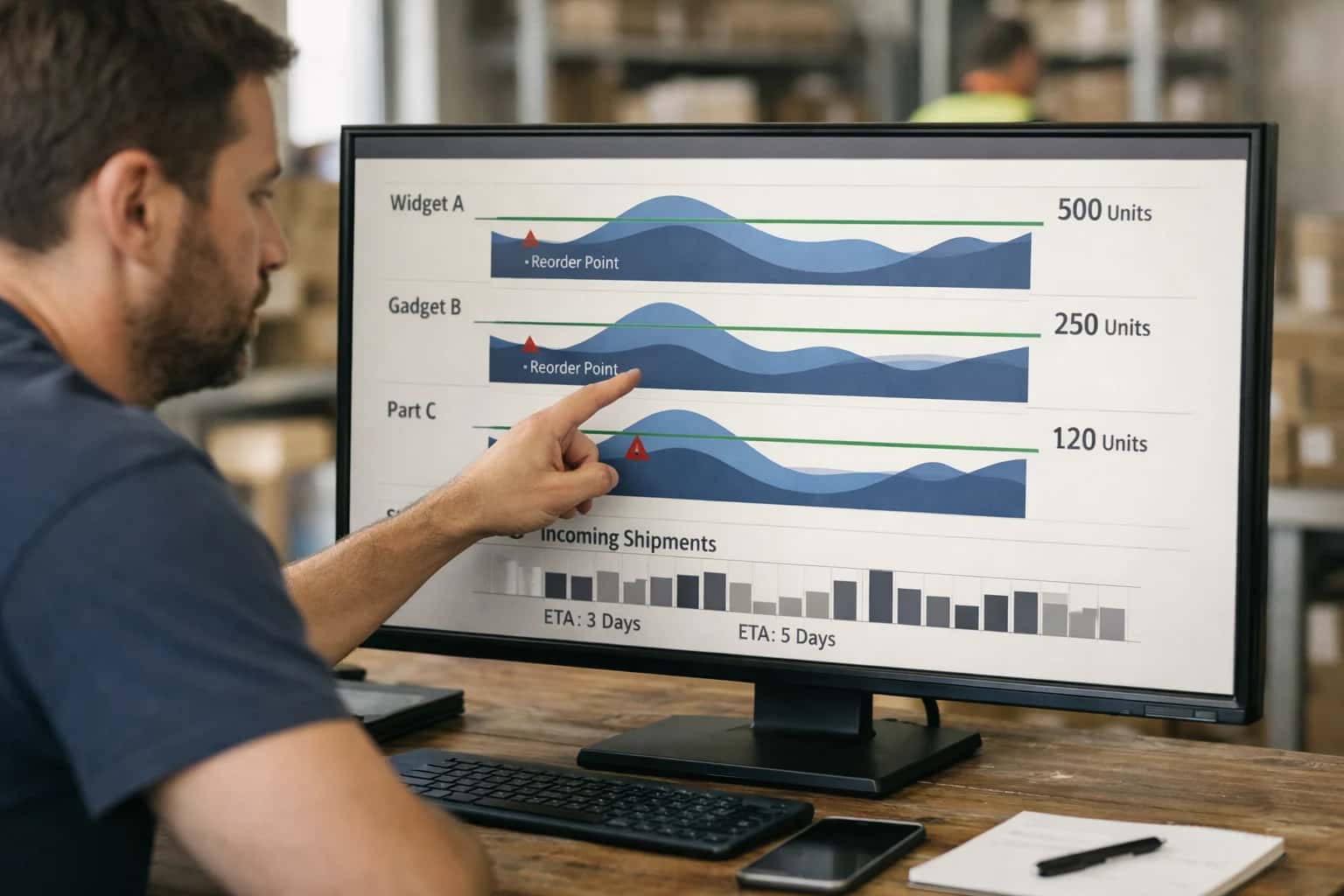
ADAPTIVE INVENTORY TRIGGERS
What is Dynamic Reorder Point?
A dynamic reorder point is a replenishment trigger that continuously recalculates the optimal inventory level for initiating a new purchase order based on real-time demand signals, lead time fluctuations, and current stock posture.
This adaptive logic directly addresses demand volatility clustering and concept drift, where static parameters become obsolete as market conditions shift. By integrating with probabilistic demand forecasting and predictive lead time analytics, the system ensures the reorder trigger reflects the most current probability distribution of future demand and supply uncertainty, enabling a more precise service level target without manual planner intervention.
ADAPTIVE INVENTORY TRIGGERS
Core Characteristics of Dynamic Reorder Points
A dynamic reorder point is a replenishment trigger that continuously self-adjusts based on real-time demand signals, lead time fluctuations, and current inventory posture. Unlike static min/max levels, it absorbs volatility to maintain target service levels without manual recalibration.
01
Real-Time Demand Signal Integration
The reorder point ingests demand sensing data streams—point-of-sale transactions, web traffic, and promotional calendars—to detect immediate shifts in consumption velocity. When a demand volatility cluster is detected, the trigger automatically elevates to prevent stockouts during turbulent periods. This replaces periodic forecast updates with continuous, signal-driven adjustment.
02
Lead Time Distribution Fitting
Rather than assuming a fixed supplier lead time, the dynamic reorder point incorporates lead time distribution fitting. Historical delivery data is matched to a probability distribution (e.g., gamma, Weibull) to model replenishment uncertainty. The trigger rises when supplier reliability degrades and falls when deliveries stabilize, directly linking buffer sizing to actual vendor performance.
03
Service Level Target Calibration
The reorder point is mathematically derived from a specified cycle service level or fill rate optimization target. For a 98% service level with normally distributed demand, the trigger equals: ROP = d̄ × L̄ + Z × √(L̄ × σ²d + d̄² × σ²L). The Z-score corresponds to the desired probability of no stockout, making the buffer profit-optimized rather than arbitrary.
04
Concept Drift Detection
Dynamic reorder points include automated concept drift monitoring. When the statistical properties of demand or supply shift permanently—such as a product entering decline phase or a supplier relocating—the model detects degradation in accuracy. This triggers Bayesian safety stock updates, combining prior assumptions with new evidence to prevent silent model failure.
05
Multi-Echelon Coordination
In a network with risk pooling across locations, dynamic reorder points at each echelon communicate to avoid bullwhip amplification. A warehouse reorder point adjusts not only to its own demand but to upstream decoupling point status and downstream retail triggers. This bullwhip dampening prevents independent nodes from over-ordering in response to the same demand signal.
06
Buffer Adjustment Frequency
The recalculation cadence balances responsiveness against planning stability. High-velocity items with intermittent demand patterns may recalculate hourly using quantile forecasting, while stable items update daily. The frequency is itself a tunable parameter, preventing excessive nervousness in procurement schedules while ensuring triggers never lag critical demand shifts.
DYNAMIC REORDER POINT
Frequently Asked Questions
Clear, technical answers to the most common questions about how dynamic reorder points function, their mathematical foundations, and their operational impact on modern supply chains.
A dynamic reorder point is a replenishment trigger level that continuously adjusts based on real-time demand signals, lead time fluctuations, and current inventory posture. Unlike a static reorder point, which remains fixed until manually recalculated, a dynamic reorder point autonomously shifts upward during periods of high demand volatility or supplier unreliability and downward when conditions stabilize. The core formula expands the classic ROP = d × LT + SS by making each variable a function of time: ROP(t) = d(t) × LT(t) + SS(t), where d(t) is the current demand rate, LT(t) is the predicted lead time, and SS(t) is the dynamically calculated safety stock. This prevents the twin failures of static systems: stockouts when conditions deteriorate and excess inventory when they improve.
Enabling Efficiency, Speed & Accuracy
Intelligent Analysis, Decision & Execution
We build AI systems for teams that need search across company data, workflow automation across tools, or AI features inside products and internal software.
Talk to Us
Search across company data
Give teams answers from docs, tickets, runbooks, and product data with sources and permissions.
Useful when people spend too long searching or get different answers from different systems.
Enterprise searchRAGPermissions
Read more
Automate internal workflows
Use AI to route work, draft outputs, trigger actions, and keep approvals and logs in place.
Useful when repetitive work moves across multiple tools and teams.
AI agentsWorkflow automationGovernance
Read more
Add AI to products and internal tools
Build assistants, guided actions, or decision support into the software your team or customers already use.
Useful when AI needs to be part of the product, not a separate tool.
AI integrationDecision supportModel routing
Read more
About the author
Prasad Kumkar
CEO & MD, Inference Systems
Prasad Kumkar is the CEO & MD of Inference Systems and writes about AI systems architecture, LLM infrastructure, model serving, evaluation, and production deployment. Over 5+ years, he has worked across computer vision models, L5 autonomous vehicle systems, and LLM research, with a focus on taking complex AI ideas into real-world engineering systems.
His work and writing cover AI systems, large language models, AI agents, multimodal systems, autonomous systems, inference optimization, RAG, evaluation, and production AI engineering.
LinkedIn
Limited slotsGet a Free AI Consultation
Partnered with leading AI, data, and software stack.





How We Work
Custom AI workflows for your Business
One-fit-all AI don't work for modern businesses. At Inferensys, we aim to understand your business & custom requirements; which we use to define most efficient agentic workflows, the data, and the tools for your business.
01
Review the use case
We understand the task, the users, and where AI can actually help.
Read more02
Pick the right approach
We define what needs search, automation, or product integration.
Read more03
Build the first useful version
We implement the part that proves the value first.
Read more04
Improve from there
We add the checks and visibility needed to keep it useful.
Read moreThe first call is a practical review of your use case and the right next step.
Talk to Us