The decoupling point is the strategic inventory buffer that separates the forecast-driven (push) segment of a supply chain from the order-driven (pull) segment. It acts as a shock absorber, holding stock to satisfy downstream customer orders immediately while insulating upstream production from volatile demand signals, thereby breaking the bullwhip effect.

Glossary
Decoupling Point
A decoupling point is the strategic inventory location in a supply chain that separates forecast-driven (push) operations from order-driven (pull) operations, absorbing demand variability upstream.
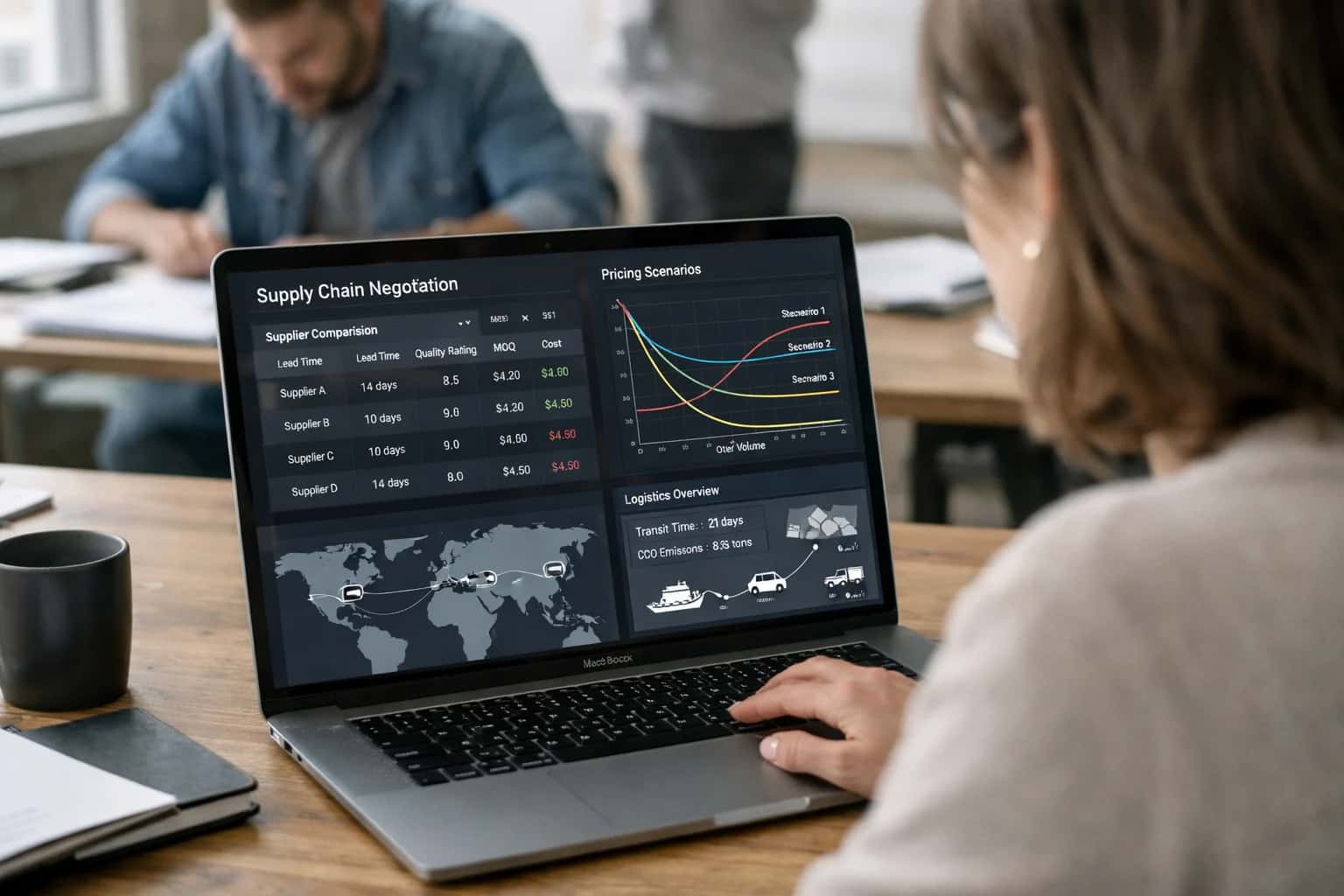
STRATEGIC INVENTORY POSITIONING
What is Decoupling Point?
The decoupling point is the strategic inventory location in a supply chain that separates forecast-driven operations from order-driven operations, absorbing demand variability upstream.
Positioning the decoupling point involves a trade-off between delivery speed and inventory cost. Placing it closer to raw materials enables mass customization and postponement, while positioning it near finished goods maximizes responsiveness. The optimal location is determined by the customer order decoupling point analysis, balancing lead time expectations against demand predictability.
STRATEGIC INVENTORY POSITIONING
Key Characteristics of a Decoupling Point
A decoupling point is defined by specific operational and strategic characteristics that distinguish it from standard inventory. These attributes determine its effectiveness in absorbing variability and enabling a shift from forecast-driven push to order-driven pull.
01
Strategic Inventory Buffer
The decoupling point holds a calculated safety stock specifically designed to absorb upstream demand variability and supply disruptions. Unlike cycle stock, which covers expected demand, this buffer is sized using probabilistic methods like quantile forecasting to achieve a target service level. It acts as a firewall, preventing the bullwhip effect from propagating downstream.
02
Push-Pull Boundary
This is the critical interface where the operating model shifts. Upstream of the point, processes are forecast-driven (push) , relying on predictions to plan production and procurement. Downstream, processes become order-driven (pull) , activated by actual customer demand. This boundary allows for economies of scale upstream while maintaining customer responsiveness downstream.
03
Product-Process Modularity
A decoupling point is often positioned where a generic, semi-finished product is transformed into a customer-specific final good. This leverages postponement strategies—delaying final assembly, labeling, or packaging until a real order is received. It enables mass customization by combining standardized upstream components with flexible downstream configuration.
04
Information Decoupling
The point separates two distinct information environments. Upstream, planning relies on aggregated forecasts and MRP logic. Downstream, execution is driven by real-time demand signals, actual orders, and point-of-sale data. This prevents noisy, short-term demand fluctuations from disrupting upstream production schedules and creating nervousness.
05
Lead Time Commitment Zone
For the customer, the decoupling point defines the order penetration point—the moment their order is linked to a specific product. The downstream lead time from this point to delivery is the maximum waiting time the customer experiences. Positioning the point closer to the customer reduces delivery lead times but increases inventory carrying costs.
06
Variety Funnel
The decoupling point sits at the neck of the variety funnel. Upstream, product variety is low, and volume is high. Downstream, variety explodes as generic products are configured into numerous final SKUs. Holding inventory at this low-variety stage minimizes total stock-keeping units while maximizing the ability to meet diverse customer requirements.
DECOUPLING POINT STRATEGY
Frequently Asked Questions
Clear, technical answers to the most common questions about strategic inventory positioning and how decoupling points absorb demand variability in modern supply chains.
A decoupling point is the strategic inventory location in a supply chain that separates forecast-driven operations from order-driven operations. It functions as a buffer where product flow transitions from a push-based, speculative model to a pull-based, customer-order model. Upstream of the decoupling point, processes are planned using probabilistic demand forecasting and operate on anticipated demand. Downstream, activities are triggered only by actual customer orders. The inventory held at this point absorbs demand variability, preventing the bullwhip effect from propagating upstream while enabling downstream responsiveness. Common positions include finished goods (make-to-stock), work-in-process (assemble-to-order), or raw materials (make-to-order).
Enabling Efficiency, Speed & Accuracy
Intelligent Analysis, Decision & Execution
We build AI systems for teams that need search across company data, workflow automation across tools, or AI features inside products and internal software.
Talk to Us
Search across company data
Give teams answers from docs, tickets, runbooks, and product data with sources and permissions.
Useful when people spend too long searching or get different answers from different systems.
Enterprise searchRAGPermissions
Read more
Automate internal workflows
Use AI to route work, draft outputs, trigger actions, and keep approvals and logs in place.
Useful when repetitive work moves across multiple tools and teams.
AI agentsWorkflow automationGovernance
Read more
Add AI to products and internal tools
Build assistants, guided actions, or decision support into the software your team or customers already use.
Useful when AI needs to be part of the product, not a separate tool.
AI integrationDecision supportModel routing
Read more
About the author
Prasad Kumkar
CEO & MD, Inference Systems
Prasad Kumkar is the CEO & MD of Inference Systems and writes about AI systems architecture, LLM infrastructure, model serving, evaluation, and production deployment. Over 5+ years, he has worked across computer vision models, L5 autonomous vehicle systems, and LLM research, with a focus on taking complex AI ideas into real-world engineering systems.
His work and writing cover AI systems, large language models, AI agents, multimodal systems, autonomous systems, inference optimization, RAG, evaluation, and production AI engineering.
LinkedIn
Limited slotsGet a Free AI Consultation
Partnered with leading AI, data, and software stack.





How We Work
Custom AI workflows for your Business
One-fit-all AI don't work for modern businesses. At Inferensys, we aim to understand your business & custom requirements; which we use to define most efficient agentic workflows, the data, and the tools for your business.
01
Review the use case
We understand the task, the users, and where AI can actually help.
Read more02
Pick the right approach
We define what needs search, automation, or product integration.
Read more03
Build the first useful version
We implement the part that proves the value first.
Read more04
Improve from there
We add the checks and visibility needed to keep it useful.
Read moreThe first call is a practical review of your use case and the right next step.
Talk to Us