A digital twin is a dynamic virtual model that mirrors a physical object, process, or system in real-time. It ingests live data from IoT sensors, transactional records, and operational logs to continuously update its state, enabling precise simulation and analysis. Unlike static models, a digital twin evolves alongside its physical counterpart, providing a synchronized, high-fidelity environment for stress-testing scenarios and predicting future behavior without disrupting live operations.

Glossary
Digital Twin
A dynamic, real-time virtual representation of a physical supply chain asset, process, or system used for simulation, monitoring, and optimization.
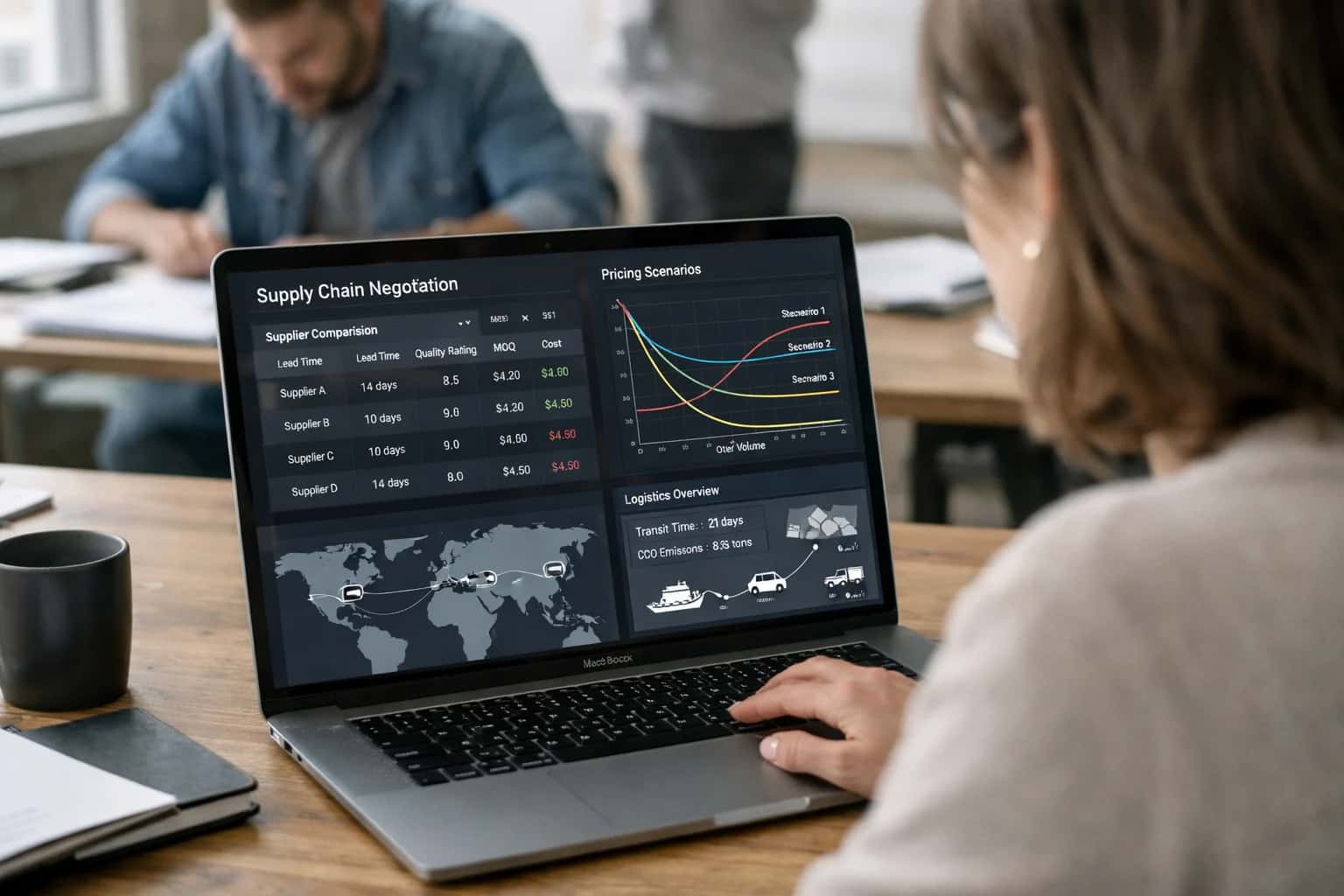
VIRTUAL REPRESENTATION
What is Digital Twin?
A digital twin is a dynamic, real-time virtual representation of a physical supply chain asset, process, or system, used for simulation, monitoring, and optimization.
The core value lies in bridging the physical and digital worlds through a digital thread that ensures data provenance. By applying Monte Carlo simulations and what-if analyses to the twin, organizations can optimize multi-echelon inventory, forecast predictive lead times, and quantify the bullwhip effect. This closed-loop architecture allows for prescriptive decision-making, where the twin not only diagnoses anomalies but autonomously recommends corrective actions back to the physical supply chain.
CORE ATTRIBUTES
Key Characteristics of a Digital Twin
A digital twin is defined by a set of essential characteristics that distinguish it from a static model. These attributes enable the continuous, bidirectional link between the physical and virtual worlds for simulation, monitoring, and optimization.
01
Real-Time Data Connectivity
A digital twin is not a snapshot; it is a living model continuously fed by streaming data from its physical counterpart. This connection is established via IoT sensors, SCADA systems, and transactional APIs (e.g., OPC UA). The data flow enables the virtual state to mirror the physical asset's current condition, from temperature and vibration to throughput and queue length.
- Latency: Data synchronization can range from sub-second for closed-loop control to hourly for strategic planning.
- Protocols: Common ingestion methods include MQTT, AMQP, and OPC UA.
- Contrast: A static 3D CAD model lacks this live tether, making it a digital model, not a twin.
< 100ms
Typical Sync Latency
02
Bidirectional Fidelity
The connection between the physical object and its virtual representation is a closed-loop system. Data flows from the physical to the virtual for state synchronization, but commands and optimizations also flow from the virtual back to the physical. This enables a digital twin to not just monitor, but to actively control actuators, reroute orders, or adjust machine parameters.
- Physical-to-Virtual: Sensor telemetry updates the model's state.
- Virtual-to-Physical: The simulation's output triggers a command in the real world, such as adjusting a valve or dispatching a robot.
- Human-in-the-Loop: For critical decisions, the twin recommends an action that a human operator must approve before execution.
03
Physics-Based and Data-Driven Hybrid
A robust digital twin fuses first-principles physics models with machine learning surrogates. The physics engine ensures the simulation obeys fundamental laws (thermodynamics, kinematics), while ML models capture complex, non-linear behaviors that are difficult to model analytically, such as wear-and-tear degradation or human operator variability.
- Physics Models: Govern the deterministic, known behavior of the system (e.g., motor torque curves).
- Data-Driven Models: Learn stochastic patterns from historical data (e.g., Remaining Useful Life estimation).
- Hybrid Approach: The twin uses the physics model as a baseline and the ML model to correct for the sim-to-real gap.
04
Lifecycle Integration via the Digital Thread
A digital twin is the execution engine, while the Digital Thread is the communication framework that feeds it authoritative data. The thread connects disparate data sources across the entire product lifecycle—from CAD design and BOM to manufacturing process plans and field service records. This ensures the twin is not an isolated replica but is contextually linked to the product's complete history.
- Traceability: Every component in the twin can be traced back to its design specification and material lot.
- Feedback Loop: Field performance data from the twin informs future design iterations.
- Authoritative Source of Truth: The thread ensures the twin is built from the latest, approved engineering data.
05
Scenario Simulation and What-If Analysis
The primary value of a digital twin is the ability to safely stress-test the system without disrupting live operations. Users can inject hypothetical disruptions—such as a supplier bankruptcy, a port closure, or a demand spike—and observe the cascading effects. This is powered by techniques like Discrete Event Simulation (DES) and Agent-Based Modeling (ABM).
- Risk Mitigation: Quantify the impact of a 'Ripple Effect' before it happens.
- Optimization: Use Bayesian Optimization to automatically tune parameters (e.g., safety stock levels) against a Multi-Objective Pareto Frontier.
- Deterministic Replay: Re-run past scenarios with the original random seed to audit decisions.
06
Fidelity Scaling and Abstraction
A digital twin does not operate at a single level of detail. Fidelity Scaling allows the model's complexity to be dynamically adjusted based on the use case. A high-fidelity, physics-accurate model might be used for engineering failure analysis, while a low-fidelity, fast-running Surrogate Model is used for real-time optimization across a fleet of thousands of assets.
- High Fidelity: Finite element analysis for stress testing a single component.
- Medium Fidelity: A discrete event model of a factory line.
- Low Fidelity: A system dynamics model of the global supply chain network.
- Co-Simulation: A Co-Simulation Bus orchestrates multiple twins at different fidelities to interact.
DIGITAL TWIN SIMULATION
Frequently Asked Questions
Clear, technically precise answers to the most common questions about digital twin technology in supply chain contexts.
A digital twin is a dynamic, real-time virtual representation of a physical supply chain asset, process, or system that continuously synchronizes with its physical counterpart through streaming sensor data, transactional records, and telemetry. It works by ingesting data via interfaces like OPC UA or MQTT into a simulation model that mirrors the physical entity's state, behavior, and constraints. This synchronized model enables three core capabilities: monitoring (visualizing current state), simulation (running what-if scenarios without disrupting operations), and optimization (prescribing actions based on predicted outcomes). Unlike static 3D models, a digital twin maintains bidirectional data flow—changes in the physical world update the twin, and insights from the twin can trigger actions in the physical world through actuators or workflow automation.
COMPARATIVE ANALYSIS
Digital Twin vs. Related Concepts
Distinguishing a dynamic digital twin from static models, traditional simulations, and related architectural patterns in supply chain intelligence.
| Feature | Digital Twin | Discrete Event Simulation | Digital Thread |
|---|---|---|---|
Data Synchronization | Real-time, bidirectional | Batch or scenario-based input | Unidirectional traceability |
State Persistence | Continuous, stateful | Ephemeral, resets per run | Immutable historical record |
Primary Purpose | Monitoring, optimization, prediction | Process analysis and bottleneck identification | Lifecycle traceability and provenance |
Temporal Fidelity | Real-time to near-real-time | Compressed or accelerated time | As-designed vs. as-built comparison |
Physical Counterpart Link | |||
What-If Scenario Capability | |||
Anomaly Detection | Continuous, streaming | Post-hoc statistical analysis | Deviation from design spec |
Typical Latency | < 100 ms | Minutes to hours per run | Query-dependent |
Enabling Efficiency, Speed & Accuracy
Intelligent Analysis, Decision & Execution
We build AI systems for teams that need search across company data, workflow automation across tools, or AI features inside products and internal software.
Talk to Us
Search across company data
Give teams answers from docs, tickets, runbooks, and product data with sources and permissions.
Useful when people spend too long searching or get different answers from different systems.
Enterprise searchRAGPermissions
Read more
Automate internal workflows
Use AI to route work, draft outputs, trigger actions, and keep approvals and logs in place.
Useful when repetitive work moves across multiple tools and teams.
AI agentsWorkflow automationGovernance
Read more
Add AI to products and internal tools
Build assistants, guided actions, or decision support into the software your team or customers already use.
Useful when AI needs to be part of the product, not a separate tool.
AI integrationDecision supportModel routing
Read moreVIRTUAL-TO-PHYSICAL ORCHESTRATION
Supply Chain Digital Twin Use Cases
Digital twins transform supply chain management from reactive firefighting to proactive simulation. These use cases demonstrate how dynamic virtual replicas enable stress-testing, optimization, and autonomous decision-making across global operations.
01
Network Stress-Testing & Disruption Simulation
Inject simulated disruptions—port closures, factory fires, geopolitical tariffs—into a virtual replica to quantify financial impact and cascading failure modes before they occur.
- Run thousands of Monte Carlo simulations to model the probability distribution of recovery times
- Identify hidden single points of failure in n-tier supplier networks
- Validate contingency plans against a library of historical and hypothetical black-swan events
Example: A global automaker simulates a 4-week shutdown of its sole semiconductor supplier in Taiwan, revealing a $2.3B revenue-at-risk exposure and triggering dual-sourcing qualification.
72 hrs
Average disruption response time reduction
02
Multi-Echelon Inventory Optimization
Continuously synchronize the digital twin with real-time point-of-sale data, warehouse stock levels, and in-transit shipments to dynamically rebalance inventory across the network.
- Apply reinforcement learning agents that learn optimal safety stock placement policies
- Model the Bullwhip Effect to dampen demand signal amplification upstream
- Evaluate trade-offs on the Pareto frontier between service level, working capital, and carbon footprint
Example: A pharmaceutical distributor uses its twin to reposition cold-chain inventory pre-emptively ahead of a hurricane, maintaining 99.7% order fill rates while competitors face stockouts.
15-30%
Working capital reduction
03
Predictive Maintenance & Asset Lifecycle Management
Ingest real-time IoT sensor telemetry from conveyors, AGVs, and cold storage units into their virtual counterparts to forecast degradation and schedule interventions.
- Compute Remaining Useful Life (RUL) using physics-informed neural networks
- Trigger autonomous work orders when anomaly scores exceed dynamic thresholds
- Simulate the downstream impact of a critical asset failure on order fulfillment SLAs
Example: A logistics hub's digital twin predicts a sorter bearing failure 14 days in advance, scheduling maintenance during a natural lull and avoiding 8 hours of unplanned downtime costing $1.2M.
30-50%
Unplanned downtime reduction
04
Strategic Network Design & Greenfield Planning
Model the entire physical footprint—warehouses, cross-docks, last-mile hubs—to evaluate capital investment decisions with surgical precision.
- Run Design of Experiments (DOE) to test facility location, capacity, and transportation mode combinations
- Optimize for conflicting objectives using multi-objective genetic algorithms
- Incorporate carbon tax scenarios and Scope 3 emissions modeling into the objective function
Example: An e-commerce giant simulates 50 candidate fulfillment center locations across Southeast Asia, identifying a configuration that reduces average delivery time by 1.2 days while meeting 2030 net-zero targets.
10-20%
Logistics cost reduction in optimized networks
05
Real-Time Control Tower & Exception Management
Fuse the digital twin with a supply chain control tower to move from descriptive analytics to autonomous resolution of in-flight exceptions.
- Detect plan-vs-actual deviations in shipment milestones and trigger root-cause analysis agents
- Simulate corrective action options (expedite, re-route, source from alternative node) in seconds
- Push the optimal resolution to execution systems via MCP-based tool calling
Example: When a container misses its vessel cut-off in Rotterdam, the twin instantly simulates air freight vs. rail alternatives, recommending a rail-to-air bridge that saves $47K vs. a full air charter.
< 2 min
Time from exception detection to resolution recommendation
06
Sustainability & Circular Economy Modeling
Extend the digital twin beyond forward logistics to model reverse flows, remanufacturing loops, and end-of-life material recovery.
- Calculate cradle-to-grave Scope 1, 2, and 3 emissions using activity-based carbon accounting
- Simulate the impact of packaging material changes on recyclability and transport density
- Model the economics of product-as-a-service models with predictive return and refurbishment rates
Example: A consumer electronics brand twins its entire device lifecycle, identifying that a modular battery design increases remanufacturing yield by 40% and reduces e-waste by 12,000 tonnes annually.

About the author
Prasad Kumkar
CEO & MD, Inference Systems
Prasad Kumkar is the CEO & MD of Inference Systems and writes about AI systems architecture, LLM infrastructure, model serving, evaluation, and production deployment. Over 5+ years, he has worked across computer vision models, L5 autonomous vehicle systems, and LLM research, with a focus on taking complex AI ideas into real-world engineering systems.
His work and writing cover AI systems, large language models, AI agents, multimodal systems, autonomous systems, inference optimization, RAG, evaluation, and production AI engineering.
LinkedIn
Limited slotsGet a Free AI Consultation
Partnered with leading AI, data, and software stack.





How We Work
Custom AI workflows for your Business
One-fit-all AI don't work for modern businesses. At Inferensys, we aim to understand your business & custom requirements; which we use to define most efficient agentic workflows, the data, and the tools for your business.
01
Review the use case
We understand the task, the users, and where AI can actually help.
Read more02
Pick the right approach
We define what needs search, automation, or product integration.
Read more03
Build the first useful version
We implement the part that proves the value first.
Read more04
Improve from there
We add the checks and visibility needed to keep it useful.
Read moreThe first call is a practical review of your use case and the right next step.
Talk to Us