Deterministic replay is the ability to perfectly reconstruct a prior simulation run by re-initializing the system with the original random seed and sequentially re-feeding all logged external inputs. This guarantees that every state transition, agent decision, and stochastic event occurs identically to the original execution, transforming non-repeatable, probabilistic simulations into auditable, step-by-step traces for debugging complex supply chain logic.

Glossary
Deterministic Replay
Deterministic replay is the ability to perfectly reconstruct a past simulation run by reusing the initial random seed and logged inputs, critical for debugging and auditing.
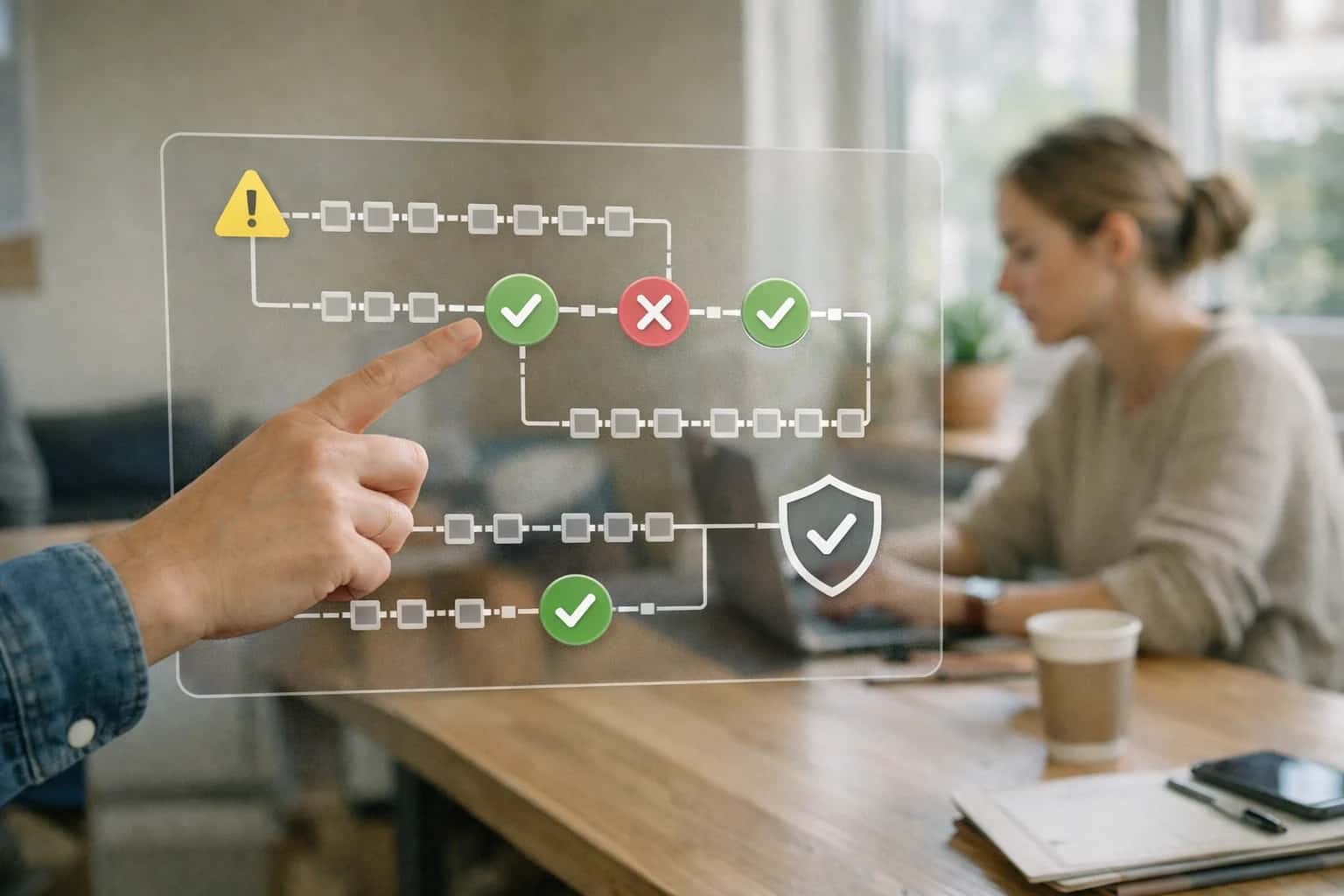
SIMULATION DEBUGGING
What is Deterministic Replay?
Deterministic replay is a core capability in digital twin simulation that guarantees identical reconstruction of past execution states for root-cause analysis.
In multi-agent orchestration and digital twin environments, replay relies on capturing a deterministic log of all non-deterministic events—such as message arrival order, sensor noise, and user interactions—alongside the initial seed. This capability is critical for auditing autonomous decisions, reproducing rare edge-case failures, and validating that model updates do not introduce regressions in previously stable scenarios.
DEBUGGING & AUDITING
Core Characteristics of Deterministic Replay
Deterministic replay is the property that guarantees a simulation can be perfectly reconstructed, bit-for-bit, from a known initial state and a recorded sequence of inputs. This capability transforms debugging from an exercise in probabilistic guesswork into a precise, repeatable scientific method.
01
Immutable Random Seed Anchoring
The foundation of replay is the pseudo-random number generator (PRNG) . By capturing the exact integer seed used to initialize the PRNG at simulation start, the entire sequence of 'random' events—from demand spikes to machine failures—becomes a fixed, repeatable stream. Without this, stochastic models produce different results on every run, making bugs non-reproducible.
02
Exhaustive Input Event Logging
Replay requires a tamper-proof, ordered log of every external stimulus injected into the simulation. This includes:
- Transactional Data: Order creation timestamps, quantity changes, cancellation signals.
- Sensor Telemetry: IoT temperature readings, GPS pings, RFID scans.
- User Interactions: Manual overrides, parameter adjustments made during a live scenario. The log acts as the authoritative script that the simulation engine reads back verbatim.
03
State Vector Snapshotting
To avoid replaying an entire multi-hour simulation just to debug a failure at hour 10, the system periodically persists a complete state vector. This binary dump of all entity attributes, event queues, and agent memories allows for warm-start replay from any checkpoint. This is critical for rapid iteration during root cause analysis.
04
Single-Threaded Execution Mode
True determinism often requires a strict sequential execution mode that disables parallel discrete event simulation (PDES) optimizations. In PDES, race conditions between processors can cause events to be processed in slightly different orders across runs. A replay-compliant engine enforces a global total ordering of events based on timestamp and a tie-breaking priority, sacrificing speed for absolute consistency.
05
External Dependency Mocking
A simulation often calls external services (e.g., a live weather API or a freight rate engine). For replay, these calls must be intercepted and served from a recorded response cache rather than live endpoints. This ensures that a replay executed a year later does not diverge because an external API changed its data format or returned different values.
06
Bitwise Output Comparison
The final validation step is a checksum or hash comparison between the original run's output logs and the replay's output logs. Any divergence—even a single floating-point rounding error—indicates a non-deterministic code path (e.g., uninitialized memory, reliance on wall-clock time, or unordered hash map iteration). This binary-level precision is mandatory for regulatory auditing.
DETERMINISTIC REPLAY
Frequently Asked Questions
Explore the core concepts behind deterministic replay, the foundational technology that enables perfect reconstruction of past simulation states for debugging, auditing, and regulatory compliance in digital twin environments.
Deterministic replay is a computational technique that guarantees the perfect, bit-for-bit reconstruction of a past simulation run by capturing and reusing the initial random seed and all non-deterministic inputs. The mechanism works by logging every external event, user interaction, and system call that introduces non-determinism into the execution stream. During replay, the system ignores live inputs and instead feeds the recorded log back into the simulation, which, combined with the identical initial seed, forces the pseudo-random number generator to produce the exact same sequence of values. This ensures that every agent decision, physics calculation, and state transition occurs identically to the original run, transforming a complex stochastic simulation into a fully auditable, repeatable scientific instrument.
Enabling Efficiency, Speed & Accuracy
Intelligent Analysis, Decision & Execution
We build AI systems for teams that need search across company data, workflow automation across tools, or AI features inside products and internal software.
Talk to Us
Search across company data
Give teams answers from docs, tickets, runbooks, and product data with sources and permissions.
Useful when people spend too long searching or get different answers from different systems.
Enterprise searchRAGPermissions
Read more
Automate internal workflows
Use AI to route work, draft outputs, trigger actions, and keep approvals and logs in place.
Useful when repetitive work moves across multiple tools and teams.
AI agentsWorkflow automationGovernance
Read more
Add AI to products and internal tools
Build assistants, guided actions, or decision support into the software your team or customers already use.
Useful when AI needs to be part of the product, not a separate tool.
AI integrationDecision supportModel routing
Read more
About the author
Prasad Kumkar
CEO & MD, Inference Systems
Prasad Kumkar is the CEO & MD of Inference Systems and writes about AI systems architecture, LLM infrastructure, model serving, evaluation, and production deployment. Over 5+ years, he has worked across computer vision models, L5 autonomous vehicle systems, and LLM research, with a focus on taking complex AI ideas into real-world engineering systems.
His work and writing cover AI systems, large language models, AI agents, multimodal systems, autonomous systems, inference optimization, RAG, evaluation, and production AI engineering.
LinkedIn
Limited slotsGet a Free AI Consultation
Partnered with leading AI, data, and software stack.





How We Work
Custom AI workflows for your Business
One-fit-all AI don't work for modern businesses. At Inferensys, we aim to understand your business & custom requirements; which we use to define most efficient agentic workflows, the data, and the tools for your business.
01
Review the use case
We understand the task, the users, and where AI can actually help.
Read more02
Pick the right approach
We define what needs search, automation, or product integration.
Read more03
Build the first useful version
We implement the part that proves the value first.
Read more04
Improve from there
We add the checks and visibility needed to keep it useful.
Read moreThe first call is a practical review of your use case and the right next step.
Talk to Us