Reinforcement learning for procurement is a machine learning paradigm where an autonomous agent learns optimal purchasing and negotiation policies by interacting with a simulated market environment. The agent takes actions—such as placing bids, adjusting pricing, or selecting suppliers—and receives reward signals based on outcomes like cost savings, lead time reduction, or risk mitigation. Through repeated trial-and-error cycles, the agent discovers strategies that maximize cumulative reward over time, adapting to dynamic conditions including competitor behavior, demand fluctuations, and supply constraints without explicit programming of every decision rule.

Glossary
Reinforcement Learning for Procurement
The application of reward-based machine learning to train AI agents on optimal bidding and negotiation strategies through iterative simulation against dynamic market environments.
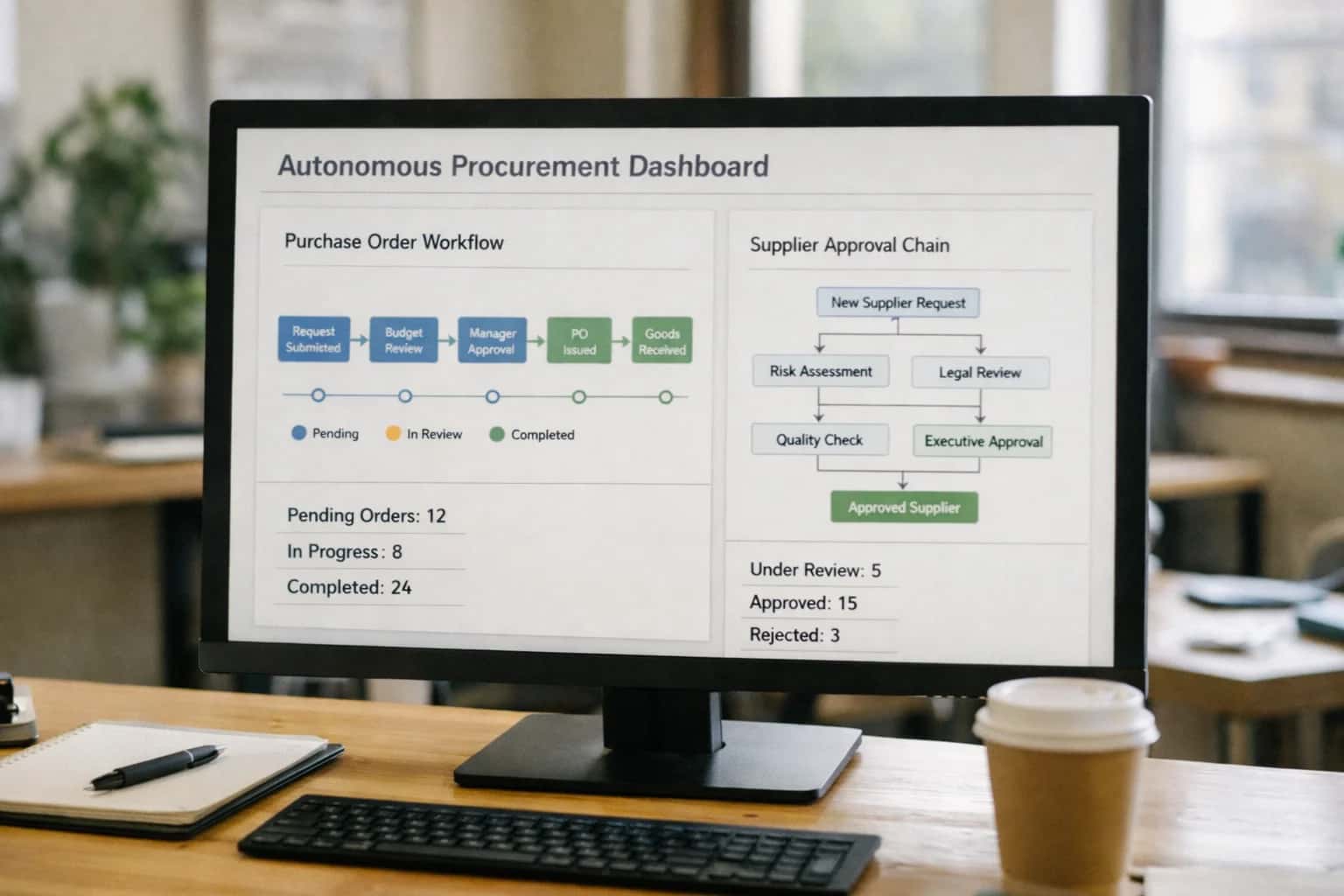
DEFINITION
What is Reinforcement Learning for Procurement?
Reinforcement learning for procurement applies reward-based machine learning to train autonomous agents on optimal sourcing, bidding, and negotiation strategies through iterative simulation against dynamic market environments.
Unlike supervised learning approaches that require labeled historical data, reinforcement learning excels in sequential decision-making scenarios where actions have delayed consequences. In procurement contexts, this enables agents to master complex multi-step negotiation protocols, balance short-term cost against long-term supplier relationships, and discover non-obvious bidding strategies through self-play. The technology underpins autonomous sourcing bots and negotiation protocol engines, allowing procurement systems to continuously improve their performance through experience rather than static heuristics.
CORE ARCHITECTURE
Key Characteristics of Procurement RL Agents
Reinforcement Learning agents for procurement are defined by their ability to optimize sequential decisions—such as bidding and negotiation—through reward-based simulation against dynamic market environments.
01
Markov Decision Process Formulation
The procurement problem is formally structured as an MDP where the agent observes the current market state and selects an action to maximize cumulative reward.
- State: Current bid price, competitor history, inventory levels, and lead times
- Action: Bid increment, accept offer, switch supplier, or walk away
- Reward: Cost savings, quality thresholds met, or delivery time minimized
- Transition: Probabilistic model of how the market responds to the agent's action
This mathematical grounding ensures the agent's strategy is provably optimal under uncertainty.
02
Policy Gradient Optimization
Procurement agents often use policy gradient methods like PPO (Proximal Policy Optimization) to learn negotiation strategies directly without modeling the entire market.
- The agent outputs a probability distribution over possible bid values
- After each simulated negotiation episode, the policy is updated to favor actions that led to higher savings
- Entropy regularization prevents premature convergence to suboptimal bidding patterns
- Handles continuous action spaces naturally, enabling precise bid increments rather than discrete steps
This approach excels in complex, high-dimensional procurement scenarios where value function approximation is difficult.
03
Adversarial Self-Play Training
To master negotiation, agents train against adversarial copies of themselves in simulated auction environments, a technique borrowed from game-playing AI.
- Self-play: The agent plays both buyer and supplier roles, iteratively discovering exploitable strategies
- Population-based training: Multiple agent variants compete, with successful strategies surviving and mutating
- Exposes the agent to diverse negotiation tactics including bluffing, anchoring, and concession patterns
- Results in robust policies that don't overfit to a single supplier behavior model
This method produced agents that discovered novel negotiation heuristics not explicitly programmed by engineers.
04
Constrained Action Spaces
Real-world procurement operates under hard business constraints that must be enforced during both training and inference to prevent invalid or non-compliant actions.
- Budget caps: Agent cannot bid above pre-authorized thresholds
- Supplier diversity mandates: Minimum allocation percentages to certified minority-owned businesses
- Regulatory compliance: Automatic exclusion of sanctioned entities or embargoed regions
- Volume commitments: Contractual minimum order quantities that constrain negotiation flexibility
Constraint enforcement is typically implemented via action masking, where invalid actions receive negative infinity logits before the softmax layer.
05
Simulation-to-Reality Transfer
Agents are trained in high-fidelity market simulators before deployment, requiring careful handling of the sim-to-real gap to ensure live performance matches training results.
- Domain randomization: Training across varied supplier behaviors, market volatilities, and lead time distributions
- Behavioral cloning warm-start: Initializing the agent by imitating historical human buyer decisions before RL fine-tuning
- Online adaptation: Lightweight fine-tuning on live transaction data to adjust to real market dynamics
- Shadow mode deployment: Agent runs alongside human buyers, generating recommendations without execution authority for validation
This staged rollout builds trust and catches distribution shift before full autonomy is granted.
06
Multi-Objective Reward Shaping
Procurement success is rarely defined by cost alone. RL agents use carefully crafted reward functions that balance competing business objectives.
- Cost savings: Primary reward signal from beating market baseline prices
- Quality scoring: Bonus reward for selecting suppliers with higher historical defect-free delivery rates
- Lead time minimization: Positive reward for securing shorter delivery windows
- Relationship maintenance: Penalty for excessive supplier switching that damages long-term partnerships
- Sustainability weighting: Reward modifier for selecting suppliers with lower carbon footprints
These objectives are combined via scalarization with business-defined weights, or handled through Pareto-optimal multi-policy approaches.
REINFORCEMENT LEARNING FOR PROCUREMENT
Frequently Asked Questions
Explore the core concepts behind applying reward-based machine learning to autonomous sourcing and negotiation. These answers address the most common technical and strategic questions from procurement automation directors and AI architects.
Reinforcement learning for procurement is a machine learning paradigm where an autonomous agent learns optimal sourcing and negotiation strategies through trial-and-error interaction with a dynamic market environment, guided by a reward signal. Unlike supervised learning, which requires labeled historical datasets of 'correct' negotiation outcomes, reinforcement learning discovers novel strategies through iterative simulation. The agent takes actions—such as placing a bid, making a concession, or switching suppliers—and receives a scalar reward based on key performance indicators like total cost savings, delivery lead time, or risk mitigation. Through thousands of simulated procurement episodes, the agent learns a policy that maps market states to actions that maximize cumulative long-term reward, often uncovering non-intuitive bargaining tactics that human buyers might overlook.
METHODOLOGY COMPARISON
Reinforcement Learning vs. Other Procurement AI Approaches
A technical comparison of the core mechanisms, data dependencies, and operational characteristics distinguishing Reinforcement Learning from supervised learning and heuristic rule-based systems in procurement automation.
| Feature | Reinforcement Learning | Supervised Learning | Heuristic Rules |
|---|---|---|---|
Core Mechanism | Learns optimal policy via trial-and-error reward maximization in an environment | Learns mapping from labeled input-output pairs via error minimization | Executes predefined if-then logic crafted by domain experts |
Data Dependency | Requires a simulator or live environment; no historical labels needed | Requires large, labeled historical dataset of correct decisions | Requires no data; relies entirely on encoded human expertise |
Adaptation to Market Shifts | Continuously adapts strategy as environment dynamics change | Static model; degrades as data drifts from training distribution | Rigid; requires manual rule updates to address new scenarios |
Handles Sequential Decisions | |||
Optimizes Long-Term Outcome | |||
Explainability | Low; policy is often a black-box neural network | Low to moderate; feature importance can be extracted | High; every decision path is explicitly traceable |
Cold-Start Performance | Poor; requires extensive simulation training before deployment | Good; performs immediately if training data is representative | Excellent; rules execute instantly on day one |
Procurement Use Case | Autonomous negotiation and dynamic auction bidding | Spend classification and supplier risk scoring | Three-way matching and compliance checks |
Enabling Efficiency, Speed & Accuracy
Intelligent Analysis, Decision & Execution
We build AI systems for teams that need search across company data, workflow automation across tools, or AI features inside products and internal software.
Talk to Us
Search across company data
Give teams answers from docs, tickets, runbooks, and product data with sources and permissions.
Useful when people spend too long searching or get different answers from different systems.
Enterprise searchRAGPermissions
Read more
Automate internal workflows
Use AI to route work, draft outputs, trigger actions, and keep approvals and logs in place.
Useful when repetitive work moves across multiple tools and teams.
AI agentsWorkflow automationGovernance
Read more
Add AI to products and internal tools
Build assistants, guided actions, or decision support into the software your team or customers already use.
Useful when AI needs to be part of the product, not a separate tool.
AI integrationDecision supportModel routing
Read more
About the author
Prasad Kumkar
CEO & MD, Inference Systems
Prasad Kumkar is the CEO & MD of Inference Systems and writes about AI systems architecture, LLM infrastructure, model serving, evaluation, and production deployment. Over 5+ years, he has worked across computer vision models, L5 autonomous vehicle systems, and LLM research, with a focus on taking complex AI ideas into real-world engineering systems.
His work and writing cover AI systems, large language models, AI agents, multimodal systems, autonomous systems, inference optimization, RAG, evaluation, and production AI engineering.
LinkedIn
Limited slotsGet a Free AI Consultation
Partnered with leading AI, data, and software stack.





How We Work
Custom AI workflows for your Business
One-fit-all AI don't work for modern businesses. At Inferensys, we aim to understand your business & custom requirements; which we use to define most efficient agentic workflows, the data, and the tools for your business.
01
Review the use case
We understand the task, the users, and where AI can actually help.
Read more02
Pick the right approach
We define what needs search, automation, or product integration.
Read more03
Build the first useful version
We implement the part that proves the value first.
Read more04
Improve from there
We add the checks and visibility needed to keep it useful.
Read moreThe first call is a practical review of your use case and the right next step.
Talk to Us