An Obligation Monitoring Agent is a specialized AI bot that ingests structured and unstructured contract data to create a dynamic registry of actionable commitments. It continuously cross-references these obligations against real-time enterprise data—such as purchase order volumes or support ticket logs—to detect non-compliance or underutilization. Unlike static calendar reminders, the agent interprets complex conditional logic, such as rebate thresholds or tiered pricing triggers, and calculates financial exposure when terms are breached.

Glossary
Obligation Monitoring Agent
An autonomous software agent that continuously tracks active contractual commitments—such as minimum volume guarantees, renewal deadlines, and service-level agreements—and alerts stakeholders to prevent value leakage.
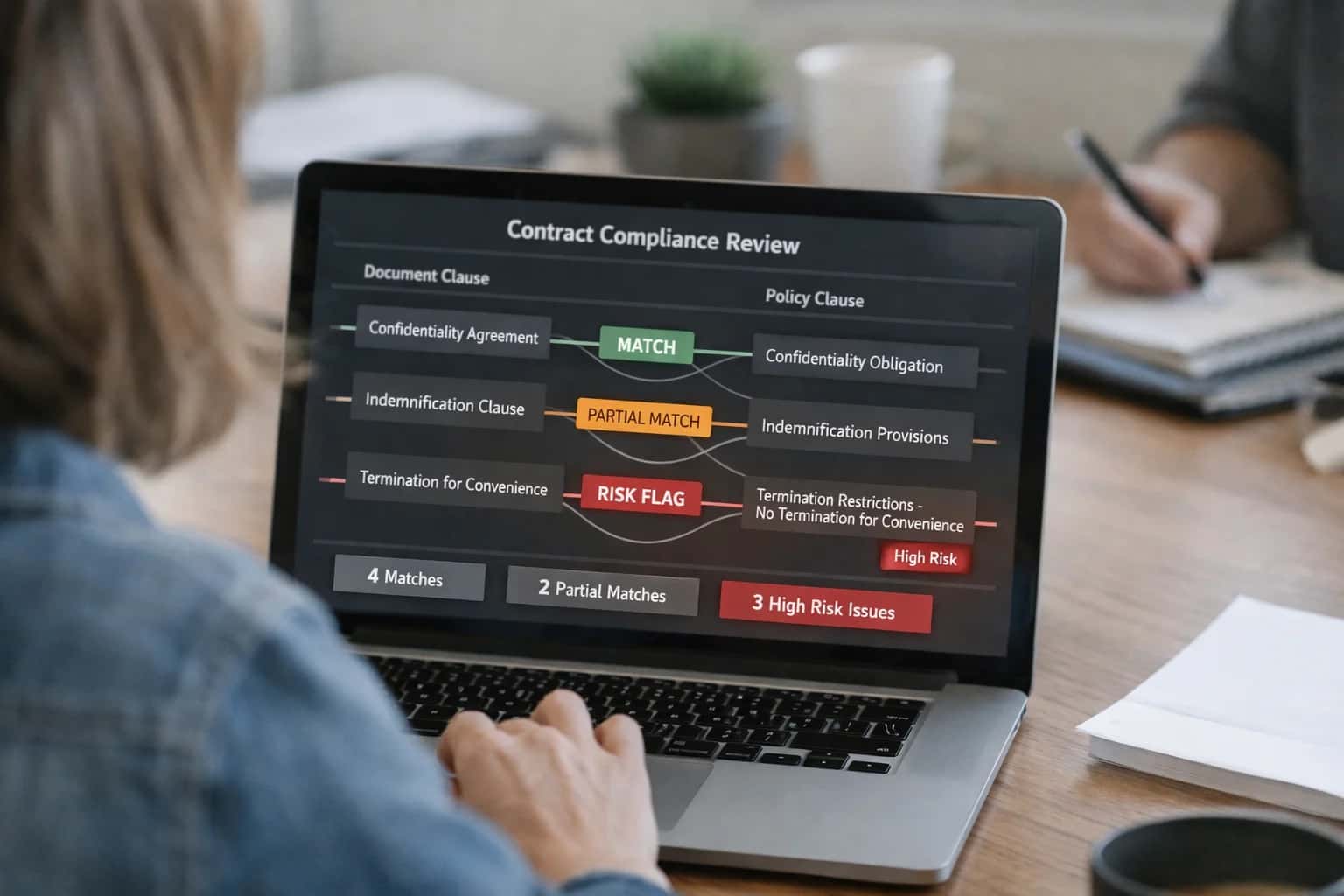
CONTRACTUAL COMPLIANCE AUTOMATION
What is an Obligation Monitoring Agent?
An Obligation Monitoring Agent is an autonomous software bot that continuously tracks active contractual commitments—such as minimum volume guarantees, renewal deadlines, and service level agreements—to alert stakeholders and prevent value leakage.
By integrating with Contract Lifecycle Management (CLM) systems and ERP platforms, the agent automates the enforcement of entitlements and prevents auto-renewal oversights. It generates prioritized alerts for procurement and legal teams, distinguishing between critical value leakage risks and routine administrative deadlines. This deterministic monitoring ensures that negotiated savings, volume discounts, and exclusivity rights are fully realized rather than eroded through operational neglect.
CONTRACTUAL COMPLIANCE AUTOMATION
Key Features of Obligation Monitoring Agents
Obligation Monitoring Agents are autonomous software entities that continuously scan active contractual commitments to prevent value leakage. They transform static legal documents into dynamic, trackable data points that trigger alerts and workflows.
01
Continuous Obligation Extraction
The agent ingests unstructured contract documents and uses natural language processing (NLP) to identify and classify specific commitments. It parses clauses to isolate minimum volume guarantees, renewal deadlines, price adjustment windows, and service level agreements (SLAs). Extracted obligations are then structured into a machine-readable ontology, mapping each commitment to a specific owner, trigger date, and performance metric. This process converts a static PDF into a living, queryable dataset that updates as amendments are executed.
02
Real-Time Performance Gap Analysis
The agent cross-references extracted obligations against live operational data from ERP, procurement, and financial systems. It continuously calculates the delta between committed and actual performance. For example, if a contract stipulates a minimum purchase of 10,000 units per quarter and current POs total only 6,000 with two weeks remaining, the agent flags a compliance gap. This analysis extends to rebate thresholds, delivery timeliness penalties, and volume discount tiers, ensuring no financial lever is left unmonitored.
03
Proactive Deadline and Renewal Management
The agent maintains a temporal map of all contractual milestones and triggers escalation workflows based on configurable lead times. It monitors for:
- Auto-renewal deadlines: Alerting 90, 60, and 30 days before a contract rolls over.
- Price escalation dates: Flagging upcoming index-based price adjustments for validation.
- Termination for convenience windows: Notifying stakeholders of limited opt-out periods.
- Warranty and claim expiry: Ensuring defect claims are filed before contractual deadlines lapse. This prevents the silent auto-renewal of unfavorable terms and preserves negotiation leverage.
04
Automated Stakeholder Notification
Upon detecting an obligation breach or upcoming deadline, the agent executes a rules-based notification protocol. It identifies the responsible party from the obligation ontology and dispatches alerts via integrated channels such as Slack, Microsoft Teams, or email. Notifications are context-rich, including the specific clause reference, the financial impact of non-compliance, and a direct link to the relevant contract section. Escalation paths are predefined: if a category manager does not acknowledge a volume shortfall within 48 hours, the alert cascades to the Director of Procurement.
05
Audit Trail and Compliance Reporting
Every detection, notification, and resolution action is immutably logged to provide a verifiable audit trail. The agent generates structured reports demonstrating regulatory compliance with standards like SOX and IFRS 16. For each obligation, the system records the original clause text, the data source used for validation, the timestamp of any breach, and the subsequent remediation action taken. This transforms obligation monitoring from a periodic, manual audit exercise into a continuous, defensible control that satisfies both internal audit committees and external regulators.
06
Value Leakage Quantification
Beyond simple breach detection, the agent calculates the financial impact of non-compliance. It quantifies value leakage by applying contractual penalty rates, missed discount percentages, or unclaimed rebate amounts to the observed performance gap. For instance, if a 2% early payment discount on a $500,000 invoice is missed due to a processing delay, the agent logs a $10,000 value leakage event. Aggregated dashboards then prioritize the most costly compliance failures, allowing procurement and finance teams to focus remediation efforts where the return on attention is highest.
Enabling Efficiency, Speed & Accuracy
Intelligent Analysis, Decision & Execution
We build AI systems for teams that need search across company data, workflow automation across tools, or AI features inside products and internal software.
Talk to Us
Search across company data
Give teams answers from docs, tickets, runbooks, and product data with sources and permissions.
Useful when people spend too long searching or get different answers from different systems.
Enterprise searchRAGPermissions
Read more
Automate internal workflows
Use AI to route work, draft outputs, trigger actions, and keep approvals and logs in place.
Useful when repetitive work moves across multiple tools and teams.
AI agentsWorkflow automationGovernance
Read more
Add AI to products and internal tools
Build assistants, guided actions, or decision support into the software your team or customers already use.
Useful when AI needs to be part of the product, not a separate tool.
AI integrationDecision supportModel routing
Read moreOBLIGATION MONITORING AGENT
Frequently Asked Questions
Explore the mechanics of autonomous contract surveillance. These answers detail how AI agents track commitments, prevent value leakage, and ensure compliance across the procurement lifecycle.
An Obligation Monitoring Agent is an autonomous AI bot that continuously tracks active contractual commitments to prevent value leakage. It works by ingesting structured and unstructured contract data, extracting specific clauses such as minimum volume guarantees, rebate thresholds, and renewal deadlines using natural language processing. The agent then maps these obligations against real-time transactional data from enterprise resource planning systems. If a deviation is detected—such as failing to meet a quarterly spend target—the agent triggers an alert, calculates the financial exposure, and can optionally initiate a remediation workflow, such as notifying a category manager or generating a corrective purchase order.
CONTRACTUAL VALUE PROTECTION
Common Use Cases for Obligation Monitoring
An Obligation Monitoring Agent continuously audits active contractual commitments—such as minimum volume guarantees, renewal deadlines, and SLA penalties—to prevent value leakage and ensure compliance across the procurement lifecycle.
01
Minimum Volume Guarantee Tracking
Monitors cumulative purchase volumes against take-or-pay clauses and minimum volume guarantees (MVGs) in real time. The agent calculates projected shortfalls based on current run rates and alerts category managers weeks before a penalty is triggered.
- Tracks spend against tiered discount thresholds
- Forecasts quarter-end volume gaps with 95% confidence intervals
- Triggers spot-buy recommendations to close deficits
Example: A manufacturer avoids a $2.3M penalty by receiving an alert 45 days before missing a raw material volume commitment, enabling a tactical bulk purchase.
45 days
Average Early Warning
$2.3M+
Penalty Avoided per Incident
02
Contract Renewal & Expiry Management
Scans the entire contract repository to extract expiration dates, auto-renewal clauses, and notice period requirements. The agent initiates a structured workflow 90 days before termination, ensuring stakeholders either renegotiate or source alternatives before a gap occurs.
- Distinguishes between auto-renewal and fixed-term contracts
- Calculates negotiation leverage based on incumbent performance scores
- Prevents zombie spend on expired contracts with evergreen billing
Example: A logistics firm prevents a 14-month lapse on a warehousing lease by triggering a renewal review 120 days before expiry, saving $480K in spot-market premiums.
120 days
Standard Alert Window
100%
Contract Coverage
03
SLA Penalty & Rebate Calculation
Ingests supplier performance data—on-time delivery rates, quality acceptance scores, and response times—and maps them against contractual service level agreements. The agent automatically calculates earned rebates or penalty invoices, eliminating manual reconciliation.
- Correlates goods receipt timestamps with promised lead times
- Applies weighted scoring models for multi-dimensional SLAs
- Generates debit memo drafts for AP approval
Example: An automotive OEM recovers $1.7M annually by automating the detection of 2,300 late deliveries that previously went unpenalized due to manual tracking gaps.
$1.7M
Annual Recovery
2,300+
Violations Detected
04
Price Escalation & Index Compliance
Validates that supplier invoices adhere to contracted pricing formulas tied to commodity indices, foreign exchange rates, or consumer price index adjustments. The agent flags discrepancies between the agreed escalation mechanism and the actual charged amount.
- Monitors LME, CME, and other index feeds in real time
- Recalculates allowable price ceilings per contract terms
- Identifies unauthorized surcharges and fuel adjustments
Example: A construction firm identifies $890K in overcharges when a steel supplier applies a 6.2% escalation against a contract capped at 4.5% tied to the CRU index.
$890K
Overcharge Identified
< 24 hrs
Invoice Audit Cycle
05
Exclusivity & Non-Compete Monitoring
Audits supplier behavior and internal purchasing patterns to detect violations of exclusivity agreements, right-of-first-refusal clauses, or non-compete provisions. The agent cross-references spend data with contract terms to identify leakage to unauthorized vendors.
- Matches supplier parent-child hierarchies to contract entities
- Detects maverick spend that violates category exclusivity
- Quantifies rebate erosion from non-compliant purchasing
Example: A retailer discovers $4.2M in off-contract packaging spend that violated a volume-based rebate agreement, triggering a supplier negotiation that recovered $620K in retroactive discounts.
$4.2M
Non-Compliant Spend Found
$620K
Retroactive Recovery
06
Insurance & Indemnification Compliance
Verifies that active suppliers maintain required insurance certificates, indemnification limits, and bonding requirements as stipulated in master service agreements. The agent cross-references expiration dates and coverage amounts against contractual minimums.
- Integrates with third-party certificate tracking platforms
- Escalates lapsed coverage to legal and risk management teams
- Blocks new POs for non-compliant vendors automatically
Example: A chemical processor prevents a $12M liability exposure by halting work with a contractor whose umbrella policy had lapsed 17 days prior, detected during a nightly compliance scan.
$12M
Liability Exposure Mitigated
Nightly
Compliance Scan Frequency

About the author
Prasad Kumkar
CEO & MD, Inference Systems
Prasad Kumkar is the CEO & MD of Inference Systems and writes about AI systems architecture, LLM infrastructure, model serving, evaluation, and production deployment. Over 5+ years, he has worked across computer vision models, L5 autonomous vehicle systems, and LLM research, with a focus on taking complex AI ideas into real-world engineering systems.
His work and writing cover AI systems, large language models, AI agents, multimodal systems, autonomous systems, inference optimization, RAG, evaluation, and production AI engineering.
LinkedIn
Limited slotsGet a Free AI Consultation
Partnered with leading AI, data, and software stack.





How We Work
Custom AI workflows for your Business
One-fit-all AI don't work for modern businesses. At Inferensys, we aim to understand your business & custom requirements; which we use to define most efficient agentic workflows, the data, and the tools for your business.
01
Review the use case
We understand the task, the users, and where AI can actually help.
Read more02
Pick the right approach
We define what needs search, automation, or product integration.
Read more03
Build the first useful version
We implement the part that proves the value first.
Read more04
Improve from there
We add the checks and visibility needed to keep it useful.
Read moreThe first call is a practical review of your use case and the right next step.
Talk to Us