A Contract Lifecycle Management Bot is an autonomous AI agent that continuously administers the end-to-end lifecycle of procurement agreements. It ingests unstructured contract documents, extracts key metadata such as expiration dates and payment terms using natural language processing, and actively monitors compliance against actual transactional data from the procure-to-pay system.

Glossary
Contract Lifecycle Management Bot
An autonomous agent that monitors the creation, execution, and expiration of procurement contracts, triggering renewal workflows and flagging non-compliant deviations in real-time.
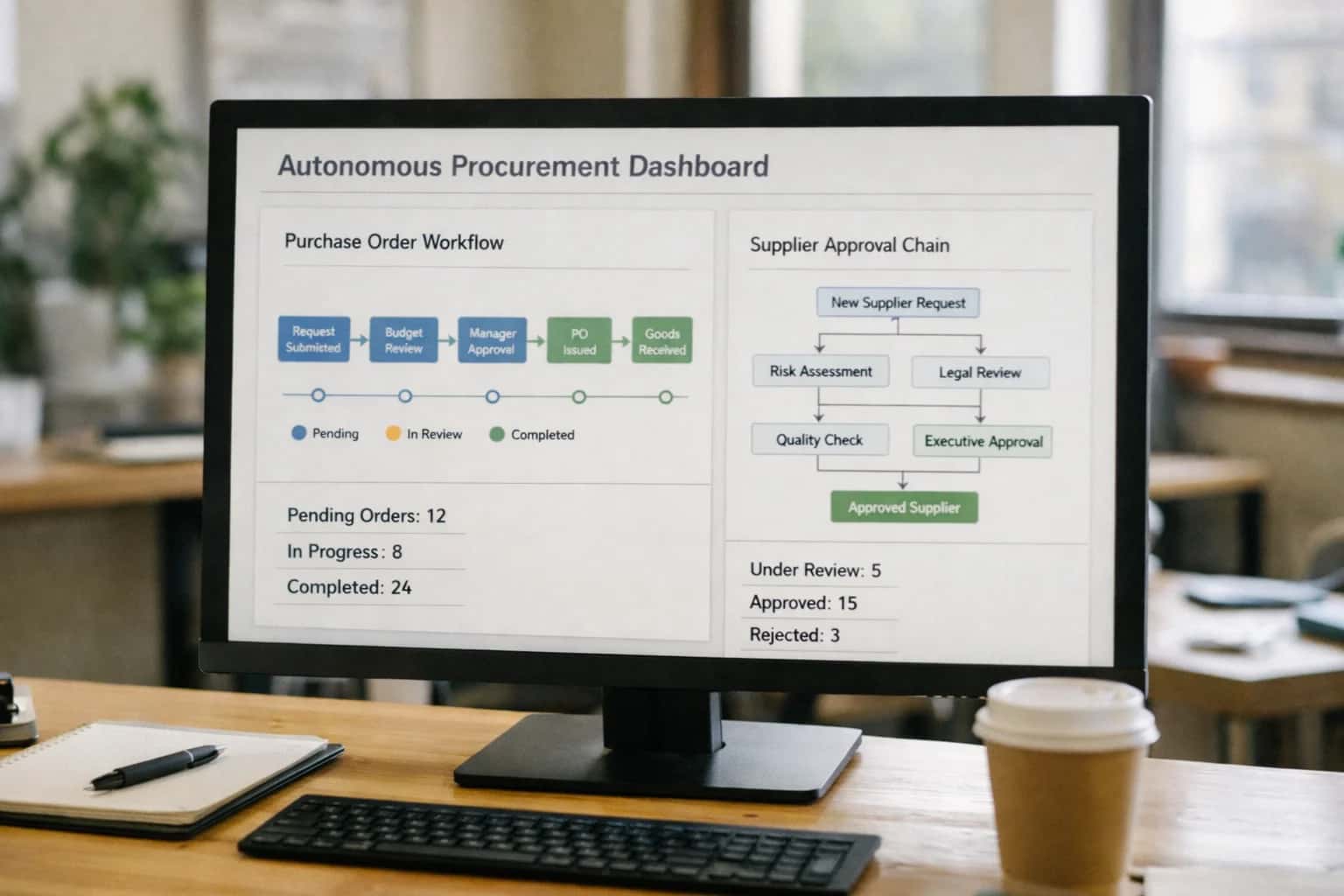
AUTONOMOUS PROCUREMENT AGENT
What is Contract Lifecycle Management Bot?
An autonomous software agent that monitors the creation, execution, and expiration of procurement contracts, triggering renewal workflows and flagging non-compliant deviations in real-time.
Unlike static repositories, the bot triggers automated workflows for upcoming renewals, renegotiations, or terminations. It cross-references executed purchase orders against master agreements to detect maverick spend and obligation leakage, alerting stakeholders instantly when off-contract buying occurs or when volume commitments are at risk of not being met.
AUTONOMOUS CONTRACT GOVERNANCE
Core Capabilities of a CLM Bot
A Contract Lifecycle Management Bot is an autonomous agent that monitors the creation, execution, and expiration of procurement contracts, triggering renewal workflows and flagging non-compliant deviations in real-time. Below are its core functional modules.
01
Automated Clause Extraction
Leverages natural language processing (NLP) models to parse unstructured contract documents and isolate critical legal clauses. The bot identifies and tags indemnification, limitation of liability, termination for convenience, and payment terms without manual review.
- Reduces contract review time by up to 80%
- Maps extracted clauses to a standardized clause library
- Flags deviations from pre-approved legal playbooks
02
Obligation Monitoring & Alerting
Continuously tracks active contractual commitments against real-time operational data. The bot monitors minimum volume guarantees, rebate thresholds, and service level agreements (SLAs) to prevent value leakage.
- Generates automated alerts 90 days before renewal deadlines
- Cross-references purchase order data against contracted pricing
- Calculates realized vs. negotiated savings in real-time
03
Non-Compliance Detection
An unsupervised anomaly detection engine that identifies transactions occurring outside of negotiated terms. The bot flags maverick spend and supplier billing discrepancies by comparing invoice line items against the canonical contract record.
- Detects price overcharges and duplicate billing
- Monitors for unauthorized subcontracting or scope creep
- Generates audit-ready compliance reports
04
Renewal Workflow Orchestration
Triggers multi-step approval workflows based on contract expiration timelines and predefined business rules. The bot autonomously routes renewal decisions to category managers, legal counsel, and finance approvers.
- Initiates auto-renewal for low-risk, standard agreements
- Escalates strategic contracts for manual renegotiation
- Archives executed amendments with full version control
05
Performance Scorecard Integration
Feeds contract compliance data directly into supplier performance scoring models. The bot quantifies delivery timeliness, quality acceptance rates, and pricing accuracy against contractual baselines.
- Dynamically adjusts supplier risk scores based on breach frequency
- Provides objective data for quarterly business reviews
- Informs future risk-adjusted sourcing decisions
06
Digital Twin Contract Repository
Maintains a structured, queryable knowledge graph of all contractual relationships, obligations, and entities. This semantic layer enables complex queries like 'show all contracts with auto-renewal clauses expiring next quarter.'
- Links contracts to supplier master data and purchase orders
- Enables full-text search across the entire contract corpus
- Provides a single source of truth for audit and regulatory inquiries
CONTRACT LIFECYCLE MANAGEMENT BOT
Frequently Asked Questions
Clear, technical answers to the most common questions about autonomous contract lifecycle management agents, their architecture, and their role in modern procurement.
A Contract Lifecycle Management Bot is an autonomous software agent that monitors the creation, execution, and expiration of procurement contracts, triggering renewal workflows and flagging non-compliant deviations in real-time. It operates by integrating with enterprise resource planning (ERP) systems and contract repositories, continuously scanning structured and unstructured contract data. The bot uses natural language processing (NLP) to extract key clauses, dates, and obligations, then applies a rules engine or reinforcement learning model to determine required actions. When a contract approaches expiration, the bot autonomously initiates a renewal workflow, notifying stakeholders and pre-populating documents with existing terms. For compliance, it compares actual purchase order activity against contracted pricing and volume commitments, flagging discrepancies such as maverick spend or unauthorized supplier substitutions. The architecture typically includes a memory layer for tracking obligation states, a reasoning module for decision logic, and API connectors for executing actions in downstream systems like e-signature platforms or payment systems.
Enabling Efficiency, Speed & Accuracy
Intelligent Analysis, Decision & Execution
We build AI systems for teams that need search across company data, workflow automation across tools, or AI features inside products and internal software.
Talk to Us
Search across company data
Give teams answers from docs, tickets, runbooks, and product data with sources and permissions.
Useful when people spend too long searching or get different answers from different systems.
Enterprise searchRAGPermissions
Read more
Automate internal workflows
Use AI to route work, draft outputs, trigger actions, and keep approvals and logs in place.
Useful when repetitive work moves across multiple tools and teams.
AI agentsWorkflow automationGovernance
Read more
Add AI to products and internal tools
Build assistants, guided actions, or decision support into the software your team or customers already use.
Useful when AI needs to be part of the product, not a separate tool.
AI integrationDecision supportModel routing
Read more
About the author
Prasad Kumkar
CEO & MD, Inference Systems
Prasad Kumkar is the CEO & MD of Inference Systems and writes about AI systems architecture, LLM infrastructure, model serving, evaluation, and production deployment. Over 5+ years, he has worked across computer vision models, L5 autonomous vehicle systems, and LLM research, with a focus on taking complex AI ideas into real-world engineering systems.
His work and writing cover AI systems, large language models, AI agents, multimodal systems, autonomous systems, inference optimization, RAG, evaluation, and production AI engineering.
LinkedIn
Limited slotsGet a Free AI Consultation
Partnered with leading AI, data, and software stack.





How We Work
Custom AI workflows for your Business
One-fit-all AI don't work for modern businesses. At Inferensys, we aim to understand your business & custom requirements; which we use to define most efficient agentic workflows, the data, and the tools for your business.
01
Review the use case
We understand the task, the users, and where AI can actually help.
Read more02
Pick the right approach
We define what needs search, automation, or product integration.
Read more03
Build the first useful version
We implement the part that proves the value first.
Read more04
Improve from there
We add the checks and visibility needed to keep it useful.
Read moreThe first call is a practical review of your use case and the right next step.
Talk to Us