A Compliance Checking Agent is an autonomous software entity that continuously audits procurement transactions in real-time, validating every purchase order and supplier interaction against a dynamic ruleset of regulatory mandates, internal corporate policies, and global sanctions lists before financial commitment occurs. It acts as a deterministic gatekeeper, preventing non-compliant spend.

Glossary
Compliance Checking Agent
A continuous auditing bot that screens purchase orders and supplier interactions against regulatory requirements, internal policies, and sanctions lists before execution.
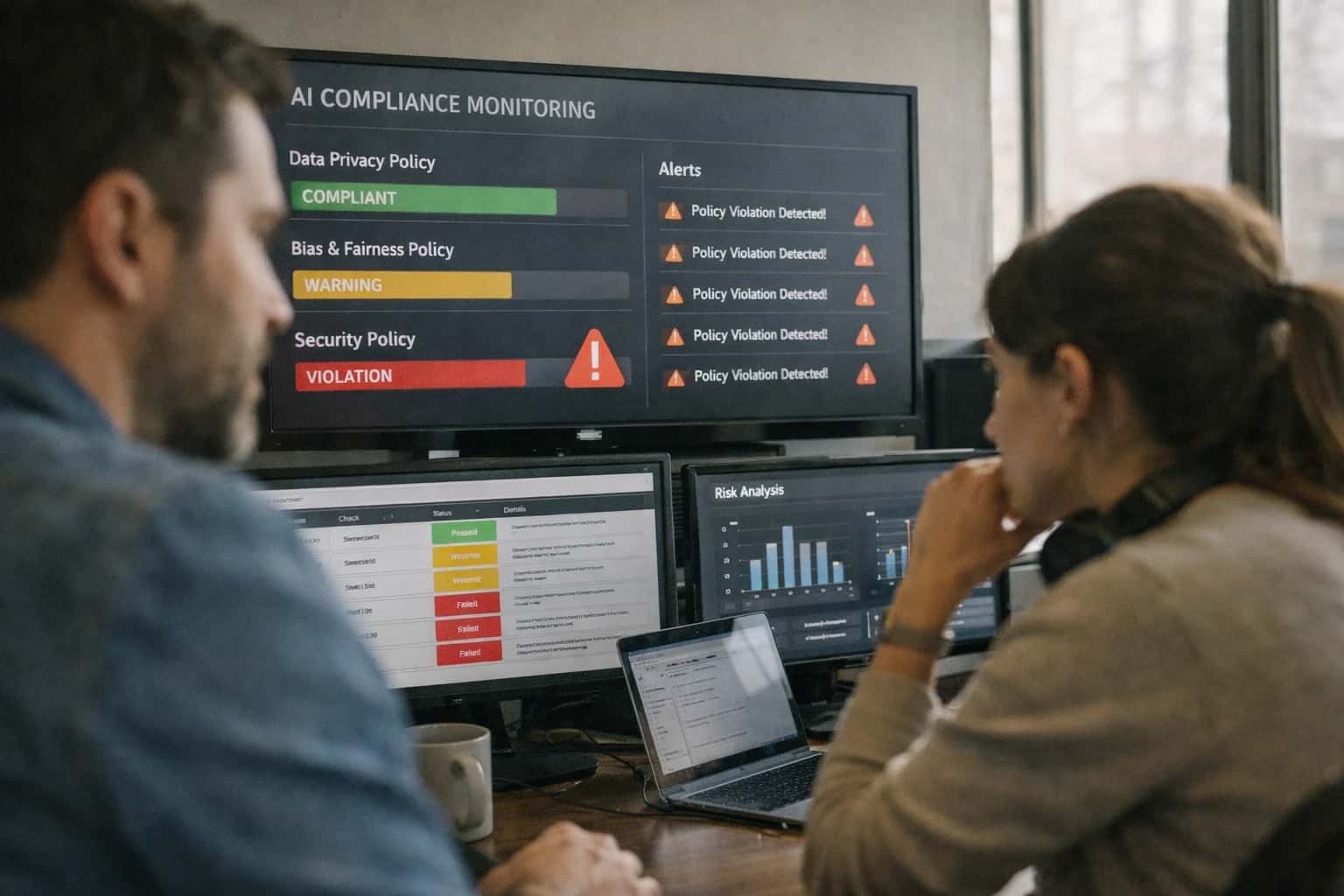
AUTOMATED PROCUREMENT GOVERNANCE
What is Compliance Checking Agent?
A continuous auditing bot that screens purchase orders and supplier interactions against regulatory requirements, internal policies, and sanctions lists before execution.
By integrating with enterprise resource planning systems and external watchlist databases, the agent performs entity resolution to flag sanctioned beneficial owners and uses natural language processing to verify that contract terms align with pre-approved legal templates. This eliminates manual compliance review bottlenecks and ensures an auditable, immutable record of every decision.
AUTOMATED GOVERNANCE
Key Features of Compliance Checking Agents
Compliance checking agents function as continuous, autonomous auditors embedded within the procure-to-pay workflow. They intercept transactions before execution, validating them against a dynamic ruleset of regulatory mandates, internal policies, and global sanctions lists.
01
Real-Time Sanctions & Denied Party Screening
Before a purchase order is transmitted, the agent cross-references supplier master data, beneficial ownership structures, and bank details against consolidated global watchlists (OFAC, EU, UN, HMT) in real time.
- Fuzzy Logic Matching: Uses phonetic algorithms and transliteration to catch spelling variations designed to evade exact-match filters.
- Continuous Monitoring: Does not just screen at onboarding; triggers an alert if an existing vendor is added to a sanctions list mid-contract.
- False Positive Reduction: Applies secondary identifiers (location, IP address, corporate registration numbers) to automatically clear low-risk matches without human review.
< 500ms
Screening Latency
99.8%
Auto-Clearance Rate
03
Documentary Compliance & Clause Extraction
Using natural language processing, the agent parses unstructured attachments to ensure documentary evidence aligns with transactional data.
- Certificate Validation: Extracts expiration dates from insurance certificates, ISO certifications, and diversity classifications, flagging expired credentials.
- Contract Clause Adherence: Compares the commercial terms in a supplier's proforma invoice against the master agreement to detect unapproved deviations in payment terms or liability caps.
- Tax Identifier Verification: Validates VAT/GST numbers against government databases to ensure correct tax treatment and prevent fraud.
04
Audit Trail Immutability
Every decision made by the compliance agent is cryptographically logged to provide a defensible audit trail for internal auditors and external regulators.
- Explainable Decisions: The agent does not just issue a 'block' or 'pass' verdict; it provides a detailed, human-readable reason code and cites the specific policy paragraph or regulation violated.
- Tamper-Proof Logging: All screening results, override justifications, and approval timestamps are hashed and stored in an append-only ledger.
- Regulatory Reporting: Automatically generates suspicious activity reports (SARs) or compliance metric dashboards required by bodies like FINRA or the FCA.
05
Geopolitical & Supply Chain Risk Correlation
Beyond static list screening, the agent correlates real-time news and risk intelligence feeds to predict compliance breaches before they occur.
- Forced Labor Prevention: Cross-references supplier locations and materials with lists of high-risk regions for forced labor (e.g., Xinjiang) to enforce UFLPA or similar regulations.
- Export Control Classification: Automatically determines if a requisitioned item requires an export license based on its ECCN or dual-use classification.
- Beneficial Ownership Transparency: Maps complex corporate hierarchies to identify ultimate beneficial owners (UBOs) and prevent transactions with shell companies or sanctioned oligarchs.
06
Human-in-the-Loop Override Protocols
When an exception is flagged, the agent initiates a structured resolution workflow rather than simply halting the process.
- Risk-Based Escalation: Low-risk false positives are routed to a shared queue, while high-risk hits (e.g., direct OFAC match) lock the transaction and notify the Chief Compliance Officer.
- Override Justification: Users must select from predefined, auditable reasons to override a block, preventing 'rubber-stamping'.
- Time-Bound Resolution: Escalated items are tracked with service level agreements (SLAs); if a human does not respond within the window, the agent defaults to the safest action (usually a hard block).
COMPLIANCE AUTOMATION
Frequently Asked Questions
Clear answers to the most common questions about autonomous compliance checking agents and their role in modern procurement.
A Compliance Checking Agent is an autonomous software bot that continuously audits purchase orders, supplier interactions, and procurement transactions against a defined set of regulatory requirements, internal policies, and sanctions lists before execution is permitted. It operates by intercepting transactional data at the pre-approval stage, normalizing unstructured information such as free-text requisitions and supplier names, and then running that data against a series of deterministic and probabilistic rule engines. The agent cross-references entities against global watchlists like the OFAC SDN List, checks for segregation of duties violations, validates that contract clauses match the transaction type, and ensures adherence to industry-specific regulations such as ITAR or GDPR. If a violation is detected, the agent can either block the transaction outright or route it to a human compliance officer with a detailed risk score and explanation of the flagged issue.
Enabling Efficiency, Speed & Accuracy
Intelligent Analysis, Decision & Execution
We build AI systems for teams that need search across company data, workflow automation across tools, or AI features inside products and internal software.
Talk to Us
Search across company data
Give teams answers from docs, tickets, runbooks, and product data with sources and permissions.
Useful when people spend too long searching or get different answers from different systems.
Enterprise searchRAGPermissions
Read more
Automate internal workflows
Use AI to route work, draft outputs, trigger actions, and keep approvals and logs in place.
Useful when repetitive work moves across multiple tools and teams.
AI agentsWorkflow automationGovernance
Read more
Add AI to products and internal tools
Build assistants, guided actions, or decision support into the software your team or customers already use.
Useful when AI needs to be part of the product, not a separate tool.
AI integrationDecision supportModel routing
Read more
About the author
Prasad Kumkar
CEO & MD, Inference Systems
Prasad Kumkar is the CEO & MD of Inference Systems and writes about AI systems architecture, LLM infrastructure, model serving, evaluation, and production deployment. Over 5+ years, he has worked across computer vision models, L5 autonomous vehicle systems, and LLM research, with a focus on taking complex AI ideas into real-world engineering systems.
His work and writing cover AI systems, large language models, AI agents, multimodal systems, autonomous systems, inference optimization, RAG, evaluation, and production AI engineering.
LinkedIn
Limited slotsGet a Free AI Consultation
Partnered with leading AI, data, and software stack.





How We Work
Custom AI workflows for your Business
One-fit-all AI don't work for modern businesses. At Inferensys, we aim to understand your business & custom requirements; which we use to define most efficient agentic workflows, the data, and the tools for your business.
01
Review the use case
We understand the task, the users, and where AI can actually help.
Read more02
Pick the right approach
We define what needs search, automation, or product integration.
Read more03
Build the first useful version
We implement the part that proves the value first.
Read more04
Improve from there
We add the checks and visibility needed to keep it useful.
Read moreThe first call is a practical review of your use case and the right next step.
Talk to Us