Hop Set Identification is the signal intelligence process of determining the complete set of carrier frequencies used by a frequency-hopping spread spectrum (FHSS) network. By intercepting and clustering observed transmission frequencies over time, a non-cooperative receiver reconstructs the network's channel map, which is the foundational step for predicting future hops and enabling follow-on demodulation or jamming.

Glossary
Hop Set Identification
The process of clustering and cataloging the specific frequency channels used by a frequency-hopping radio network to reconstruct its hopping pattern and predict future dwells.
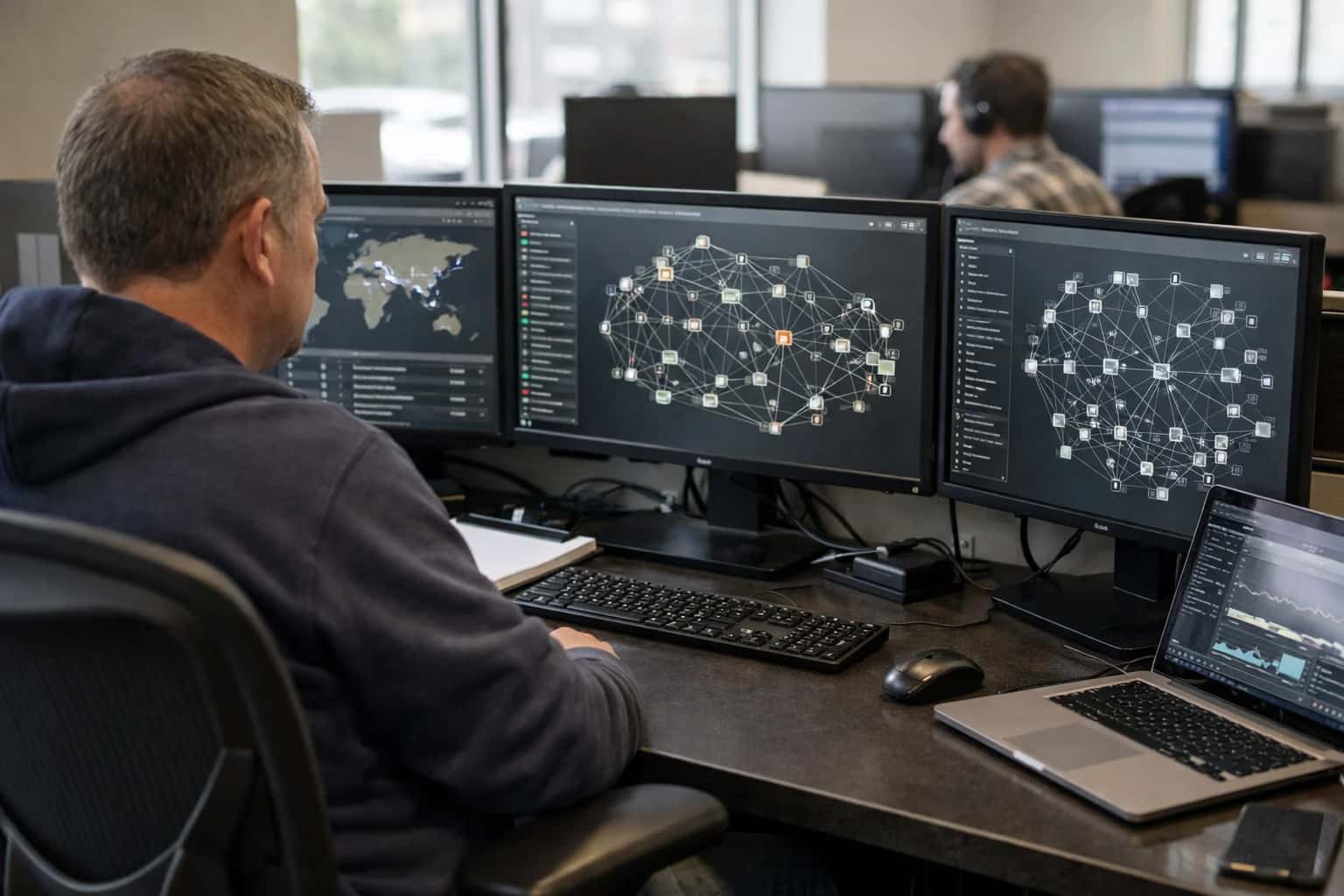
FHSS PATTERN RECONSTRUCTION
What is Hop Set Identification?
The process of clustering and cataloging the specific frequency channels used by a frequency-hopping radio network to reconstruct its hopping pattern and predict future dwells.
This process relies on time-frequency analysis and clustering algorithms to distinguish active hop channels from noise and interference. Once the hop set is cataloged, it constrains the search space for hop timing recovery and spreading code estimation, allowing an electronic warfare system to lock onto the transmitter's pseudo-random pattern and anticipate its next dwell time.
FREQUENCY-HOPPING SIGNAL ANALYSIS
Key Characteristics of Hop Set Identification
Hop set identification is the foundational process of cataloging the specific frequency channels used by a frequency-hopping radio network. By clustering observed transmissions, analysts can reconstruct the hopping pattern and predict future dwells.
01
Channelized Energy Detection
The primary front-end technique for identifying active hop channels. A channelized radiometer splits the wide surveillance bandwidth into parallel narrowband channels, integrating energy in each to detect and characterize frequency-hopping signals in real time.
- Mechanism: Compares per-channel energy against an adaptive noise floor threshold
- Output: A binary time-frequency mask indicating active hop slots
- Key parameter: Channel bandwidth must match or be narrower than the target signal's instantaneous bandwidth
- Challenge: Distinguishing hopper energy from burst interference or other transient emitters
μs-level
Detection Latency
1000s
Parallel Channels
02
Clustering by Signal Parameters
Once individual hop transmissions are detected, they must be grouped into coherent networks. Clustering algorithms analyze per-hop features to associate transmissions belonging to the same emitter.
- Frequency agility pattern: The sequence of occupied channels over time
- Dwell timing: Consistent dwell duration is a strong clustering feature
- Amplitude profile: Received signal strength indicates emitter range and mobility
- Angle of arrival: Direction-finding data provides spatial separation of co-channel networks
- Unsupervised methods: DBSCAN and Gaussian mixture models are commonly applied to the multi-dimensional feature space
03
Hop Timing Recovery
The process of synchronizing a non-cooperative receiver with the exact switching instants of a frequency-hopping transmitter. Accurate timing recovery is essential for subsequent demodulation and pattern analysis.
- Transition detection: Identifying the brief spectral transients between dwells
- Clock drift estimation: Tracking slow variations in the hop clock over long observation windows
- Phase-locked loop analogy: Similar to symbol timing recovery in digital communications
- Output: A reconstructed hop clock that enables slot-aligned signal extraction
- Challenge: Low probability of intercept (LPI) waveforms may use smoothed transitions to obscure timing
04
Pattern Reconstruction and Prediction
With the hop set cataloged and timing recovered, the final step is reconstructing the pseudo-random hopping sequence. This enables prediction of future dwells for proactive jamming or interception.
- Linear feedback shift register (LFSR) analysis: Many hop patterns are generated by LFSRs; reverse-engineering the feedback polynomial reveals the entire sequence
- Sequence periodicity: Identifying the repeat period of the hop pattern through autocorrelation
- Machine learning approaches: Recurrent neural networks can learn complex, non-linear hop patterns
- Confidence scoring: Each predicted next hop is assigned a probability based on pattern consistency
- Countermeasure awareness: Adaptive hoppers may switch patterns upon detecting hostile analysis
05
Time-Frequency Visualization
Time-frequency analysis transforms are essential tools for human analysts to visually inspect and validate automated hop set identification. The spectrogram maps signal energy across both time and frequency axes simultaneously.
- Spectrogram: Short-time Fourier transform displaying energy as a heatmap
- Wigner-Ville distribution: Higher resolution but introduces cross-term artifacts
- Persistence displays: Accumulate energy over time to reveal infrequent hops
- Interactive tools: Allow analysts to select individual hops and assign them to network clusters
- Gap interpolation: Visual patterns help identify missed detections due to fading or interference
06
Blind Hop Set Discovery
In the most challenging scenario, no prior information about the target network exists. Blind hop set discovery must simultaneously detect, cluster, and catalog hops without known channel plans or timing references.
- Wideband scanning: Continuous coverage of the entire band of interest
- Unsupervised clustering: No labeled training data; algorithms must self-organize detected emissions
- Adaptive thresholding: Noise floor estimation must track dynamic electromagnetic environments
- Multi-emitter deinterleaving: Separating multiple overlapping hopping networks operating in the same band
- Computational constraints: Real-time processing of gigahertz-wide bandwidths requires FPGA acceleration
Enabling Efficiency, Speed & Accuracy
Intelligent Analysis, Decision & Execution
We build AI systems for teams that need search across company data, workflow automation across tools, or AI features inside products and internal software.
Talk to Us
Search across company data
Give teams answers from docs, tickets, runbooks, and product data with sources and permissions.
Useful when people spend too long searching or get different answers from different systems.
Enterprise searchRAGPermissions
Read more
Automate internal workflows
Use AI to route work, draft outputs, trigger actions, and keep approvals and logs in place.
Useful when repetitive work moves across multiple tools and teams.
AI agentsWorkflow automationGovernance
Read more
Add AI to products and internal tools
Build assistants, guided actions, or decision support into the software your team or customers already use.
Useful when AI needs to be part of the product, not a separate tool.
AI integrationDecision supportModel routing
Read moreHOP SET IDENTIFICATION
Frequently Asked Questions
Explore the core concepts behind reconstructing frequency-hopping patterns from non-cooperative intercepts, a critical capability for electronic warfare support and tactical SIGINT operations.
Hop set identification is the process of clustering and cataloging the specific frequency channels used by a frequency-hopping radio network to reconstruct its hopping pattern and predict future dwells. It involves passively intercepting a frequency-hopping spread spectrum (FHSS) signal, extracting the sequence of occupied carrier frequencies over time, and mapping them to a finite alphabet of channels. The goal is to determine the complete set of frequencies the transmitter cycles through, enabling a non-cooperative receiver to follow the hop pattern for subsequent demodulation or jamming. This process is distinct from hop timing recovery, which focuses on synchronizing to the switching instants, and from spreading code estimation, which targets direct-sequence systems. Hop set identification is a foundational step in electronic warfare support (ES) and tactical SIGINT, where reconstructing an adversary's frequency plan reveals network topology and spectral utilization strategies.

About the author
Prasad Kumkar
CEO & MD, Inference Systems
Prasad Kumkar is the CEO & MD of Inference Systems and writes about AI systems architecture, LLM infrastructure, model serving, evaluation, and production deployment. Over 5+ years, he has worked across computer vision models, L5 autonomous vehicle systems, and LLM research, with a focus on taking complex AI ideas into real-world engineering systems.
His work and writing cover AI systems, large language models, AI agents, multimodal systems, autonomous systems, inference optimization, RAG, evaluation, and production AI engineering.
LinkedIn
Limited slotsGet a Free AI Consultation
Partnered with leading AI, data, and software stack.





How We Work
Custom AI workflows for your Business
One-fit-all AI don't work for modern businesses. At Inferensys, we aim to understand your business & custom requirements; which we use to define most efficient agentic workflows, the data, and the tools for your business.
01
Review the use case
We understand the task, the users, and where AI can actually help.
Read more02
Pick the right approach
We define what needs search, automation, or product integration.
Read more03
Build the first useful version
We implement the part that proves the value first.
Read more04
Improve from there
We add the checks and visibility needed to keep it useful.
Read moreThe first call is a practical review of your use case and the right next step.
Talk to Us