Model quantization maps continuous high-precision values, such as FP32 weights, to a discrete lower-precision representation like INT8. This is achieved by defining a scaling factor and zero-point to linearly map the floating-point range to the integer domain, enabling integer arithmetic during the forward pass without full retraining.

Glossary
Model Quantization
A compression technique that reduces the numerical precision of a neural network's weights and activations, typically from 32-bit floating point to 8-bit integer, to accelerate inference on edge hardware.
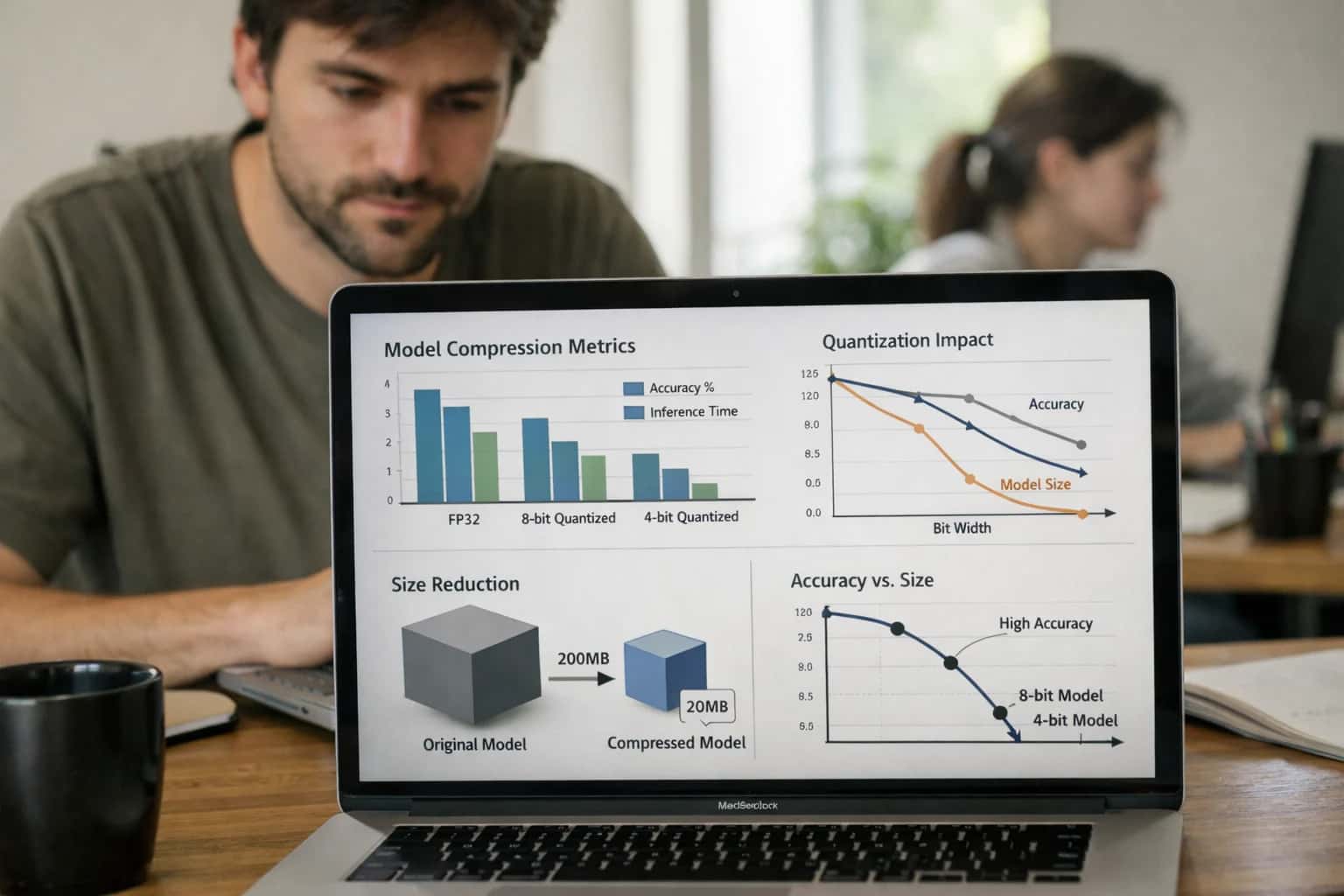
COMPRESSION TECHNIQUE
What is Model Quantization?
Model quantization is a compression technique that reduces the numerical precision of a neural network's weights and activations, typically from 32-bit floating point to 8-bit integer, to accelerate inference on edge hardware.
The primary benefit is a significant reduction in model size and inference latency, often with minimal accuracy loss. Post-training quantization (PTQ) calibrates the model using a representative dataset, while quantization-aware training (QAT) simulates quantization noise during training to preserve accuracy on resource-constrained FPGA and edge TPU targets.
MODEL COMPRESSION
Key Quantization Techniques
Quantization reduces the numerical precision of weights and activations to accelerate inference on resource-constrained edge hardware. The following techniques represent the core methodologies for deploying modulation classifiers on FPGAs and embedded processors.
02
Quantization-Aware Training (QAT)
Simulates quantization effects during the forward pass of training, allowing the model to learn parameters robust to reduced precision. The backward pass still uses full-precision gradients.
- Fake quantization nodes inserted into the computational graph
- Model learns to compensate for rounding errors and clipping
- Recovers accuracy that PTQ might lose, especially for aggressive bit-widths
- Essential for INT4 or lower precision targets
QAT is the standard approach when deploying to Edge TPU or bare-metal inference engines where every bit counts.
03
Dynamic Range Quantization
Quantizes only the weights to INT8 while activations remain in floating-point during inference. The activations are quantized dynamically based on their observed range at runtime.
- Simplest quantization method — no calibration dataset needed
- Weights are statically quantized post-training
- Activations quantized on-the-fly with minimal overhead
- Achieves 2-4x speedup on CPUs with SIMD instruction support
Commonly used in TensorFlow Lite for rapid prototyping on mobile and embedded CPUs.
04
Per-Channel vs. Per-Tensor Quantization
Two granularity strategies for assigning scale and zero-point parameters. Per-tensor uses a single scale for an entire weight tensor, while per-channel assigns independent scales to each output channel.
- Per-tensor: Simpler, faster, but sensitive to outlier channels
- Per-channel: Higher accuracy, especially for depthwise convolutions
- Per-channel adds minimal compute overhead on modern hardware
- Critical for preserving accuracy in CNN-based modulation classifiers
Per-channel quantization is the default in TensorRT and recommended for vision and signal processing models.
05
Mixed-Precision Quantization
Assigns different numerical precisions to different layers based on their sensitivity to quantization error. Sensitive layers retain FP16 or INT16, while robust layers drop to INT8 or INT4.
- Layer-wise sensitivity analysis guides precision assignment
- First and last layers often kept at higher precision
- Balances model size, latency, and accuracy trade-offs
- Automated tools like NVIDIA's TAO Toolkit perform this analysis
Essential for complex architectures where uniform quantization causes unacceptable degradation in critical feature extraction layers.
06
Integer-Only Arithmetic Inference
The end-goal of quantization: executing the entire forward pass using only integer operations. This eliminates floating-point units entirely, enabling deployment on bare-metal microcontrollers and FPGAs.
- All operations — convolutions, activations, batch norm — are integer-based
- Requires careful calibration of zero-point and scale for each tensor
- Enables execution on hardware without FPUs, like ARM Cortex-M
- Used in TensorFlow Lite Micro for true edge deployment
For real-time spectrum classification, integer-only inference on an FPGA offload engine achieves deterministic, low-latency classification within the inference latency budget.
NUMERICAL PRECISION FORMATS
Precision Format Comparison
Comparison of common numerical precision formats used in neural network quantization for edge deployment of modulation classifiers.
| Feature | FP32 | FP16 | INT8 |
|---|---|---|---|
Bit Width | 32 bits | 16 bits | 8 bits |
Dynamic Range | ±3.4 × 10³⁸ | ±65,504 | ±127 |
Memory per Parameter | 4 bytes | 2 bytes | 1 byte |
Model Size Reduction | Baseline | 2× smaller | 4× smaller |
Hardware Acceleration | |||
Native GPU Support | |||
Inference Speedup vs FP32 | 1× | 2-3× | 4-8× |
Post-Training Quantization |
MODEL QUANTIZATION
Frequently Asked Questions
Essential questions about reducing numerical precision in neural networks to accelerate real-time modulation classification on edge hardware.
Model quantization is a compression technique that reduces the numerical precision of a neural network's weights and activations from 32-bit floating-point (FP32) to lower-bit representations, typically 8-bit integers (INT8). The process works by mapping the continuous range of floating-point values to a discrete set of integer levels using a scale factor and zero-point offset. During inference, the model performs matrix multiplications using integer arithmetic, which is significantly faster and more energy-efficient on CPUs, FPGAs, and specialized accelerators like the Edge TPU. Quantization can be applied post-training—calibrating the model on a representative dataset after training—or via quantization-aware training (QAT), where the model learns to compensate for quantization error during the training process itself, resulting in higher accuracy for aggressive bit-width reductions.
Enabling Efficiency, Speed & Accuracy
Intelligent Analysis, Decision & Execution
We build AI systems for teams that need search across company data, workflow automation across tools, or AI features inside products and internal software.
Talk to Us
Search across company data
Give teams answers from docs, tickets, runbooks, and product data with sources and permissions.
Useful when people spend too long searching or get different answers from different systems.
Enterprise searchRAGPermissions
Read more
Automate internal workflows
Use AI to route work, draft outputs, trigger actions, and keep approvals and logs in place.
Useful when repetitive work moves across multiple tools and teams.
AI agentsWorkflow automationGovernance
Read more
Add AI to products and internal tools
Build assistants, guided actions, or decision support into the software your team or customers already use.
Useful when AI needs to be part of the product, not a separate tool.
AI integrationDecision supportModel routing
Read more
About the author
Prasad Kumkar
CEO & MD, Inference Systems
Prasad Kumkar is the CEO & MD of Inference Systems and writes about AI systems architecture, LLM infrastructure, model serving, evaluation, and production deployment. Over 5+ years, he has worked across computer vision models, L5 autonomous vehicle systems, and LLM research, with a focus on taking complex AI ideas into real-world engineering systems.
His work and writing cover AI systems, large language models, AI agents, multimodal systems, autonomous systems, inference optimization, RAG, evaluation, and production AI engineering.
LinkedIn
Limited slotsGet a Free AI Consultation
Partnered with leading AI, data, and software stack.





How We Work
Custom AI workflows for your Business
One-fit-all AI don't work for modern businesses. At Inferensys, we aim to understand your business & custom requirements; which we use to define most efficient agentic workflows, the data, and the tools for your business.
01
Review the use case
We understand the task, the users, and where AI can actually help.
Read more02
Pick the right approach
We define what needs search, automation, or product integration.
Read more03
Build the first useful version
We implement the part that proves the value first.
Read more04
Improve from there
We add the checks and visibility needed to keep it useful.
Read moreThe first call is a practical review of your use case and the right next step.
Talk to Us