Vitis AI is a comprehensive IP core and software stack that enables the deployment of accelerated deep learning inference on Xilinx hardware. It provides a Deep Learning Processor Unit (DPU) configurable IP, along with a toolchain for model quantization, compilation, and profiling, specifically targeting edge AI workloads like real-time signal classification.

Glossary
Vitis AI
Vitis AI is AMD's development environment for compiling, optimizing, and deploying deep learning models onto Xilinx FPGA and adaptive SoC platforms, specifically targeting edge AI workloads like signal classification.
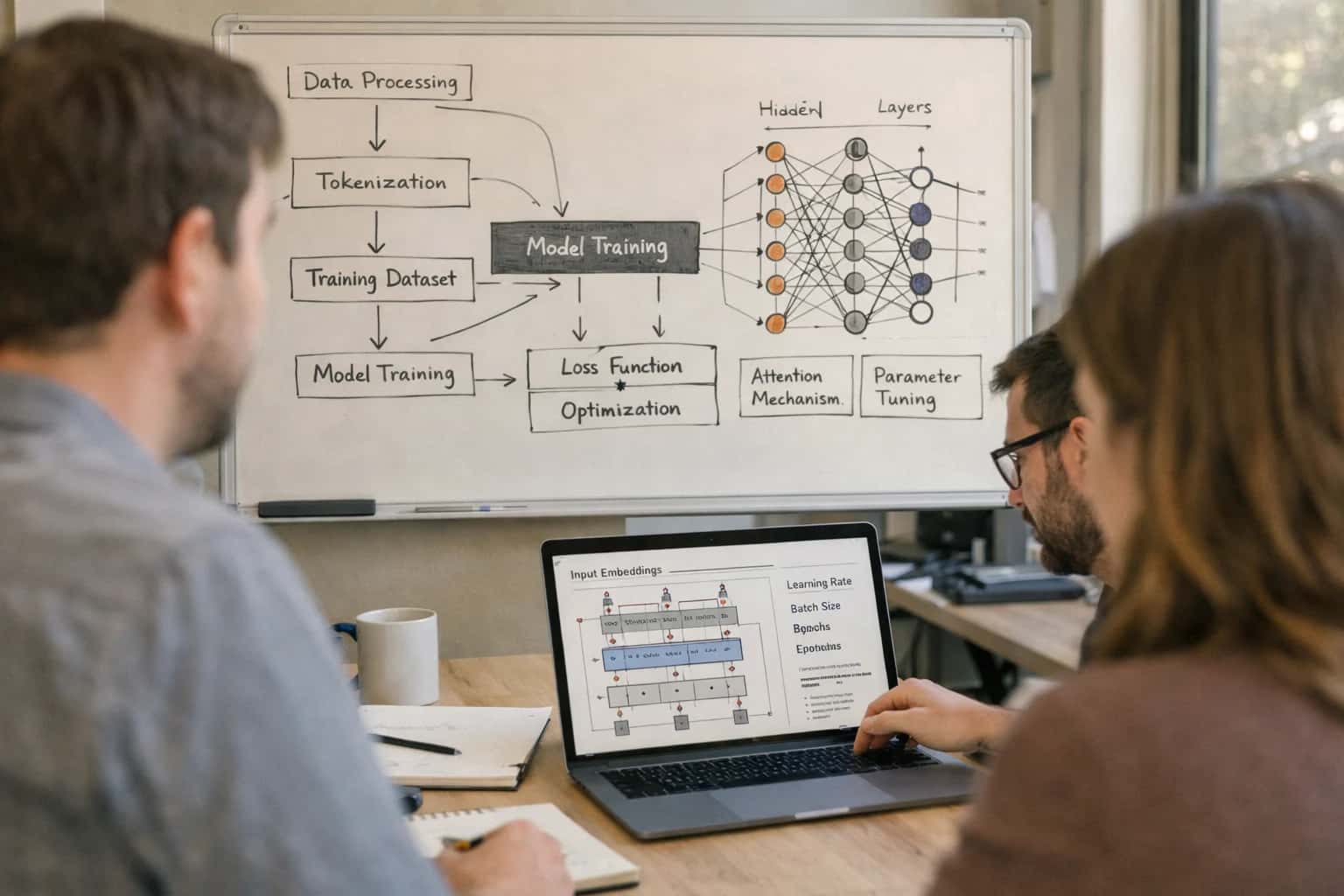
FPGA DEEP LEARNING DEVELOPMENT ENVIRONMENT
What is Vitis AI?
Vitis AI is AMD's integrated development environment for compiling, optimizing, and deploying deep learning inference models onto Xilinx FPGA and adaptive SoC platforms.
The platform supports mainstream frameworks such as TensorFlow and PyTorch, converting trained models into highly efficient instructions for the DPU's systolic array. By leveraging integer-only inference and operator fusion, Vitis AI maximizes throughput per watt, making it a critical tool for deploying compressed modulation classifiers on resource-constrained, low-latency FPGA fabric.
EDGE AI DEVELOPMENT ENVIRONMENT
Key Features of Vitis AI
AMD's Vitis AI provides a comprehensive toolchain for compiling, optimizing, and deploying deep learning models onto Xilinx FPGA and adaptive SoC platforms, specifically targeting high-performance, low-latency edge AI workloads like signal classification.
01
Deep Learning Processor Unit (DPU)
The DPU is a programmable engine optimized specifically for convolutional neural network inference. It features a custom instruction set and a dedicated systolic array to maximize the efficiency of matrix multiplications. Vitis AI configures the DPU's architecture—including the number of Multiply-Accumulate (MAC) units and memory bandwidth—to match the specific needs of your model, enabling high-throughput, low-power execution on adaptive SoCs.
Custom ISA
Instruction Set Architecture
02
AI Optimizer: Pruning & Compression
The AI Optimizer employs advanced model compression techniques to reduce the computational footprint of neural networks for edge deployment. It performs iterative weight pruning to remove redundant connections, guided by principles similar to the Lottery Ticket Hypothesis. This is combined with channel pruning to structurally reduce model size, drastically lowering FLOPs Reduction requirements while preserving the accuracy of modulation classification models.
03
AI Quantizer: Mixed-Precision Calibration
The AI Quantizer converts floating-point models to fixed-point for integer-only inference. It supports Post-Training Quantization (PTQ) with a fast calibration dataset and Quantization-Aware Training (QAT) using a Straight-Through Estimator (STE) for maximum accuracy. A key feature is mixed-precision quantization, which assigns different bit-widths to layers, balancing the trade-off between model size and signal classification fidelity.
04
AI Compiler: Graph-Level Optimization
The AI Compiler maps the optimized model graph to the DPU's instruction set. It performs critical optimizations including operator fusion, which combines consecutive operations like convolution, bias, and activation into a single kernel. It also executes batch normalization folding, mathematically absorbing BN parameters into preceding weights to eliminate redundant runtime calculations and reduce memory bandwidth bottlenecks.
05
Vitis AI Profiler & Debugger
This tool provides deep visibility into the execution of a model on the DPU. It generates a roof-line model analysis to identify if your workload is memory-bound or compute-bound. The profiler visualizes the streaming architecture dataflow, helping you optimize a ping-pong buffer strategy to overlap data transfer with computation, ensuring continuous, low-latency IQ sample processing for real-time classification.
06
Vitis AI Library & Model Zoo
The Vitis AI Library offers pre-optimized C++ and Python APIs for common tasks like classification, detection, and segmentation, abstracting away low-level DPU programming. The Model Zoo provides a curated collection of pre-trained models, including those suitable for RF tasks, which have been pruned and quantized for optimal performance. This accelerates the deployment of hardware-aware NAS results directly onto Xilinx platforms.
VITIS AI FAQ
Frequently Asked Questions
Clear, technical answers to common questions about AMD's Vitis AI development environment for compiling and deploying deep learning models on Xilinx adaptive SoCs and FPGAs.
Vitis AI is AMD's comprehensive development environment for compiling, optimizing, and deploying deep learning models onto Xilinx FPGA and adaptive SoC platforms. It works by providing a full-stack workflow: developers start with a trained model from frameworks like PyTorch or TensorFlow, which is then parsed and optimized by the Vitis AI Optimizer through techniques like pruning. The optimized model is quantized to INT8 precision using the Vitis AI Quantizer, calibrated against a representative dataset to minimize accuracy loss. The quantized model is then compiled by the Vitis AI Compiler into a highly efficient instruction stream targeting the Deep Learning Processor Unit (DPU) , a dedicated hardware accelerator implemented in the FPGA fabric. The final output is an .xmodel file that runs on the DPU with the Vitis AI Runtime (VART) managing execution, memory, and scheduling. This end-to-end flow abstracts hardware complexity while achieving high throughput and low latency for edge AI workloads like signal classification.
Enabling Efficiency, Speed & Accuracy
Intelligent Analysis, Decision & Execution
We build AI systems for teams that need search across company data, workflow automation across tools, or AI features inside products and internal software.
Talk to Us
Search across company data
Give teams answers from docs, tickets, runbooks, and product data with sources and permissions.
Useful when people spend too long searching or get different answers from different systems.
Enterprise searchRAGPermissions
Read more
Automate internal workflows
Use AI to route work, draft outputs, trigger actions, and keep approvals and logs in place.
Useful when repetitive work moves across multiple tools and teams.
AI agentsWorkflow automationGovernance
Read more
Add AI to products and internal tools
Build assistants, guided actions, or decision support into the software your team or customers already use.
Useful when AI needs to be part of the product, not a separate tool.
AI integrationDecision supportModel routing
Read more
About the author
Prasad Kumkar
CEO & MD, Inference Systems
Prasad Kumkar is the CEO & MD of Inference Systems and writes about AI systems architecture, LLM infrastructure, model serving, evaluation, and production deployment. Over 5+ years, he has worked across computer vision models, L5 autonomous vehicle systems, and LLM research, with a focus on taking complex AI ideas into real-world engineering systems.
His work and writing cover AI systems, large language models, AI agents, multimodal systems, autonomous systems, inference optimization, RAG, evaluation, and production AI engineering.
LinkedIn
Limited slotsGet a Free AI Consultation
Partnered with leading AI, data, and software stack.





How We Work
Custom AI workflows for your Business
One-fit-all AI don't work for modern businesses. At Inferensys, we aim to understand your business & custom requirements; which we use to define most efficient agentic workflows, the data, and the tools for your business.
01
Review the use case
We understand the task, the users, and where AI can actually help.
Read more02
Pick the right approach
We define what needs search, automation, or product integration.
Read more03
Build the first useful version
We implement the part that proves the value first.
Read more04
Improve from there
We add the checks and visibility needed to keep it useful.
Read moreThe first call is a practical review of your use case and the right next step.
Talk to Us