A Deep Learning Processor Unit (DPU) is a programmable hardware engine architected specifically to accelerate the inference of deep neural networks, primarily convolutional neural networks (CNNs). It features a custom instruction set and a dedicated systolic array of processing elements, enabling highly parallel, deterministic computation of matrix multiplications and convolutions with superior performance-per-watt compared to general-purpose CPUs or GPUs for edge deployment.

Glossary
Deep Learning Processor Unit (DPU)
A programmable engine optimized specifically for convolutional neural network inference, featuring a custom instruction set and a dedicated systolic array for high-efficiency edge deployment.
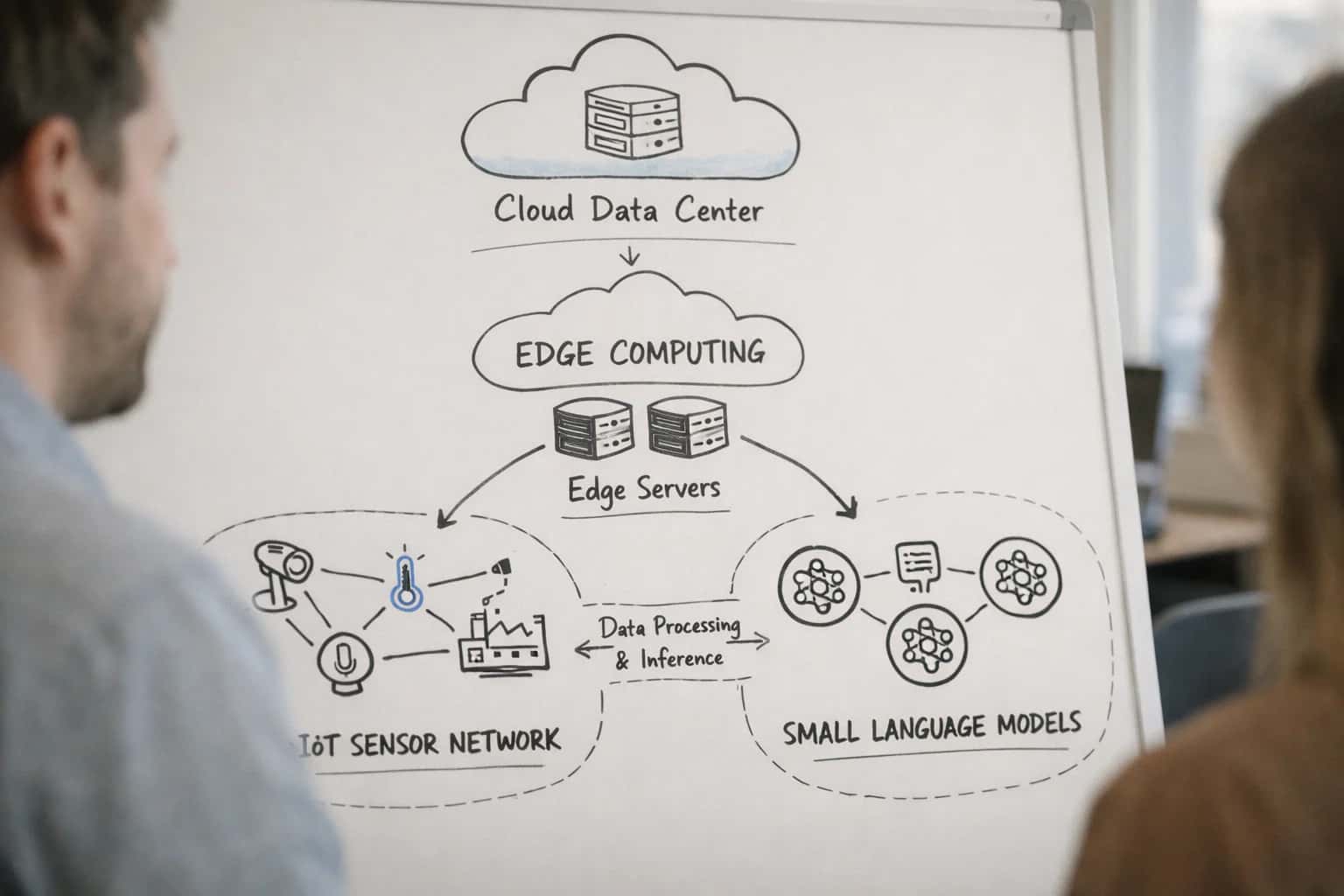
EDGE AI ACCELERATOR
What is Deep Learning Processor Unit (DPU)?
A DPU is a specialized hardware accelerator designed for high-efficiency deep learning inference, particularly for convolutional neural networks, on edge devices.
DPUs are commonly integrated into FPGA and adaptive System-on-Chip (SoC) platforms, such as those from AMD/Xilinx, to handle real-time AI workloads like automatic modulation classification. By executing integer-only inference and leveraging deep pipelining and operator fusion, a DPU minimizes memory bandwidth bottlenecks and latency, making it a critical component for deploying compressed RF machine learning models in power-constrained, field-deployed signal intelligence systems.
HARDWARE ACCELERATION
Key Architectural Features of a DPU
A Deep Learning Processor Unit (DPU) is a programmable engine optimized for convolutional neural network inference. Its architecture is defined by a custom instruction set and a dedicated systolic array, enabling high-efficiency deployment on edge FPGAs and adaptive SoCs.
01
Custom DPU Instruction Set
The DPU features a specialized CISC-like instruction set tailored for neural network primitives rather than general-purpose compute. Instructions operate on wide vectors and directly manage dataflow between on-chip buffers, the systolic array, and external memory. This eliminates the overhead of translating high-level framework operations into generic CPU/GPU ISA, maximizing compute density for convolution, pooling, and activation functions.
02
Systolic Array Core
At the heart of the DPU is a homogeneous grid of Multiply-Accumulate (MAC) processing elements arranged in a systolic array. Data flows rhythmically through the array in a wavefront pattern, where each element performs a MAC operation and passes operands to its neighbors. This architecture minimizes data movement and maximizes reuse of weights and feature map pixels, achieving high throughput for the dense matrix multiplications central to convolutional layers.
03
On-Chip Memory Hierarchy
The DPU employs a multi-level buffer architecture to minimize costly off-chip DRAM access:
- Weight Buffer: Stores pre-loaded kernel weights for an entire layer.
- Input/Output Buffers: Double-buffered to overlap data transfer with computation.
- Local Registers: Feed individual MAC units directly. This hierarchy is managed by the DPU's internal DMA engine, which orchestrates data movement independently of the host CPU.
04
Deep Pipelining & Streaming
The DPU implements a streaming architecture where computation is deeply pipelined. As one layer's output is generated, it is immediately consumed as input by the next layer without intermediate round-trips to external memory. This layer-to-layer cascading is critical for achieving minimal end-to-end latency on continuous data streams, such as real-time IQ sample processing for modulation classification.
05
Hardware-Aware Quantization
The DPU natively accelerates INT8 integer-only inference, mapping quantized operations directly to its MAC array. It supports per-channel and per-tensor quantization schemes. The architecture is co-designed with tools like Vitis AI, which perform cross-layer equalization and calibration to minimize accuracy loss when converting from FP32 models. This eliminates the need for floating-point units, drastically reducing power consumption.
06
Operator Fusion & Graph Optimization
During compilation, the DPU's toolchain applies aggressive graph-level optimizations:
- Batch Normalization Folding: Absorbs BN parameters into preceding convolution weights.
- Activation Fusion: Executes ReLU or LeakyReLU in-place immediately after convolution without a separate kernel launch.
- Concatenation Elision: Optimizes skip connections in residual blocks. These fusions reduce memory bandwidth bottlenecks and kernel launch overhead.
DPU ARCHITECTURE
Frequently Asked Questions
Explore the core architectural principles and operational mechanics of the Deep Learning Processor Unit (DPU), a programmable engine designed for high-efficiency convolutional neural network inference on edge devices.
A Deep Learning Processor Unit (DPU) is a specialized programmable hardware accelerator optimized for the high-speed inference of deep neural networks, particularly convolutional architectures. It operates by executing a custom instruction set tailored for deep learning operations on a dedicated systolic array of processing elements. The DPU fetches instructions from an external host CPU, loads pre-quantized weights and feature map data from off-chip memory into its internal buffer, and then orchestrates the systolic array to perform massive parallel multiply-accumulate (MAC) operations. This architecture maximizes data reuse and minimizes memory bandwidth bottlenecks, achieving significantly higher throughput and energy efficiency than general-purpose CPUs or GPUs for edge inference tasks like image classification or signal recognition.
Enabling Efficiency, Speed & Accuracy
Intelligent Analysis, Decision & Execution
We build AI systems for teams that need search across company data, workflow automation across tools, or AI features inside products and internal software.
Talk to Us
Search across company data
Give teams answers from docs, tickets, runbooks, and product data with sources and permissions.
Useful when people spend too long searching or get different answers from different systems.
Enterprise searchRAGPermissions
Read more
Automate internal workflows
Use AI to route work, draft outputs, trigger actions, and keep approvals and logs in place.
Useful when repetitive work moves across multiple tools and teams.
AI agentsWorkflow automationGovernance
Read more
Add AI to products and internal tools
Build assistants, guided actions, or decision support into the software your team or customers already use.
Useful when AI needs to be part of the product, not a separate tool.
AI integrationDecision supportModel routing
Read more
About the author
Prasad Kumkar
CEO & MD, Inference Systems
Prasad Kumkar is the CEO & MD of Inference Systems and writes about AI systems architecture, LLM infrastructure, model serving, evaluation, and production deployment. Over 5+ years, he has worked across computer vision models, L5 autonomous vehicle systems, and LLM research, with a focus on taking complex AI ideas into real-world engineering systems.
His work and writing cover AI systems, large language models, AI agents, multimodal systems, autonomous systems, inference optimization, RAG, evaluation, and production AI engineering.
LinkedIn
Limited slotsGet a Free AI Consultation
Partnered with leading AI, data, and software stack.





How We Work
Custom AI workflows for your Business
One-fit-all AI don't work for modern businesses. At Inferensys, we aim to understand your business & custom requirements; which we use to define most efficient agentic workflows, the data, and the tools for your business.
01
Review the use case
We understand the task, the users, and where AI can actually help.
Read more02
Pick the right approach
We define what needs search, automation, or product integration.
Read more03
Build the first useful version
We implement the part that proves the value first.
Read more04
Improve from there
We add the checks and visibility needed to keep it useful.
Read moreThe first call is a practical review of your use case and the right next step.
Talk to Us