Policy as Code is the methodology of writing security and compliance rules in a high-level, declarative language that can be automatically enforced, tested, and version-controlled alongside infrastructure code. It transforms manual governance documents into executable logic, enabling automated validation and remediation within CI/CD pipelines and runtime environments.

Glossary
Policy as Code
The practice of writing security and compliance rules in a high-level, machine-readable language that can be automatically enforced, tested, and version-controlled alongside infrastructure code.
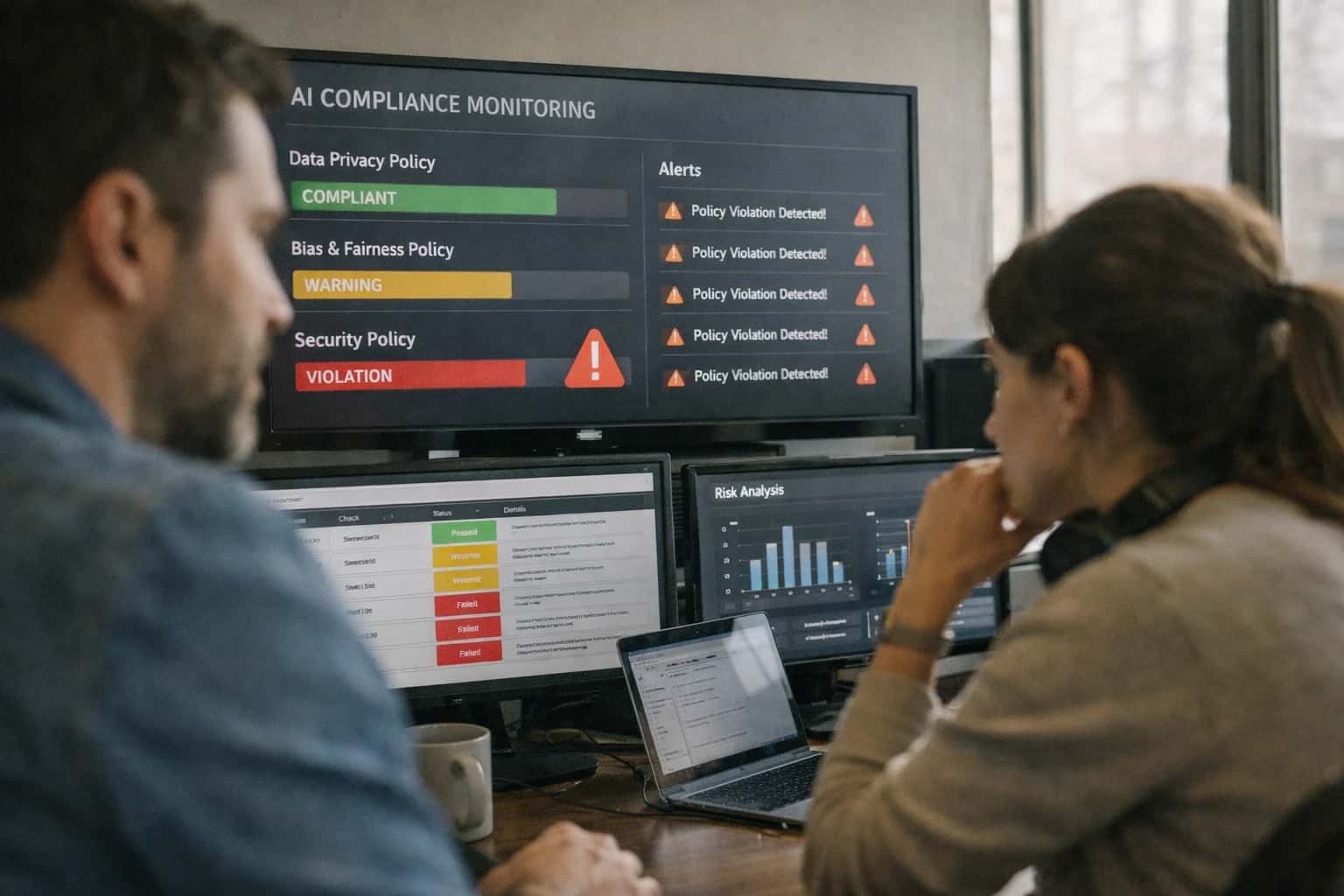
AUTOMATED COMPLIANCE
What is Policy as Code?
Policy as Code (PaC) is the practice of defining, managing, and enforcing security, compliance, and operational rules through machine-readable code rather than manual processes or documents.
By codifying policies using languages like Rego for Open Policy Agent (OPA) or Sentinel, organizations achieve consistent, auditable enforcement across multi-cloud and hybrid infrastructure. This approach integrates directly with GitOps workflows, allowing policy changes to undergo the same peer review and testing as application code, ensuring that compliance is a continuous, automated function rather than a periodic manual audit.
AUTOMATED GOVERNANCE
Core Characteristics of Policy as Code
Policy as Code (PaC) transforms security and compliance rules from static documents into executable, version-controlled software. This approach ensures that governance is automated, auditable, and enforced consistently across the entire infrastructure lifecycle.
01
Declarative Logic
Policies are written to define the desired state of a system, not the step-by-step procedure to achieve it. The PaC engine handles the logic of how to enforce the rule.
- Focus on the 'what' (e.g., 'all storage buckets must be private'), not the 'how'.
- The engine continuously evaluates the current state against the declared policy.
- This model is the foundation of reconciliation loops in Kubernetes and other declarative systems.
02
Version-Controlled Governance
Storing policies in a Git repository treats them with the same rigor as application code. This enables collaboration, audit trails, and rollbacks.
- Every policy change is a pull request, subject to peer review and automated testing.
- The Git history provides an immutable audit log of who changed a rule, when, and why.
- This practice is a core tenet of GitOps, where the repository is the single source of truth.
03
Automated Testing & Validation
PaC enables unit and integration testing for compliance rules before they affect production systems. This shifts security left in the development lifecycle.
- Write tests to confirm a policy correctly blocks a non-compliant resource and allows a compliant one.
- Integrate policy checks into CI/CD pipelines to prevent misconfigurations from being deployed.
- Tools like Open Policy Agent (OPA) provide frameworks for writing and executing these policy tests.
04
Unified Enforcement Point
A PaC engine decouples policy decisions from application logic, providing a single, centralized service for authorization and compliance across a heterogeneous stack.
- Applications query the engine via API at decision time (e.g., 'Can this user create a resource in this region?').
- This architecture eliminates siloed, hard-coded authorization logic in each microservice.
- The engine can enforce rules across diverse layers: Kubernetes admission control, API gateways, and Infrastructure as Code (IaC) provisioning.
05
High-Level Policy Languages
Policies are expressed in domain-specific, machine-readable languages designed for readability and expressiveness, not general-purpose programming.
- Rego, the language for Open Policy Agent, uses a declarative, logic-based syntax inspired by Datalog.
- Sentinel, by HashiCorp, uses a policy-as-code framework with a familiar imperative-style syntax.
- These languages abstract away the complexity of the underlying enforcement mechanisms, making policies accessible to compliance and security teams.
06
Continuous Compliance & Drift Remediation
PaC is not a one-time check; it continuously monitors the live environment for configuration drift and can automatically remediate violations.
- The engine constantly evaluates the actual state of infrastructure against the declared policy in the Git repository.
- If a manual change creates a violation, the system can trigger an alert or automatically revert the change.
- This closed-loop automation ensures that the system remains in a known, compliant state, a key concept in self-healing networks and drift remediation.
POLICY AS CODE
Frequently Asked Questions
Clear, concise answers to the most common questions about defining, testing, and enforcing security and compliance rules through machine-readable code.
Policy as Code (PaC) is the practice of defining security, compliance, and operational rules in a high-level, machine-readable language that can be automatically enforced, tested, and version-controlled alongside infrastructure code. It works by decoupling the decision logic from the application or infrastructure it governs. A policy engine, such as Open Policy Agent (OPA) or Kyverno, evaluates incoming requests against a set of declarative policies written in a language like Rego. When a request to provision a resource is made, the engine queries the policy, receives an allow or deny decision, and enforces it, ensuring every action complies with organizational rules without manual gatekeeping.
Enabling Efficiency, Speed & Accuracy
Intelligent Analysis, Decision & Execution
We build AI systems for teams that need search across company data, workflow automation across tools, or AI features inside products and internal software.
Talk to Us
Search across company data
Give teams answers from docs, tickets, runbooks, and product data with sources and permissions.
Useful when people spend too long searching or get different answers from different systems.
Enterprise searchRAGPermissions
Read more
Automate internal workflows
Use AI to route work, draft outputs, trigger actions, and keep approvals and logs in place.
Useful when repetitive work moves across multiple tools and teams.
AI agentsWorkflow automationGovernance
Read more
Add AI to products and internal tools
Build assistants, guided actions, or decision support into the software your team or customers already use.
Useful when AI needs to be part of the product, not a separate tool.
AI integrationDecision supportModel routing
Read more
About the author
Prasad Kumkar
CEO & MD, Inference Systems
Prasad Kumkar is the CEO & MD of Inference Systems and writes about AI systems architecture, LLM infrastructure, model serving, evaluation, and production deployment. Over 5+ years, he has worked across computer vision models, L5 autonomous vehicle systems, and LLM research, with a focus on taking complex AI ideas into real-world engineering systems.
His work and writing cover AI systems, large language models, AI agents, multimodal systems, autonomous systems, inference optimization, RAG, evaluation, and production AI engineering.
LinkedIn
Limited slotsGet a Free AI Consultation
Partnered with leading AI, data, and software stack.





How We Work
Custom AI workflows for your Business
One-fit-all AI don't work for modern businesses. At Inferensys, we aim to understand your business & custom requirements; which we use to define most efficient agentic workflows, the data, and the tools for your business.
01
Review the use case
We understand the task, the users, and where AI can actually help.
Read more02
Pick the right approach
We define what needs search, automation, or product integration.
Read more03
Build the first useful version
We implement the part that proves the value first.
Read more04
Improve from there
We add the checks and visibility needed to keep it useful.
Read moreThe first call is a practical review of your use case and the right next step.
Talk to Us