Service Management and Orchestration (SMO) is the centralized management framework in the O-RAN architecture responsible for the FCAPS (Fault, Configuration, Accounting, Performance, and Security) management, orchestration, and lifecycle automation of all O-RAN network functions. It provides a unified operations platform that integrates the Non-Real-Time RAN Intelligent Controller (Non-RT RIC) to host rApps and manage AI/ML workflows for long-term policy-based optimization.

Glossary
Service Management and Orchestration (SMO)
The management framework that integrates the Non-RT RIC and provides unified orchestration, administration, and lifecycle management of O-RAN network functions.
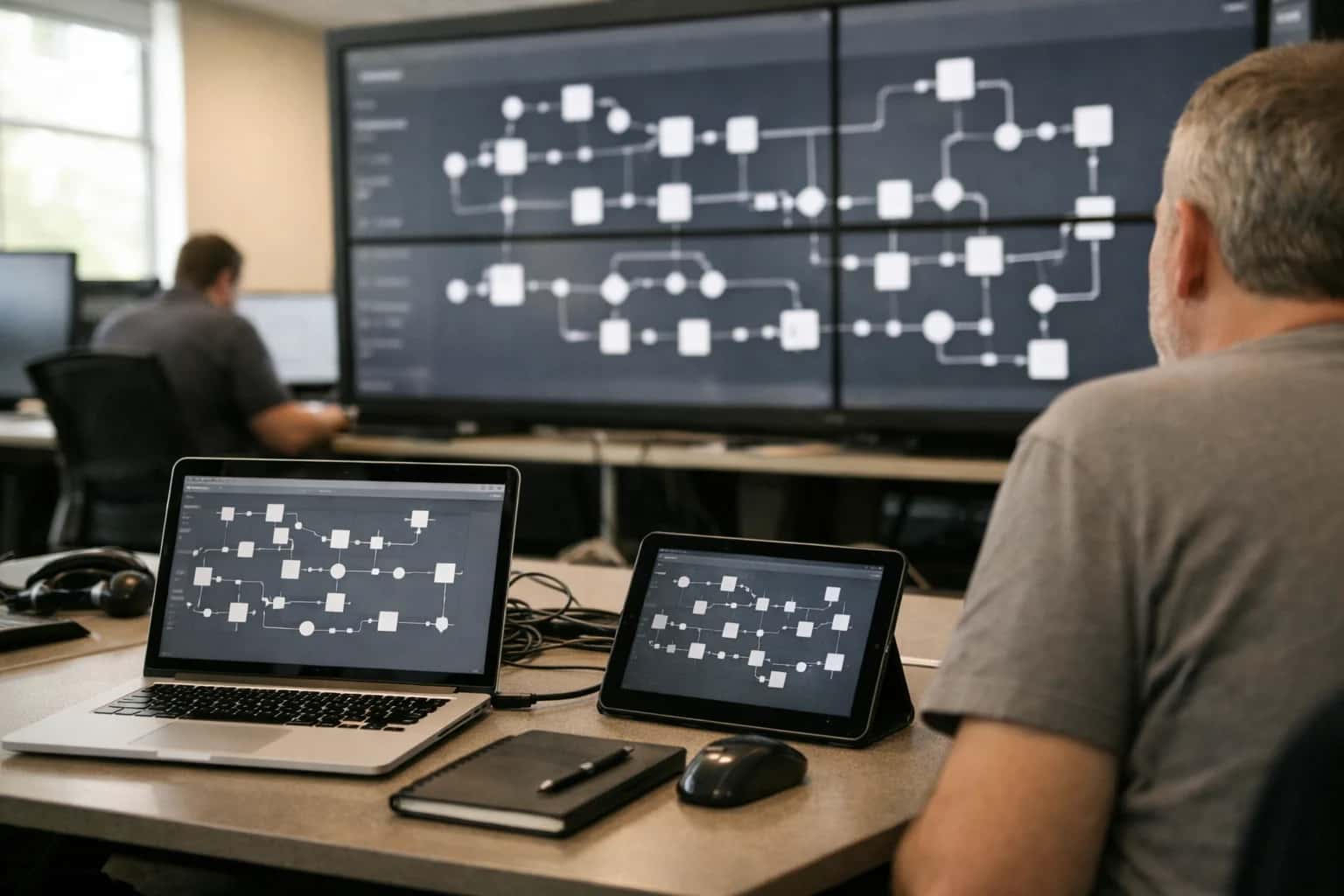
O-RAN MANAGEMENT FRAMEWORK
What is Service Management and Orchestration (SMO)?
The Service Management and Orchestration (SMO) framework provides unified, end-to-end management of O-RAN network functions, integrating the Non-RT RIC to enable AI-driven optimization.
The SMO communicates with O-RAN Central Units, Distributed Units, and Radio Units via the standardized O1 interface for management plane operations, while the O2 interface handles cloud infrastructure orchestration. By abstracting multi-vendor RAN elements into a single management domain, the SMO enables closed-loop automation, intent translation, and zero-touch provisioning across disaggregated, open radio access networks.
UNIFIED ORCHESTRATION
Core Capabilities of the SMO
The Service Management and Orchestration framework is the operational brain of the O-RAN architecture, providing a unified platform for FCAPS management, Non-RT RIC integration, and the automated lifecycle management of all network functions.
01
FCAPS Management via the O1 Interface
The SMO provides a standardized, unified framework for Fault, Configuration, Accounting, Performance, and Security (FCAPS) management across all O-RAN network functions. It terminates the O1 interface to connect to O-CU, O-DU, and O-RU elements, enabling centralized alarm correlation, performance monitoring, and configuration management. This replaces traditional, siloed element management systems with a single, vendor-agnostic pane of glass.
- Fault Management: Aggregates alarms and performs root-cause analysis across multi-vendor deployments.
- Configuration Management: Pushes desired-state configurations to network functions using NETCONF/YANG models.
- Performance Management: Collects and analyzes granular PM counters for long-term trend analysis.
O1
Standardized Interface
02
Non-RT RIC Hosting and Integration
The SMO is the native execution environment for the Non-Real-Time RAN Intelligent Controller (Non-RT RIC) . It hosts the Non-RT RIC's logical functions, including the A1 interface termination point and the rApp runtime environment. This integration allows the SMO to bridge long-term, AI/ML-driven policy guidance with near-real-time control loops. The SMO provides rApps with access to a centralized data lake of historical network telemetry for model training and validation.
- A1 Policy Manager: Securely exposes the A1 interface for rApps to send declarative policies to the Near-RT RIC.
- rApp Catalog: Manages the onboarding, instantiation, and termination of third-party rApps.
03
AI/ML Workflow Orchestration
The SMO automates the entire AI/ML model lifecycle for the RAN. It orchestrates pipelines that ingest data from the Data Collection and Distribution Framework, trigger distributed training jobs, validate model performance against a holdout dataset, and deploy the trained artifact to an inference host on the Non-RT RIC or Near-RT RIC. This capability ensures that optimization algorithms are continuously retrained on fresh data without manual intervention.
- Model Registry: A version-controlled repository for all trained AI artifacts.
- Drift Detection: Monitors deployed model accuracy and triggers automatic retraining when performance degrades below a threshold.
04
Network Function Lifecycle Management
The SMO manages the complete lifecycle of Cloud-Native Network Functions (CNFs) that compose the O-RAN central and distributed units. It orchestrates the instantiation, scaling, healing, and termination of containerized workloads on the O-Cloud infrastructure. By integrating with Kubernetes-based platforms, the SMO enables zero-touch provisioning of new cell sites and automated rollback of faulty software upgrades.
- Helm Chart Management: Stores and deploys CNF descriptors as Helm charts.
- Auto-Scaling: Dynamically adjusts compute resources for O-DU user-plane functions based on traffic load.
05
Data Collection and Distribution Framework
The SMO hosts a centralized framework that aggregates massive streams of real-time and historical telemetry from the RAN. It collects performance measurements, UE-level traces, and cell-level KPIs via the O1 interface and streams them to authorized consumers, such as rApps and operator dashboards. This framework acts as a data mesh, decoupling data producers from consumers and ensuring that AI models are trained on a consistent, high-fidelity dataset.
- Stream Processing: Filters and enriches data streams in real-time before distribution.
- Data Lake: Provides long-term storage for historical data used in offline model training.
06
Intent Translation and Closed-Loop Assurance
The SMO houses the Intent Translation Engine, which converts high-level business objectives—such as 'maximize energy efficiency in rural cells'—into machine-executable policies. It continuously monitors the network state via a closed-loop assurance mechanism, comparing observed KPIs against the declared intent. If a deviation is detected, the SMO triggers corrective actions through the Non-RT RIC or directly reconfigures network functions to maintain the desired operational state.
- Policy Conflict Detection: Identifies and resolves contradictory intents before they are deployed.
- Assurance Dashboard: Visualizes intent compliance in real-time for network operations teams.
SERVICE MANAGEMENT AND ORCHESTRATION
Frequently Asked Questions
Clear, technically precise answers to the most common questions about the O-RAN Service Management and Orchestration framework, its components, and its role in enabling AI-driven network automation.
The Service Management and Orchestration (SMO) framework is the centralized management entity in the O-RAN architecture that provides unified orchestration, administration, and lifecycle management of all O-RAN network functions. It integrates the Non-Real-Time RAN Intelligent Controller (Non-RT RIC) and delivers FCAPS (Fault, Configuration, Accounting, Performance, Security) management capabilities to the entire RAN domain. The SMO abstracts the complexity of multi-vendor deployments by providing a single pane of glass for operators to manage disaggregated Central Units (O-CU), Distributed Units (O-DU), and Radio Units (O-RU). It communicates with managed elements via the O1 interface using standardized data models based on YANG and NETCONF, while the O2 interface handles cloud infrastructure lifecycle management. The SMO is the operational brain that hosts rApps, manages AI/ML model lifecycles, and translates high-level business intents into executable network policies.
Enabling Efficiency, Speed & Accuracy
Intelligent Analysis, Decision & Execution
We build AI systems for teams that need search across company data, workflow automation across tools, or AI features inside products and internal software.
Talk to Us
Search across company data
Give teams answers from docs, tickets, runbooks, and product data with sources and permissions.
Useful when people spend too long searching or get different answers from different systems.
Enterprise searchRAGPermissions
Read more
Automate internal workflows
Use AI to route work, draft outputs, trigger actions, and keep approvals and logs in place.
Useful when repetitive work moves across multiple tools and teams.
AI agentsWorkflow automationGovernance
Read more
Add AI to products and internal tools
Build assistants, guided actions, or decision support into the software your team or customers already use.
Useful when AI needs to be part of the product, not a separate tool.
AI integrationDecision supportModel routing
Read more
About the author
Prasad Kumkar
CEO & MD, Inference Systems
Prasad Kumkar is the CEO & MD of Inference Systems and writes about AI systems architecture, LLM infrastructure, model serving, evaluation, and production deployment. Over 5+ years, he has worked across computer vision models, L5 autonomous vehicle systems, and LLM research, with a focus on taking complex AI ideas into real-world engineering systems.
His work and writing cover AI systems, large language models, AI agents, multimodal systems, autonomous systems, inference optimization, RAG, evaluation, and production AI engineering.
LinkedIn
Limited slotsGet a Free AI Consultation
Partnered with leading AI, data, and software stack.





How We Work
Custom AI workflows for your Business
One-fit-all AI don't work for modern businesses. At Inferensys, we aim to understand your business & custom requirements; which we use to define most efficient agentic workflows, the data, and the tools for your business.
01
Review the use case
We understand the task, the users, and where AI can actually help.
Read more02
Pick the right approach
We define what needs search, automation, or product integration.
Read more03
Build the first useful version
We implement the part that proves the value first.
Read more04
Improve from there
We add the checks and visibility needed to keep it useful.
Read moreThe first call is a practical review of your use case and the right next step.
Talk to Us