Cross-Device Federated Learning is a distributed training paradigm that orchestrates model optimization across a massive, loosely coordinated fleet of edge clients—often millions of smartphones or IoT sensors—that are geographically dispersed, computationally constrained, and connected only by intermittent, high-latency wireless networks. Unlike cross-silo federated learning, which assumes reliable institutional nodes, this topology must natively handle severe statistical heterogeneity and the reality that a significant fraction of selected clients will drop out before completing a local training round.

Glossary
Cross-Device Federated Learning
A federated learning topology that scales to a massive population of unreliable, intermittently connected edge devices like smartphones or IoT sensors, characterized by high client dropout rates and severe system heterogeneity.
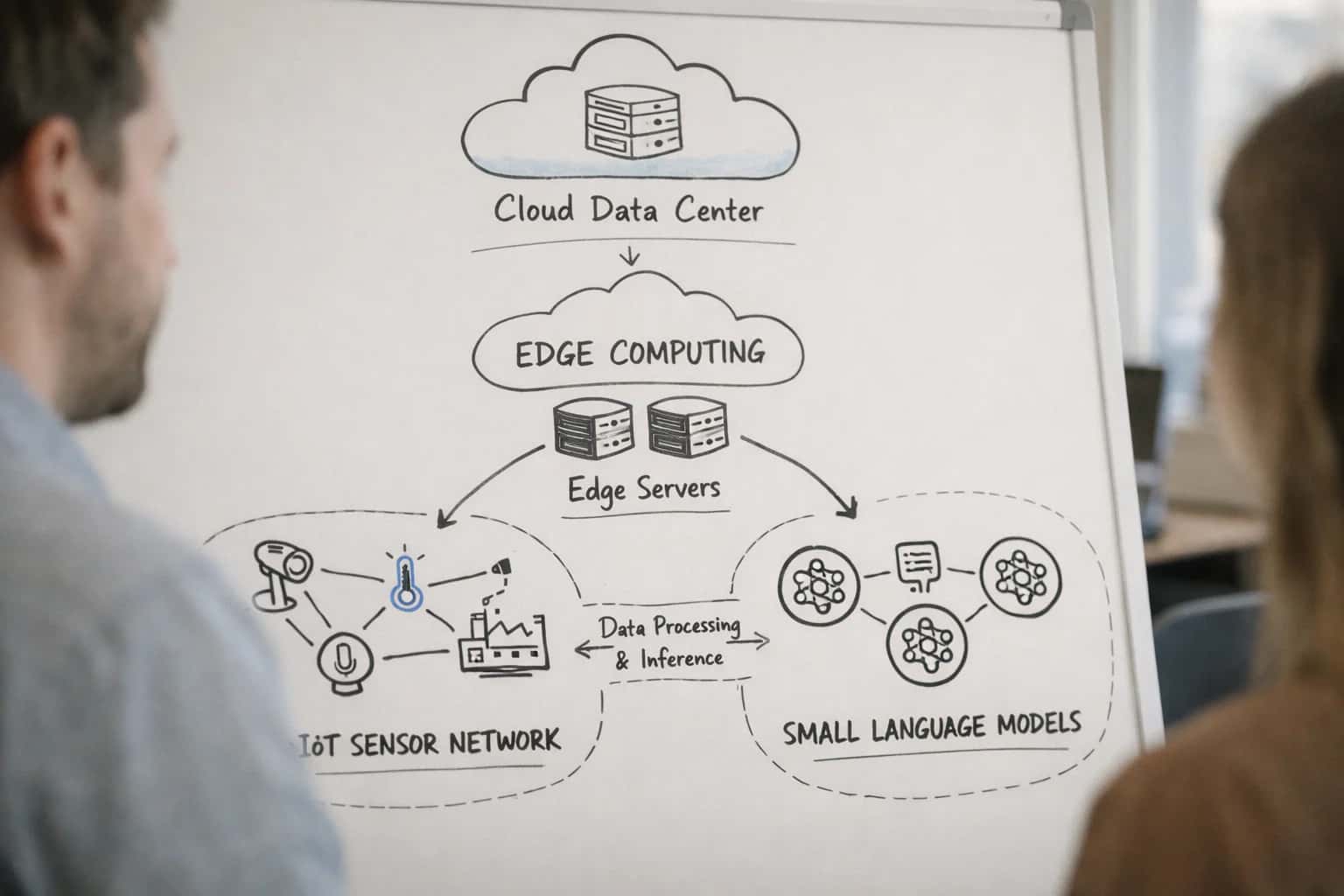
Distributed Topology
What is Cross-Device Federated Learning?
A federated learning topology designed to scale to a massive population of unreliable, intermittently connected edge devices like smartphones or IoT sensors, characterized by high client dropout rates and severe system heterogeneity.
The primary engineering challenge is straggler mitigation under extreme system heterogeneity, where processor speeds, memory budgets, and battery states vary wildly across the population. To maintain communication efficiency, techniques like gradient compression and sparse vector transmission are critical, as raw model updates can easily exceed the bandwidth limits of a cellular plan. The server must employ robust client selection strategies and asynchronous aggregation protocols, often leveraging frameworks like FedProx, to ensure stable convergence despite the non-IID, unbalanced data distributions inherent to personal device usage.
SYSTEM ARCHITECTURE
Key Characteristics of Cross-Device Federated Learning
Cross-Device Federated Learning operates at the extreme edge of distributed systems, orchestrating training across millions of unreliable, heterogeneous devices. The defining challenge is not just privacy, but managing statistical diversity and massive client dropout while maintaining model convergence.
01
Massive Client Population
Unlike cross-silo FL involving a handful of institutional servers, cross-device FL scales to millions or billions of clients (smartphones, wearables, IoT sensors). This scale introduces unique engineering bottlenecks:
- Client availability is unpredictable; devices participate only when idle, charging, and on unmetered Wi-Fi.
- The server never communicates directly with all clients; it samples a small random subset each round.
- This necessitates stateless protocols where the server treats each round as an independent sampling event.
10M+
Typical Client Pool Size
< 0.1%
Clients Sampled Per Round
02
Severe Statistical Heterogeneity
Local data distributions are profoundly Non-IID. A user's typing history is not a uniform sample of the global language; it reflects a unique idiolect. This violates the IID assumption of standard SGD.
- Label distribution skew: One user may primarily text about sports, another about cooking.
- Feature distribution skew: Different sensor calibrations or usage contexts create divergent input patterns.
- Concept drift: The same label may mean different things (e.g., 'cold' as temperature vs. illness). This heterogeneity causes local objectives to drift from the global optimum, slowing convergence or causing divergence without specialized algorithms like FedProx or SCAFFOLD.
03
Unreliable Participation & Dropout
Client dropout is not an anomaly; it is a fundamental design constraint. Devices disconnect mid-computation due to connectivity loss, battery depletion, or user interruption.
- A typical round may see 50-90% of selected clients fail to report back.
- The system must tolerate stragglers without blocking the global update indefinitely.
- Mitigation strategies include setting strict timeout thresholds, using asynchronous aggregation where updates are incorporated as they arrive, or simply ignoring late responses.
- This transient availability means the global model must converge from a highly incomplete gradient signal each round.
50-90%
Typical Dropout Rate Per Round
04
Communication as the Bottleneck
Uploading multi-megabyte model updates over cellular networks is slow, costly, and energy-intensive. Communication efficiency is paramount.
- Gradient compression techniques like quantization (reducing 32-bit floats to 2-4 bits) and sparsification (transmitting only the top-k largest gradient elements) drastically reduce payload size.
- Federated Averaging (FedAvg) itself is a communication-reducing strategy: clients perform multiple local SGD steps before communicating, trading more local compute for fewer upload rounds.
- The goal is to maximize compute-to-communication ratio, ensuring progress is not gated by bandwidth.
05
Privacy as a First-Class Requirement
Raw user data never leaves the device, but model updates can still leak information. Cross-device FL layers multiple privacy technologies:
- Secure Aggregation: A cryptographic protocol ensuring the server can only decrypt the sum of updates from a cohort, never an individual's contribution.
- Differential Privacy: Calibrated noise is added to the aggregated model (central DP) or to individual updates (local DP) to provide a mathematical privacy budget (ε) guarantee against membership inference.
- Privacy amplification by subsampling provides a tighter privacy guarantee because any single user's data has only a small probability of being included in a given training round.
06
System Heterogeneity
The client fleet is a diverse zoo of hardware capabilities, operating systems, and available sensors. A global model must be robust to this variability.
- Compute disparity: A flagship phone has orders of magnitude more FLOPs than a budget IoT sensor.
- Staleness: Slower devices may compute updates based on an older version of the global model.
- FedProx addresses this by adding a proximal term to the local objective, penalizing local models that stray too far from the current global model, stabilizing training when devices perform variable amounts of local work.
- Knowledge distillation can train a compact on-device student model from a larger server-side teacher, decoupling deployment from training architecture.
CROSS-DEVICE FL
Frequently Asked Questions
Answers to the most common technical questions about scaling federated learning to millions of unreliable, heterogeneous edge devices.
Cross-device federated learning is a distributed training topology that scales to a massive population—potentially millions—of unreliable, intermittently connected edge devices such as smartphones, IoT sensors, or wearables. Unlike cross-silo federated learning, which involves a small, stable cohort of institutional participants with substantial compute resources and persistent connectivity, cross-device FL is characterized by high client dropout rates, severe system heterogeneity, limited per-device bandwidth, and strict on-device power budgets. The server has no control over device availability; clients participate opportunistically only when plugged in, on unmetered Wi-Fi, and idle. This topology is the architecture behind production systems like Google's Gboard keyboard and Apple's Siri personalization, where training must occur on millions of devices without ever centralizing raw user data.
TOPOLOGY COMPARISON
Cross-Device vs. Cross-Silo Federated Learning
A structural comparison of the two primary federated learning topologies, contrasting their scale, reliability assumptions, and operational constraints.
| Feature | Cross-Device FL | Cross-Silo FL |
|---|---|---|
Number of Clients | Massive (10^3 to 10^10) | Small (2 to ~100) |
Client Identity | Anonymous, ephemeral | Known, persistent legal entities |
Client Availability | Intermittent, unreliable | Highly available, always-on |
Compute Resources | Severely constrained (mobile SoC) | Abundant (datacenter servers) |
Data Distribution | Highly non-IID, noisy | Structured, moderately non-IID |
Primary Bottleneck | Communication bandwidth | Computation and privacy overhead |
Statefulness | Stateless clients | Stateful institutional nodes |
Trust Model | Zero-trust, requires secure aggregation | Semi-honest, contractual trust |
Enabling Efficiency, Speed & Accuracy
Intelligent Analysis, Decision & Execution
We build AI systems for teams that need search across company data, workflow automation across tools, or AI features inside products and internal software.
Talk to Us
Search across company data
Give teams answers from docs, tickets, runbooks, and product data with sources and permissions.
Useful when people spend too long searching or get different answers from different systems.
Enterprise searchRAGPermissions
Read more
Automate internal workflows
Use AI to route work, draft outputs, trigger actions, and keep approvals and logs in place.
Useful when repetitive work moves across multiple tools and teams.
AI agentsWorkflow automationGovernance
Read more
Add AI to products and internal tools
Build assistants, guided actions, or decision support into the software your team or customers already use.
Useful when AI needs to be part of the product, not a separate tool.
AI integrationDecision supportModel routing
Read morePRODUCTION DEPLOYMENTS
Real-World Applications of Cross-Device Federated Learning
Cross-device federated learning (FL) scales model training to millions of unreliable, heterogeneous edge devices. These applications demonstrate how FL preserves privacy while improving models in production environments characterized by high client dropout and severe system heterogeneity.
01
Mobile Keyboard Prediction
The canonical cross-device FL deployment. Gboard (Google) trains next-word prediction and query suggestion models directly on user smartphones. The system must handle severe non-IID data—each user's typing style is unique—and high dropout rates as devices only participate when idle, plugged in, and connected to unmetered Wi-Fi.
- Algorithm: Federated Averaging (FedAvg) with careful client selection
- Challenge: Statistical heterogeneity across languages and typing patterns
- Result: Improved recall for personalized suggestions without raw text leaving the device
Millions
Participating Devices
02
Smart Assistant Wake-Word Detection
Voice assistants like Siri and Alexa use cross-device FL to improve wake-word models (e.g., 'Hey Siri'). Each device trains locally on its acoustic environment, capturing speaker-specific variations and background noise profiles that are impossible to simulate centrally.
- Privacy guarantee: Raw audio never leaves the device; only encrypted gradients are uploaded
- System heterogeneity: Models must run efficiently on devices ranging from smart speakers to low-power wearables
- Straggler mitigation: Asynchronous updates prevent slow devices from blocking rounds
20%+
False Trigger Reduction
03
Healthcare Wearable Monitoring
Apple Watch and similar devices use cross-device FL to train arrhythmia detection and activity classification models. Each watch collects photoplethysmography (PPG) and accelerometer data locally, training on the user's unique physiological baseline.
- Regulatory compliance: Federated architecture aligns with HIPAA and GDPR data minimization principles
- Non-IID challenge: Heart rate distributions vary dramatically by age, fitness level, and medical condition
- Differential privacy: Gaussian noise is injected into model updates to provide formal privacy guarantees with a controlled privacy budget (ε)
ε < 8
Privacy Budget
04
IoT Sensor Anomaly Detection
Industrial IoT deployments use cross-device FL to train predictive maintenance models across thousands of vibration sensors and temperature monitors on factory floors. Each sensor trains locally on its own time-series data, detecting subtle drift patterns that precede equipment failure.
- Communication efficiency: Gradient compression (quantization to 8-bit integers) reduces upload size by 4×
- Byzantine fault tolerance: Robust aggregation defends against faulty sensors sending corrupted updates
- Data sovereignty: Models train across international facilities without exporting raw operational data
4×
Bandwidth Reduction
05
Autonomous Vehicle Fleet Learning
Tesla and other autonomous vehicle manufacturers employ cross-device FL to improve perception models. Each vehicle encounters rare edge cases—unusual road signage, construction zones, adverse weather—that are underrepresented in centralized datasets. Vehicles train locally on their camera feeds and share only model updates.
- Client selection: Prioritizes vehicles that encountered high-loss scenarios (meaningful training examples)
- Split learning variant: Some architectures partition the model, with early layers processing raw sensor data on-vehicle
- Challenge: Extreme system heterogeneity across vehicle hardware generations and sensor configurations
Petabytes
Daily Training Data
06
Content Recommendation on Streaming Platforms
Streaming services deploy cross-device FL to personalize recommendation models on smart TVs, set-top boxes, and mobile devices. Each device trains on local watch history and interaction patterns, capturing contextual signals (time of day, device type, session length) that are privacy-sensitive.
- Non-IID data: Viewing preferences cluster by household demographics and regional content availability
- Straggler mitigation: Devices with slow connections are dropped after a timeout threshold to maintain round cadence
- Knowledge distillation: A compact on-device student model mimics a larger server-side teacher, enabling efficient local inference
30%+
Engagement Uplift

About the author
Prasad Kumkar
CEO & MD, Inference Systems
Prasad Kumkar is the CEO & MD of Inference Systems and writes about AI systems architecture, LLM infrastructure, model serving, evaluation, and production deployment. Over 5+ years, he has worked across computer vision models, L5 autonomous vehicle systems, and LLM research, with a focus on taking complex AI ideas into real-world engineering systems.
His work and writing cover AI systems, large language models, AI agents, multimodal systems, autonomous systems, inference optimization, RAG, evaluation, and production AI engineering.
LinkedIn
Limited slotsGet a Free AI Consultation
Partnered with leading AI, data, and software stack.





How We Work
Custom AI workflows for your Business
One-fit-all AI don't work for modern businesses. At Inferensys, we aim to understand your business & custom requirements; which we use to define most efficient agentic workflows, the data, and the tools for your business.
01
Review the use case
We understand the task, the users, and where AI can actually help.
Read more02
Pick the right approach
We define what needs search, automation, or product integration.
Read more03
Build the first useful version
We implement the part that proves the value first.
Read more04
Improve from there
We add the checks and visibility needed to keep it useful.
Read moreThe first call is a practical review of your use case and the right next step.
Talk to Us