Knowledge distillation for edge is a model compression technique where a compact student model is trained to mimic the output distribution of a cumbersome, high-capacity teacher model, typically using a softened softmax with a temperature parameter. The student learns not just from hard labels but from the rich, dark knowledge encoded in the teacher's class probabilities, enabling deployment on resource-constrained edge hardware with minimal accuracy degradation.

Glossary
Knowledge Distillation for Edge
A model compression process where a compact, edge-deployable student model is trained to replicate the behavior of a larger, more accurate teacher model, often using a surrogate loss function.
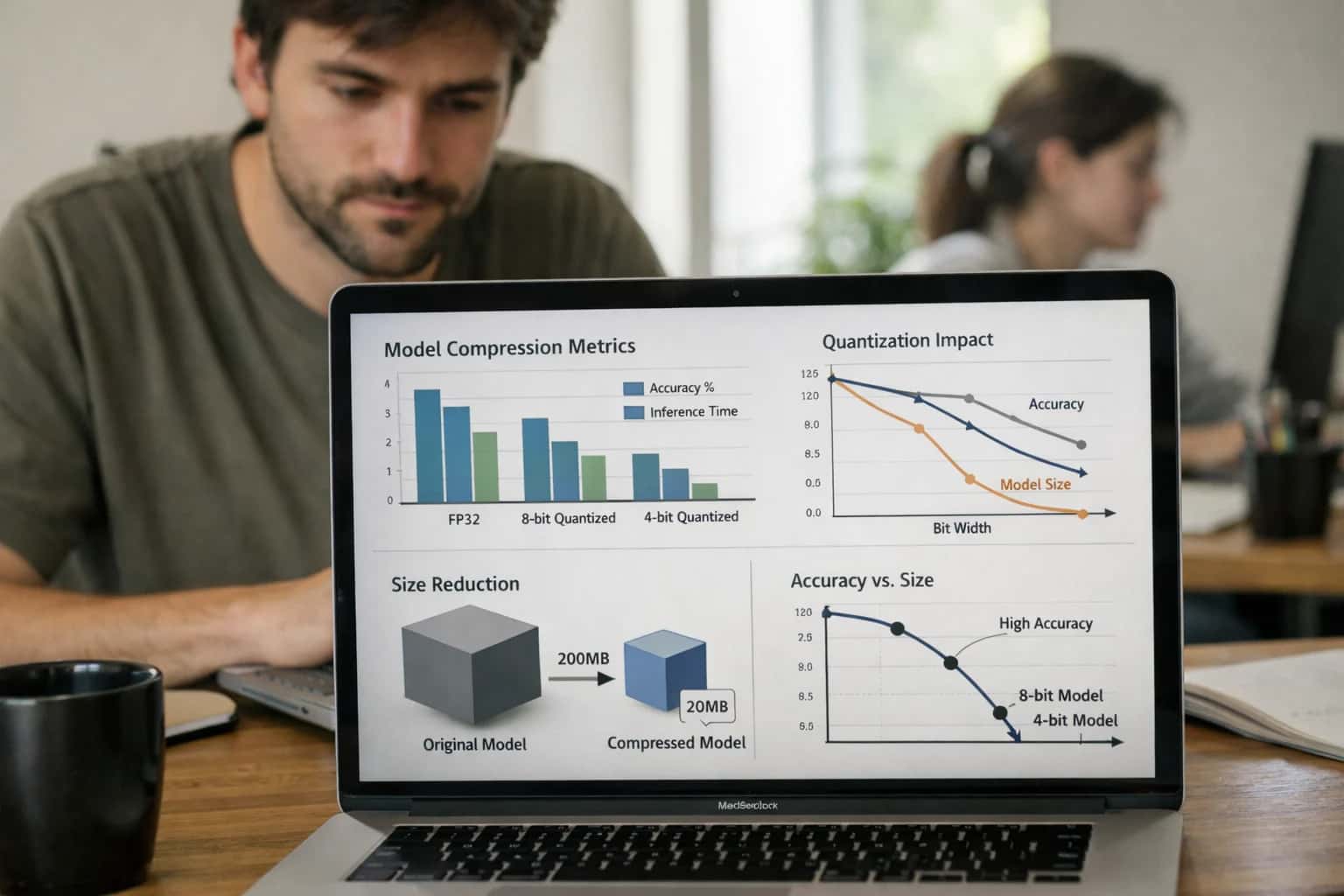
MODEL COMPRESSION
What is Knowledge Distillation for Edge?
A compression process where a compact, edge-deployable student model is trained to replicate the behavior of a larger, more accurate teacher model.
The training objective combines a standard hard-label loss with a distillation loss, often Kullback-Leibler divergence, between the teacher's and student's softened logits. This transfers the teacher's generalization capability and inter-class similarity structure. For edge inference, the resulting compact model achieves significant reductions in parameter count, FLOPs, and memory footprint while preserving predictive performance, making it suitable for real-time execution on NPUs and mobile SoCs.
Core Mechanisms
Key Features of Edge-Focused Distillation
Knowledge distillation for edge deployment is not a simple copy operation. It involves a sophisticated training regime where a compact student model learns to mimic the statistical behavior of a high-capacity teacher, optimized for the severe constraints of on-device hardware.
01
Teacher-Student Architecture Mismatch
The teacher is typically a vast, over-parameterized ensemble or a massive transformer, while the student is a lightweight architecture like MobileNetV3, EfficientNet, or a pruned DistilBERT. The distillation process bridges the capacity gap by transferring dark knowledge—the relative probabilities of incorrect classes in the teacher's softmax output—which encodes a rich similarity structure over the data that the student cannot learn from hard labels alone.
02
Temperature-Scaled Softmax
A critical hyperparameter, the temperature (T), is introduced into the softmax function of the teacher. A T > 1 softens the probability distribution, revealing the inter-class relationships learned by the teacher.
- High T: Produces a softer distribution, exposing more of the teacher's dark knowledge but also more noise.
- Low T: Approaches a hard label distribution, reducing the information transferred. The student is trained with the same high temperature, but evaluated with T=1.
03
Composite Surrogate Loss Function
The student model is optimized using a weighted combination of two distinct loss terms:
- Distillation Loss: The Kullback-Leibler (KL) divergence between the softened outputs of the teacher and student. This transfers the teacher's generalization capabilities.
- Student Loss: The standard cross-entropy loss between the student's hard predictions (T=1) and the ground-truth labels. This anchors the student to the task objective. The balance is controlled by a hyperparameter α (alpha).
04
Feature-Based Distillation
Beyond matching final output probabilities, the student can be trained to mimic the teacher's intermediate feature representations. A loss function minimizes the distance (e.g., L2 norm or Maximum Mean Discrepancy) between the student's and teacher's feature maps at specific bottleneck layers. This is particularly effective for edge models that must replicate the hierarchical feature extraction of a deeper network, often using a learned adaptation layer to project the student's narrower feature space to the teacher's dimensionality.
05
Data-Free Distillation
Edge deployment often occurs in environments where the original, privacy-sensitive training data is inaccessible. Data-free knowledge distillation synthesizes surrogate training samples by inverting the teacher model's learned parameters. The student is trained on these generated inputs, which are optimized to maximize the teacher's response, effectively extracting its knowledge without any real data. This is crucial for deploying models in regulated industries like healthcare and finance.
06
Quantization-Aware Distillation
To bridge the gap between a full-precision (FP32) teacher and an INT8-quantized student, quantization-aware distillation integrates simulated quantization operations directly into the student's training graph. The student learns to be robust to the quantization error it will encounter on a Neural Processing Unit (NPU) or DSP. This co-optimization yields significantly higher post-quantization accuracy than training a full-precision student and applying post-training quantization as a separate step.
KNOWLEDGE DISTILLATION FOR EDGE
Frequently Asked Questions
Clear, technical answers to the most common questions about compressing large AI models into efficient, deployable student networks for resource-constrained edge devices.
Knowledge distillation is a model compression technique where a compact student model is trained to mimic the behavior of a larger, more accurate teacher model. Instead of learning directly from hard labels in a dataset, the student learns from the teacher's softened output probabilities—known as soft targets. These soft targets contain rich, dark knowledge about inter-class similarities that the teacher has learned. The training process uses a surrogate loss function that combines the standard cross-entropy loss against ground-truth labels with a distillation loss, typically Kullback-Leibler divergence, that measures how closely the student's softened outputs match the teacher's. A temperature parameter T controls the softness of the probability distribution; higher temperatures produce softer targets that reveal more nuanced information about the teacher's internal representations. This process allows the student to achieve significantly higher accuracy than training on hard labels alone, often approaching the teacher's performance while being orders of magnitude smaller and faster for edge deployment.
Enabling Efficiency, Speed & Accuracy
Intelligent Analysis, Decision & Execution
We build AI systems for teams that need search across company data, workflow automation across tools, or AI features inside products and internal software.
Talk to Us
Search across company data
Give teams answers from docs, tickets, runbooks, and product data with sources and permissions.
Useful when people spend too long searching or get different answers from different systems.
Enterprise searchRAGPermissions
Read more
Automate internal workflows
Use AI to route work, draft outputs, trigger actions, and keep approvals and logs in place.
Useful when repetitive work moves across multiple tools and teams.
AI agentsWorkflow automationGovernance
Read more
Add AI to products and internal tools
Build assistants, guided actions, or decision support into the software your team or customers already use.
Useful when AI needs to be part of the product, not a separate tool.
AI integrationDecision supportModel routing
Read more
About the author
Prasad Kumkar
CEO & MD, Inference Systems
Prasad Kumkar is the CEO & MD of Inference Systems and writes about AI systems architecture, LLM infrastructure, model serving, evaluation, and production deployment. Over 5+ years, he has worked across computer vision models, L5 autonomous vehicle systems, and LLM research, with a focus on taking complex AI ideas into real-world engineering systems.
His work and writing cover AI systems, large language models, AI agents, multimodal systems, autonomous systems, inference optimization, RAG, evaluation, and production AI engineering.
LinkedIn
Limited slotsGet a Free AI Consultation
Partnered with leading AI, data, and software stack.





How We Work
Custom AI workflows for your Business
One-fit-all AI don't work for modern businesses. At Inferensys, we aim to understand your business & custom requirements; which we use to define most efficient agentic workflows, the data, and the tools for your business.
01
Review the use case
We understand the task, the users, and where AI can actually help.
Read more02
Pick the right approach
We define what needs search, automation, or product integration.
Read more03
Build the first useful version
We implement the part that proves the value first.
Read more04
Improve from there
We add the checks and visibility needed to keep it useful.
Read moreThe first call is a practical review of your use case and the right next step.
Talk to Us