DNN splitting is a specific split computing strategy that partitions a deep neural network's computational graph at a designated bottleneck layer. The initial layers, or head, execute directly on the resource-constrained device, generating a compressed intermediate feature representation. This compact tensor is transmitted wirelessly to a MEC server, where the remaining tail layers complete the inference, balancing on-device privacy with edge server computational power.

Glossary
DNN Splitting
A model partitioning technique that slices a deep neural network at a designated bottleneck layer, executing the head on-device and the tail on an edge server.
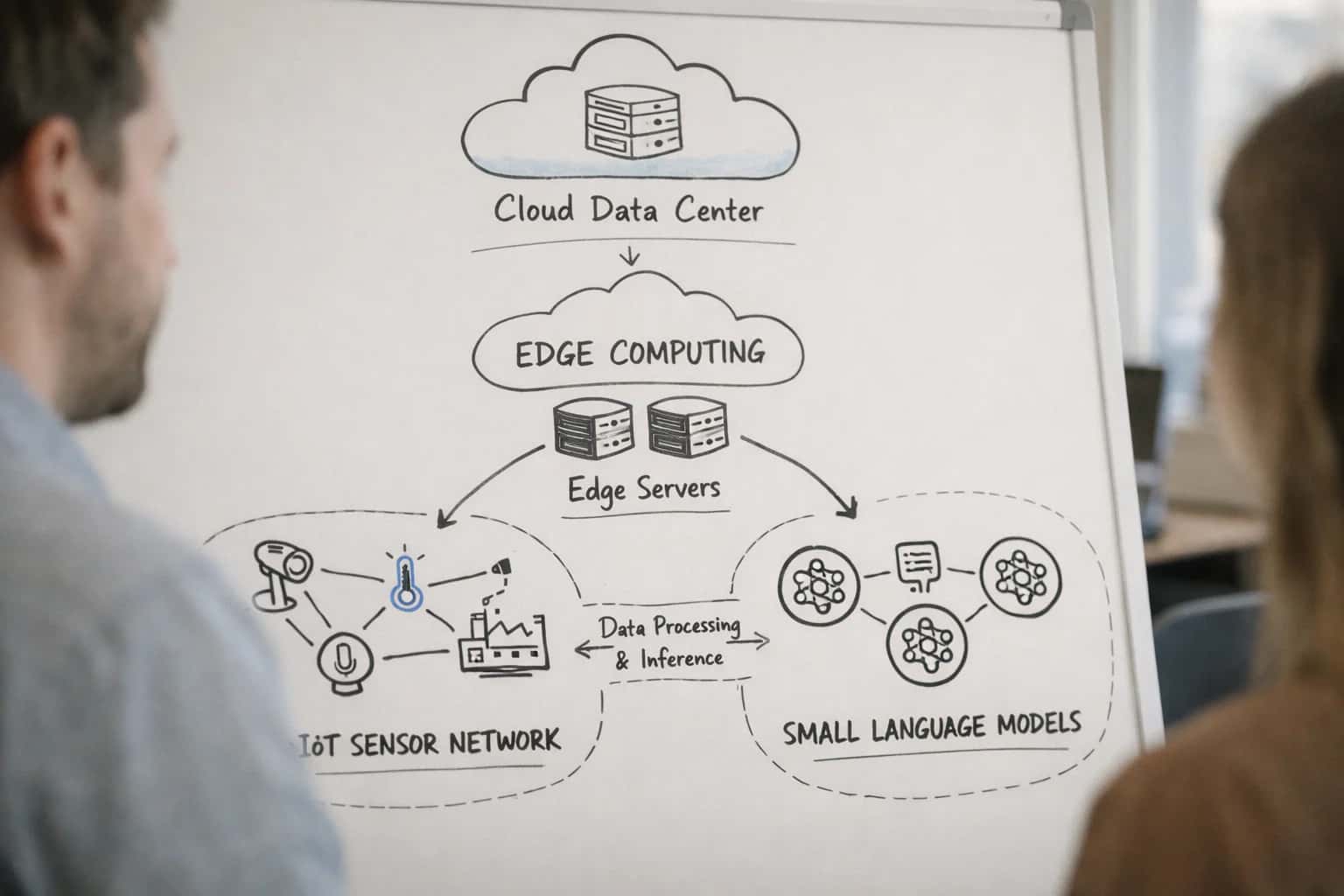
EDGE INFERENCE OFFLOADING
What is DNN Splitting?
DNN splitting is a model partitioning technique that slices a deep neural network at a designated bottleneck layer, executing the head segment on-device and the tail on an edge server to meet strict latency budgets.
The optimal partition point is selected to minimize tail latency by balancing local compute cost against transmission overhead. Unlike generic model partitioning, DNN splitting specifically targets a layer with maximal feature compression to reduce bandwidth. This technique is fundamental to the device-edge-cloud continuum, enabling QoS-aware partitioning that dynamically adapts to fluctuating channel state information and device load.
ARCHITECTURAL PRINCIPLES
Key Characteristics of DNN Splitting
DNN splitting is a specialized model partitioning technique that slices a deep neural network at a designated bottleneck layer, executing the head on-device and the tail on an edge server to balance latency, privacy, and compute load.
01
Head-Tail Execution Paradigm
The fundamental architecture of DNN splitting divides the model into two distinct segments. The head executes on the local device, processing raw sensor data through initial feature extraction layers. The tail executes on a powerful edge server, completing the computationally intensive deeper layers. This division ensures that raw, potentially sensitive data never leaves the device; only an abstract, compressed feature representation is transmitted over the network.
02
Bottleneck Layer Selection
The partition point is not arbitrary. It is chosen at a bottleneck layer—an intermediate layer with a highly compressed feature map. Key selection criteria include:
- Minimizing transmission size: The output tensor at this layer must be significantly smaller than the raw input.
- Preserving information entropy: The compressed features must retain sufficient discriminative information for the server-side tail to achieve high accuracy.
- Balancing compute: The computational load is distributed such that the device handles only what its silicon allows within the power budget.
03
Privacy-Preserving Architecture
A primary driver for DNN splitting is data privacy. By executing the initial layers on-device, the system ensures that raw user data—such as images, audio streams, or location data—is never transmitted to an external server. The server only receives an obfuscated, high-dimensional feature vector. This makes reverse-engineering the original input computationally infeasible, providing a robust technical safeguard for compliance with regulations like GDPR and HIPAA.
04
Dynamic vs. Static Partitioning
DNN splitting strategies are categorized by their adaptability:
- Static Partitioning: The split point is fixed at design time based on a known device profile. This is simple but brittle under variable network conditions.
- Dynamic Partitioning: A scheduler monitors real-time metrics—such as channel state information, device CPU load, and battery level—and shifts the partition point adaptively. This ensures the system meets a strict latency budget even as conditions fluctuate.
05
Intermediate Feature Compression
To further reduce the latency overhead of transmitting the bottleneck activations, lossy and lossless compression techniques are applied directly to the feature tensor. Common methods include:
- Quantization: Reducing the precision of activations from FP32 to INT8 or lower.
- Entropy coding: Applying Huffman or arithmetic coding to the serialized tensor.
- Dimensionality reduction: Using PCA or an autoencoder sub-layer to project features into an even lower-dimensional space before transmission.
06
Relation to Split Computing
DNN splitting is a specific implementation of the broader split computing paradigm. While split computing refers to any arbitrary distribution of a model graph, DNN splitting specifically targets a single, clean cut at a bottleneck. This contrasts with early exit architectures, where the device runs the full model but can short-circuit execution, and federated learning, where training—not inference—is distributed. DNN splitting is purely an inference-time optimization for latency and privacy.
DNN SPLITTING EXPLAINED
Frequently Asked Questions
Clear, technically precise answers to the most common questions about partitioning deep neural networks for distributed inference across devices and edge servers.
DNN splitting is a model partitioning technique that slices a deep neural network at a designated bottleneck layer, executing the initial layers (the head) on a resource-constrained device and the remaining layers (the tail) on a more powerful edge server. The process works by forwarding an input through the head model locally until reaching the partition point, where the intermediate feature representation—often a compressed activation tensor—is transmitted to the edge server. The server then completes the inference through the tail layers and returns the final prediction. This approach reduces on-device computational load and energy consumption while leveraging the server's superior processing capability, making it particularly effective for latency-sensitive applications like augmented reality and real-time video analytics where the device cannot run the full model within the required latency budget.
Enabling Efficiency, Speed & Accuracy
Intelligent Analysis, Decision & Execution
We build AI systems for teams that need search across company data, workflow automation across tools, or AI features inside products and internal software.
Talk to Us
Search across company data
Give teams answers from docs, tickets, runbooks, and product data with sources and permissions.
Useful when people spend too long searching or get different answers from different systems.
Enterprise searchRAGPermissions
Read more
Automate internal workflows
Use AI to route work, draft outputs, trigger actions, and keep approvals and logs in place.
Useful when repetitive work moves across multiple tools and teams.
AI agentsWorkflow automationGovernance
Read more
Add AI to products and internal tools
Build assistants, guided actions, or decision support into the software your team or customers already use.
Useful when AI needs to be part of the product, not a separate tool.
AI integrationDecision supportModel routing
Read more
About the author
Prasad Kumkar
CEO & MD, Inference Systems
Prasad Kumkar is the CEO & MD of Inference Systems and writes about AI systems architecture, LLM infrastructure, model serving, evaluation, and production deployment. Over 5+ years, he has worked across computer vision models, L5 autonomous vehicle systems, and LLM research, with a focus on taking complex AI ideas into real-world engineering systems.
His work and writing cover AI systems, large language models, AI agents, multimodal systems, autonomous systems, inference optimization, RAG, evaluation, and production AI engineering.
LinkedIn
Limited slotsGet a Free AI Consultation
Partnered with leading AI, data, and software stack.





How We Work
Custom AI workflows for your Business
One-fit-all AI don't work for modern businesses. At Inferensys, we aim to understand your business & custom requirements; which we use to define most efficient agentic workflows, the data, and the tools for your business.
01
Review the use case
We understand the task, the users, and where AI can actually help.
Read more02
Pick the right approach
We define what needs search, automation, or product integration.
Read more03
Build the first useful version
We implement the part that proves the value first.
Read more04
Improve from there
We add the checks and visibility needed to keep it useful.
Read moreThe first call is a practical review of your use case and the right next step.
Talk to Us