Collaborative inference is a distributed computing framework where multiple heterogeneous nodes—such as resource-constrained devices and proximate edge servers—jointly execute a single deep neural network to satisfy a strict latency budget. Unlike simple offloading, it involves the coordinated, parallel, or pipelined processing of a model's computational graph across distinct physical hardware, optimizing for end-to-end responsiveness and energy efficiency.

Glossary
Collaborative Inference
A distributed computing framework where multiple heterogeneous nodes, such as devices and edge servers, jointly execute a machine learning model to meet a strict latency budget.
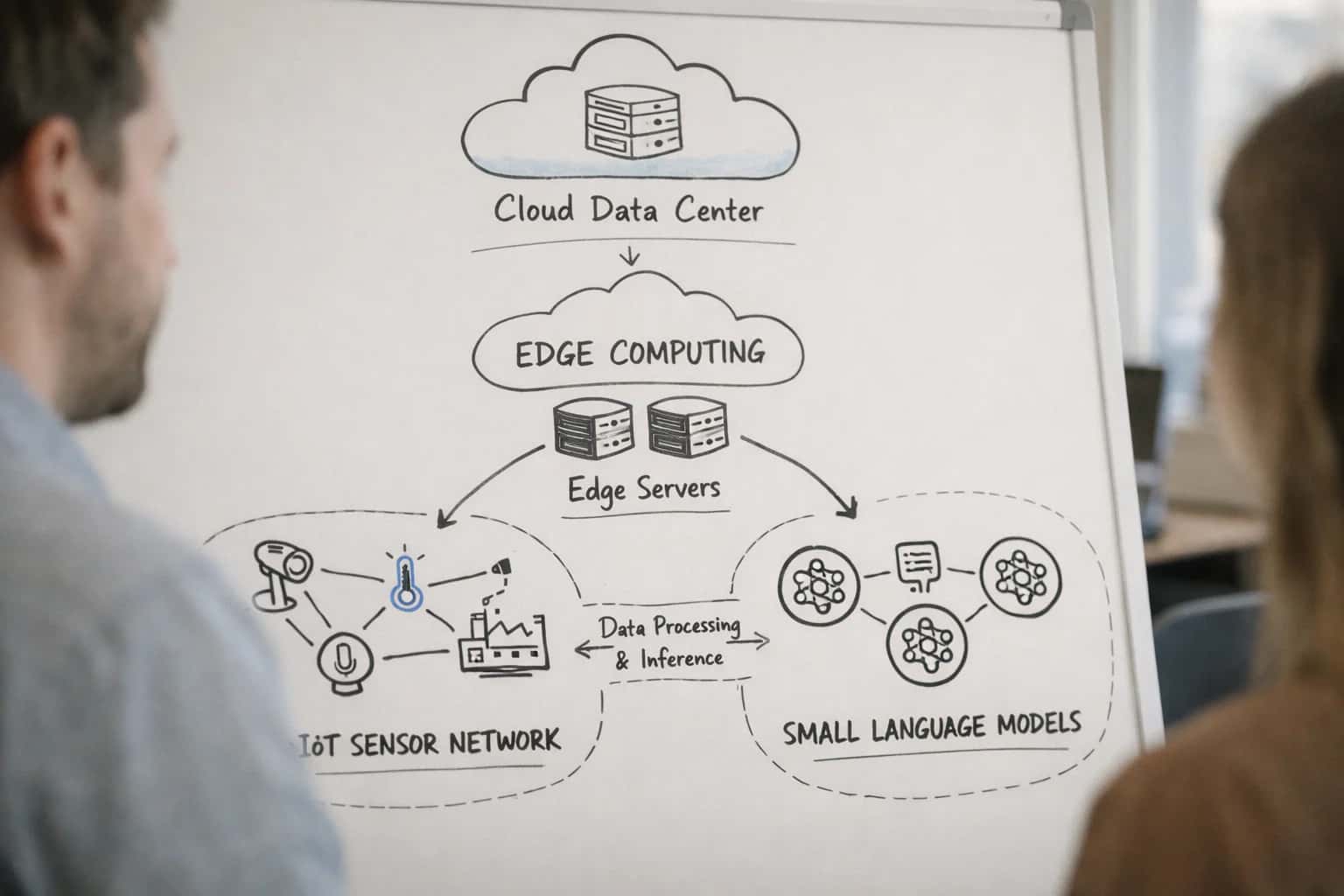
DISTRIBUTED AI EXECUTION
What is Collaborative Inference?
A distributed computing paradigm where multiple heterogeneous nodes jointly execute a single machine learning model to meet a strict latency budget.
This paradigm directly addresses the tension between model accuracy and device capability by enabling the deployment of large, complex models that cannot fit or execute quickly on a local processor. By partitioning a model using techniques like DNN splitting, the computationally intensive tail is executed on a powerful MEC server, while the privacy-sensitive head remains on-device, balancing performance, bandwidth, and data locality.
DISTRIBUTED ARCHITECTURE
Key Characteristics of Collaborative Inference
The defining technical attributes that enable multiple heterogeneous nodes to jointly execute a machine learning model while meeting strict latency budgets.
01
Heterogeneous Node Orchestration
Collaborative inference coordinates execution across diverse hardware profiles—from low-power IoT microcontrollers to high-throughput edge GPUs. The system must account for asymmetric compute capabilities, where a smartphone NPU handles the model head while an MEC server processes deeper layers. This heterogeneity requires a unified execution graph that abstracts hardware differences into a coherent scheduling framework, ensuring each node contributes optimally based on its current resource availability and thermal constraints.
02
Latency-Aware Model Partitioning
The core mechanism divides a neural network's computational graph at strategic bottleneck layers to balance on-device processing against transmission overhead. Key considerations include:
- Bandwidth consumption of intermediate feature maps
- Compute latency per layer on target hardware
- End-to-end latency budget for the application Optimal partition points shift dynamically based on channel conditions, making this a continuous optimization problem rather than a static configuration.
03
Bandwidth-Efficient Feature Exchange
Rather than transmitting raw input data, collaborative inference exchanges compressed intermediate representations at the partition boundary. Techniques include:
- Quantization to reduce activation precision to INT8 or lower
- Entropy coding to exploit statistical redundancy in feature tensors
- Dimensionality reduction via bottleneck architectures This compression is critical for operating over constrained wireless links where transmitting a 224×224 image may be more expensive than sending a 7×7×512 feature map.
04
Dynamic Offloading Decision Logic
A real-time scheduler evaluates multiple state variables to determine execution placement for each inference request:
- Device battery level and thermal headroom
- Network RTT and predicted link stability
- Server queue depth and current utilization
- Model accuracy requirements for the specific input This decision engine may employ lightweight heuristics or a trained reinforcement learning policy that continuously adapts to changing environmental conditions.
05
Privacy-Preserving Data Locality
By processing sensitive data on-device and transmitting only abstracted feature representations rather than raw inputs, collaborative inference provides inherent privacy benefits. The edge server never accesses the original image, audio, or text—only the smashed data emerging from the partition layer. This architecture aligns with regulatory requirements under frameworks like GDPR, as personally identifiable information remains confined to the user's device while still benefiting from cloud-scale compute.
06
Fault Tolerance and Graceful Degradation
Production collaborative inference systems must handle partial node failures without catastrophic service interruption. Strategies include:
- Local fallback execution when the edge server is unreachable
- Redundant server pools with session migration
- Anytime prediction capabilities that return valid results even if execution is interrupted This resilience ensures that a temporary network partition or server overload does not result in a complete inference failure, maintaining user experience under adverse conditions.
COLLABORATIVE INFERENCE
Frequently Asked Questions
Clear, technically precise answers to the most common questions about distributed model execution across heterogeneous nodes for latency-critical applications.
Collaborative inference is a distributed computing paradigm where multiple heterogeneous nodes—such as resource-constrained edge devices, on-premise servers, and cloud instances—jointly execute a single machine learning model to satisfy a strict latency budget. Unlike simple model serving, it involves model partitioning, where a deep neural network's computational graph is strategically divided into distinct segments. The initial layers, often responsible for feature extraction, execute locally on the device, while the computationally intensive remaining layers are offloaded to a more powerful edge server or cloud node. This architecture minimizes end-to-end latency by reducing the volume of raw data transmitted over the network, sending only compressed intermediate activations rather than full-resolution inputs. The process is orchestrated by a decision engine that dynamically selects the optimal partition point based on real-time network conditions, available compute resources, and the specific accuracy requirements of the inference task.
Enabling Efficiency, Speed & Accuracy
Intelligent Analysis, Decision & Execution
We build AI systems for teams that need search across company data, workflow automation across tools, or AI features inside products and internal software.
Talk to Us
Search across company data
Give teams answers from docs, tickets, runbooks, and product data with sources and permissions.
Useful when people spend too long searching or get different answers from different systems.
Enterprise searchRAGPermissions
Read more
Automate internal workflows
Use AI to route work, draft outputs, trigger actions, and keep approvals and logs in place.
Useful when repetitive work moves across multiple tools and teams.
AI agentsWorkflow automationGovernance
Read more
Add AI to products and internal tools
Build assistants, guided actions, or decision support into the software your team or customers already use.
Useful when AI needs to be part of the product, not a separate tool.
AI integrationDecision supportModel routing
Read more
About the author
Prasad Kumkar
CEO & MD, Inference Systems
Prasad Kumkar is the CEO & MD of Inference Systems and writes about AI systems architecture, LLM infrastructure, model serving, evaluation, and production deployment. Over 5+ years, he has worked across computer vision models, L5 autonomous vehicle systems, and LLM research, with a focus on taking complex AI ideas into real-world engineering systems.
His work and writing cover AI systems, large language models, AI agents, multimodal systems, autonomous systems, inference optimization, RAG, evaluation, and production AI engineering.
LinkedIn
Limited slotsGet a Free AI Consultation
Partnered with leading AI, data, and software stack.





How We Work
Custom AI workflows for your Business
One-fit-all AI don't work for modern businesses. At Inferensys, we aim to understand your business & custom requirements; which we use to define most efficient agentic workflows, the data, and the tools for your business.
01
Review the use case
We understand the task, the users, and where AI can actually help.
Read more02
Pick the right approach
We define what needs search, automation, or product integration.
Read more03
Build the first useful version
We implement the part that proves the value first.
Read more04
Improve from there
We add the checks and visibility needed to keep it useful.
Read moreThe first call is a practical review of your use case and the right next step.
Talk to Us