Knowledge Distillation CSI is a model compression strategy where a compact student network is trained to mimic the prediction outputs of a larger, computationally expensive teacher network for channel state information tasks. The student learns not just from ground-truth labels but from the teacher's softened probability distribution over predictions, capturing inter-class relationships and the teacher's learned uncertainty about the wireless propagation environment.

Glossary
Knowledge Distillation CSI
A model compression strategy where a compact student network is trained to mimic the prediction outputs of a larger, computationally expensive teacher network for Channel State Information tasks.
MODEL COMPRESSION FOR CHANNEL PREDICTION
What is Knowledge Distillation CSI?
A technique for transferring the predictive accuracy of a large, computationally expensive neural network to a smaller, deployable model for real-time channel state information tasks.
In massive MIMO systems, the teacher model is typically a high-capacity architecture like a Transformer CSI or deep convolutional network trained offline on extensive channel datasets. During distillation, the student minimizes a combined loss function that balances fidelity to the true channel measurements with fidelity to the teacher's output logits, controlled by a temperature parameter that softens the teacher's probability distribution to expose richer supervisory signals.
EFFICIENCY & FIDELITY
Core Characteristics of Distilled CSI Models
Distilled Channel State Information models transfer the predictive accuracy of complex teacher networks into lightweight student architectures, enabling real-time beamforming on resource-constrained radio units.
01
Teacher-Student Architecture
The fundamental two-network paradigm where a high-capacity teacher model (e.g., a deep Transformer CSI) generates soft targets for a compact student model (e.g., a lightweight convolutional network). The student is trained to minimize the divergence between its own predictions and the teacher's output distribution, capturing inter-class correlations that one-hot labels miss. This transfers the teacher's generalization capability without transferring its computational cost.
10-50x
Parameter Reduction
< 1 ms
Inference Latency
03
Feature-Based Distillation
Beyond matching final outputs, the student learns to replicate the teacher's intermediate feature representations. A regression loss aligns the student's hidden activations with the teacher's embedding space:
- Attention transfer: Matching spatial attention maps from self-attention layers
- Hint-based learning: Using a regressor to map student features to teacher dimensions This enforces structural similarity in how both networks internally represent the MIMO channel geometry.
04
Online vs. Offline Distillation
Two operational modes for CSI model compression:
- Offline distillation: A pre-trained, frozen teacher guides student training. Simple but teacher errors propagate.
- Online distillation: Teacher and student train simultaneously with mutual knowledge exchange. The student benefits from the teacher's evolving representations while providing regularization feedback. Online methods often yield superior NMSE performance in non-stationary channel environments.
05
Quantization-Aware Distillation
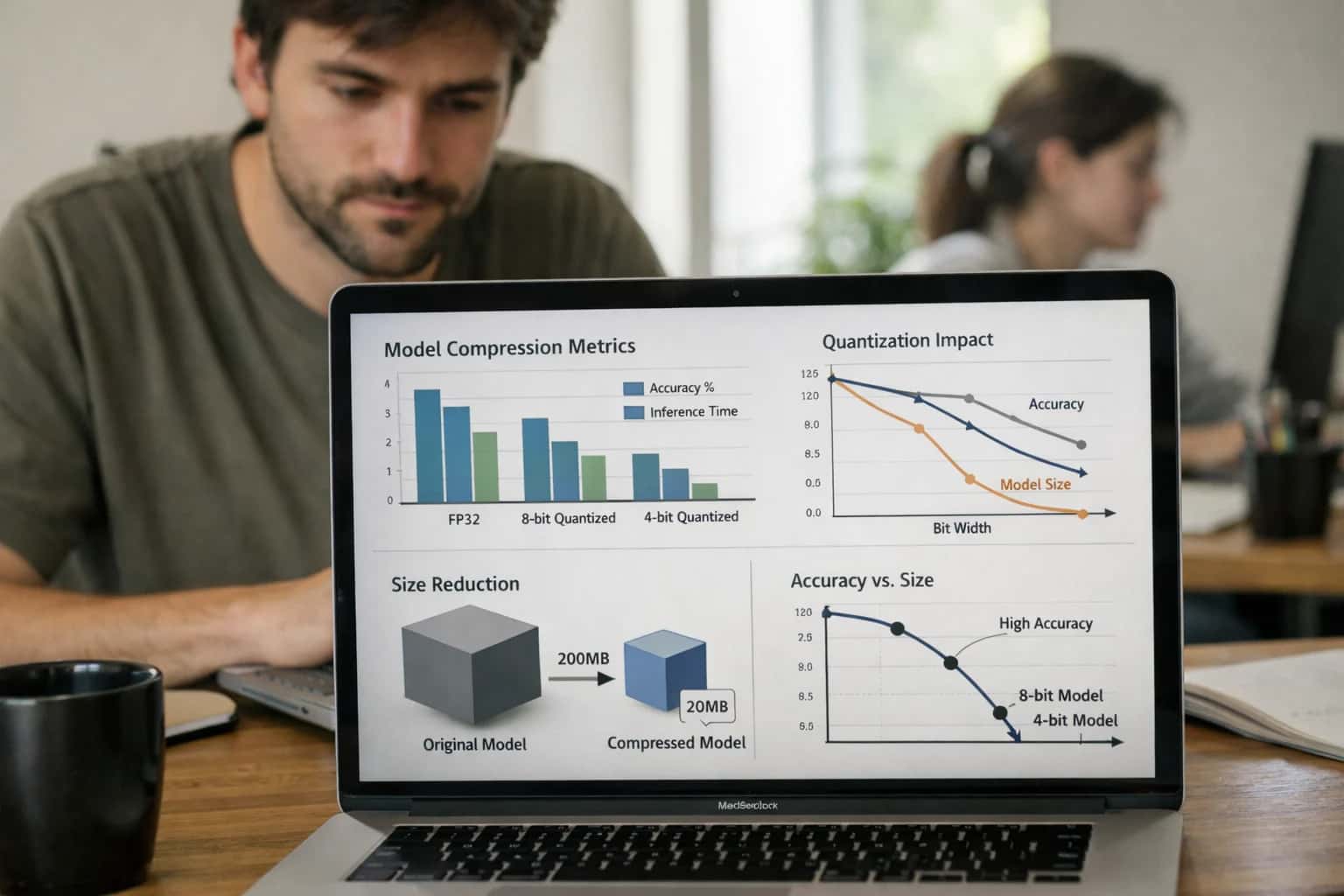
A joint optimization framework that combines knowledge distillation with post-training quantization. The student is trained to be robust to 8-bit or 4-bit weight precision while still matching the full-precision teacher's CSI reconstruction quality. This produces models deployable directly on neural processing units (NPUs) within distributed units (DUs) without floating-point hardware. Typical NMSE degradation is held below 0.5 dB compared to the full-precision teacher.
06
Multi-Task Distillation for CSI
A single student model is trained to replicate a multi-task teacher that simultaneously predicts:
- Channel Impulse Response (CIR) for equalization
- Precoding Matrix Indicator (PMI) for beam selection
- Channel Quality Indicator (CQI) for link adaptation The student learns shared representations across these correlated tasks, achieving higher per-task accuracy than independently trained compact models through cross-task knowledge transfer.
COMPRESSION METHOD COMPARISON
Distillation vs. Other Compression Techniques for CSI
A feature-level comparison of knowledge distillation against quantization, pruning, and low-rank decomposition for compressing CSI prediction and reconstruction models.
| Feature | Knowledge Distillation | Post-Training Quantization | Structured Pruning | Low-Rank Decomposition |
|---|---|---|---|---|
Core Mechanism | Student network mimics teacher's soft output distribution | Reduces numerical precision of weights and activations | Removes entire neurons, filters, or channels | Factorizes weight matrices into smaller components |
Requires Original Training Data | ||||
Preserves Original Architecture | ||||
NMSE Impact on CSI Reconstruction | < 0.5% degradation | 0.3%–1.2% degradation | 1%–5% degradation | 0.5%–2% degradation |
Hardware-Agnostic Compression | ||||
Inference Latency Reduction | 2×–10× | 2×–4× | 3×–8× | 1.5×–3× |
Model Size Reduction | 5×–20× | 2×–4× | 3×–10× | 2×–5× |
Training Overhead | High (requires teacher pre-training and student training) | None (post-hoc conversion) | Medium (requires fine-tuning after pruning) | Medium (requires fine-tuning after decomposition) |
Enabling Efficiency, Speed & Accuracy
Intelligent Analysis, Decision & Execution
We build AI systems for teams that need search across company data, workflow automation across tools, or AI features inside products and internal software.
Talk to Us
Search across company data
Give teams answers from docs, tickets, runbooks, and product data with sources and permissions.
Useful when people spend too long searching or get different answers from different systems.
Enterprise searchRAGPermissions
Read more
Automate internal workflows
Use AI to route work, draft outputs, trigger actions, and keep approvals and logs in place.
Useful when repetitive work moves across multiple tools and teams.
AI agentsWorkflow automationGovernance
Read more
Add AI to products and internal tools
Build assistants, guided actions, or decision support into the software your team or customers already use.
Useful when AI needs to be part of the product, not a separate tool.
AI integrationDecision supportModel routing
Read moreKNOWLEDGE DISTILLATION FOR CSI
Frequently Asked Questions
Addressing the most common technical inquiries regarding the compression of channel state information prediction models using teacher-student architectures.
Knowledge Distillation for Channel State Information (CSI) is a model compression strategy where a compact, low-complexity student neural network is trained to replicate the predictive outputs of a larger, computationally expensive teacher network for wireless channel forecasting tasks. The core mechanism involves transferring the 'dark knowledge'—the soft probability distribution over predicted channel coefficients—from the teacher to the student. Instead of training solely on ground-truth labels, the student minimizes the Kullback-Leibler (KL) divergence between its softened logits and the teacher's softened logits, effectively learning the nuanced inter-class relationships and uncertainty estimates that the cumbersome model has internalized. This allows the student to achieve predictive accuracy for metrics like Normalized Mean Square Error (NMSE) that approaches the teacher's performance while requiring a fraction of the floating-point operations (FLOPs) and memory, making it suitable for real-time deployment on baseband units or edge inference offloading scenarios.

About the author
Prasad Kumkar
CEO & MD, Inference Systems
Prasad Kumkar is the CEO & MD of Inference Systems and writes about AI systems architecture, LLM infrastructure, model serving, evaluation, and production deployment. Over 5+ years, he has worked across computer vision models, L5 autonomous vehicle systems, and LLM research, with a focus on taking complex AI ideas into real-world engineering systems.
His work and writing cover AI systems, large language models, AI agents, multimodal systems, autonomous systems, inference optimization, RAG, evaluation, and production AI engineering.
LinkedIn
Limited slotsGet a Free AI Consultation
Partnered with leading AI, data, and software stack.





How We Work
Custom AI workflows for your Business
One-fit-all AI don't work for modern businesses. At Inferensys, we aim to understand your business & custom requirements; which we use to define most efficient agentic workflows, the data, and the tools for your business.
01
Review the use case
We understand the task, the users, and where AI can actually help.
Read more02
Pick the right approach
We define what needs search, automation, or product integration.
Read more03
Build the first useful version
We implement the part that proves the value first.
Read more04
Improve from there
We add the checks and visibility needed to keep it useful.
Read moreThe first call is a practical review of your use case and the right next step.
Talk to Us