Parent-Child Chunking is a retrieval strategy where a small, targeted 'child' chunk is used for precise semantic matching against a query, but the larger surrounding 'parent' document block is returned to the language model for full context. This decoupling ensures that the embedding similarity search operates on granular, topically focused text while the generation step receives the complete surrounding narrative.

Glossary
Parent-Child Chunking
A retrieval strategy where a small, targeted 'child' chunk is used for precise semantic matching, but the larger surrounding 'parent' document block is returned to the language model for full context.
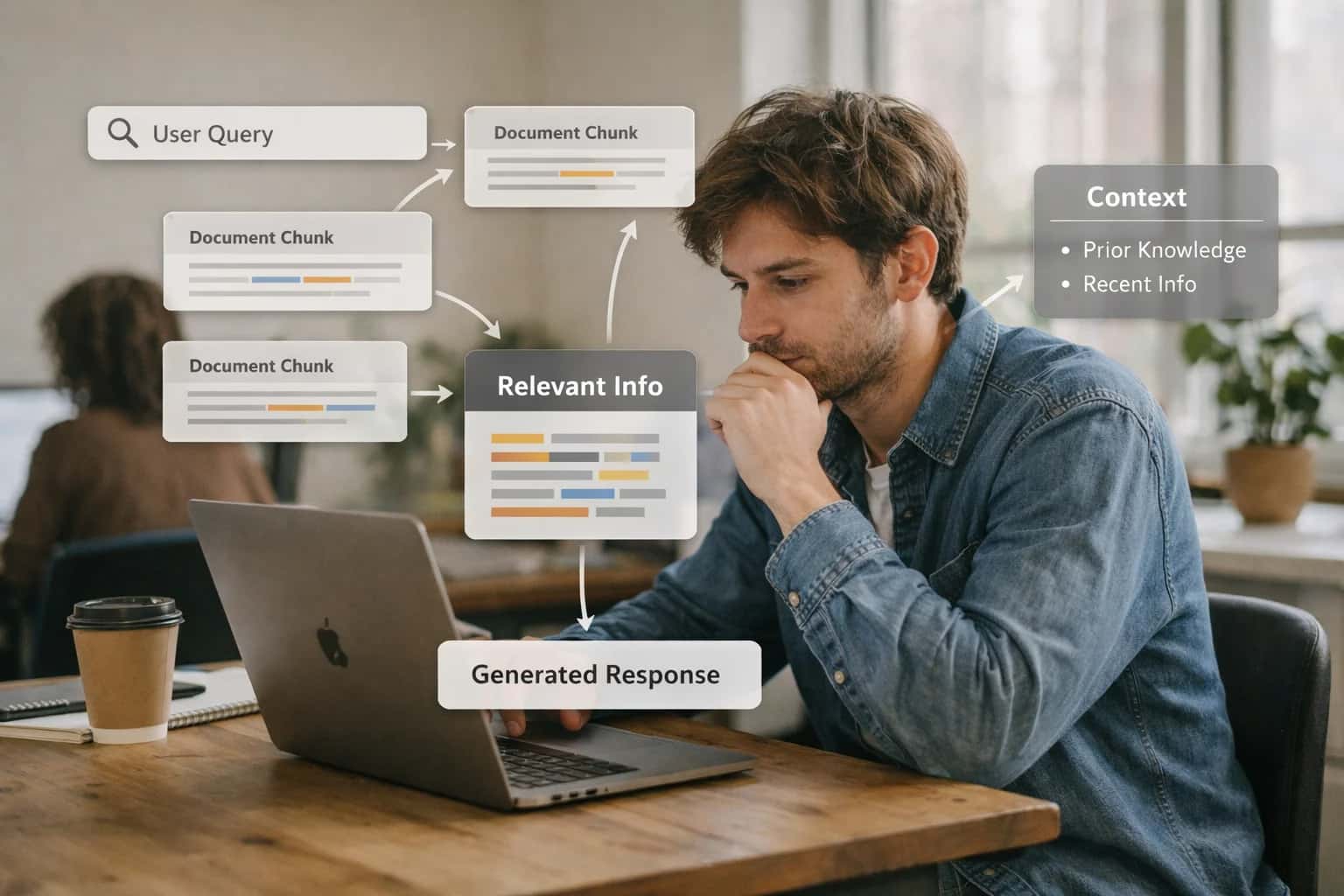
RETRIEVAL STRATEGY
What is Parent-Child Chunking?
A retrieval architecture that decouples the unit of semantic matching from the unit of contextual delivery to optimize both search precision and language model comprehension.
The technique mitigates the trade-off between retrieval accuracy and contextual richness inherent in fixed-size chunking. By indexing small child chunks for vector search but returning their broader parent context, the system prevents fragmented or incoherent responses. This approach is critical in RAG architectures where precise retrieval must coexist with the model's need for complete logical arguments.
ARCHITECTURAL PATTERNS
Key Characteristics of Parent-Child Retrieval
Parent-child chunking decouples the unit of semantic matching from the unit of context delivery. Small, precise child chunks are embedded for high-relevance vector search, while the larger parent document block is returned to the language model to preserve narrative coherence and factual grounding.
01
Decoupled Matching vs. Context
The core innovation of parent-child retrieval is the separation of two competing concerns:
- Child Chunk (Matching Unit): A small, topically focused text segment—often a single paragraph or sentence—embedded for precise semantic similarity search. Its compact size ensures the embedding vector captures a single coherent idea without noise.
- Parent Block (Context Unit): The larger surrounding document section, such as an entire section or fixed window of 1,000–2,000 tokens, returned to the LLM for generation. This preserves the argumentative flow, supporting evidence, and rhetorical structure that a small chunk would sever.
This architecture solves the context window dilemma: embedding models perform best on concise, single-topic inputs, but language models require expansive context to produce authoritative, well-supported answers.
02
Indexing Workflow: Two-Pass Structure
Parent-child chunking requires a two-pass indexing pipeline that differs fundamentally from flat chunking strategies:
- First Pass — Parent Identification: The document parser identifies structural boundaries such as sections, subsections, or semantic breaks. Each logical division becomes a parent block with a unique identifier.
- Second Pass — Child Extraction: Within each parent, a secondary splitter generates smaller child chunks. Each child inherits the parent's identifier as metadata.
- Embedding Generation: Only the child chunks are vectorized and inserted into the vector index. The parent blocks are stored in a separate document store or key-value cache.
- Metadata Linking: A mapping table associates each child's vector ID with its parent's storage location, enabling a single lookup at retrieval time.
This two-pass design ensures the vector index remains compact and fast while the full context remains accessible.
03
Retrieval-Time Resolution
At query time, the retrieval process follows a fetch-then-expand pattern:
- Step 1 — ANN Search: The user query is embedded and an approximate nearest neighbor search retrieves the top-k most similar child chunks from the vector index.
- Step 2 — Parent Lookup: For each retrieved child, the system queries the metadata mapping to fetch the associated parent block from the document store.
- Step 3 — Deduplication: Multiple children may map to the same parent. The system collapses duplicate parent references to avoid redundant context in the LLM prompt.
- Step 4 — Context Assembly: The unique parent blocks are concatenated—often with source attribution markers—and injected into the language model's context window alongside the user query.
This resolution strategy guarantees that the LLM receives complete, contiguous passages rather than fragmented sentence fragments that lack connective tissue.
04
Structural Parent Strategies
The definition of a 'parent' can vary based on document structure and use case. Common strategies include:
- Section-Based Parents: Use markdown headers or HTML
<section>tags as boundaries. Each parent is a complete subsection with its heading, preserving hierarchical context. - Fixed-Window Parents: Define parents as sliding windows of 1,000–2,000 tokens with configurable overlap. Simpler to implement but may sever mid-argument.
- Semantic Parents: Use embedding similarity between consecutive sentences to detect topic shifts, grouping related sentences into coherent parent blocks.
- Document-as-Parent: For short documents like FAQs or product descriptions, the entire document serves as a single parent, with individual sentences or bullet points as children.
Selection heuristic: Section-based parents work best for technical documentation; semantic parents excel for narrative prose; document-as-parent suits short-form structured content.
05
Trade-offs vs. Flat Chunking
Parent-child retrieval introduces complexity but addresses critical failure modes of flat chunking:
Advantages:
- Context Integrity: Eliminates the 'jigsaw puzzle' problem where the LLM receives disjointed sentence fragments that lack surrounding argumentation.
- Higher Recall: Smaller child chunks improve embedding precision, reducing the retrieval of tangentially relevant passages.
- Source Attribution: Parent-level citation is cleaner; the system cites a coherent section rather than an arbitrary 256-token slice.
Disadvantages:
- Storage Overhead: Requires maintaining both a vector index and a separate document store with mapping infrastructure.
- Latency: The parent lookup step adds a small database round-trip, though this is typically negligible with in-memory caches.
- Implementation Complexity: The two-pass indexing pipeline requires careful metadata management and deduplication logic.
When to use: Choose parent-child when answer quality depends on preserving rhetorical structure—legal analysis, medical literature review, or technical troubleshooting guides.
06
Sentence Window Retrieval Variant
A specialized implementation of parent-child chunking where:
- Child: Each sentence is embedded individually as a retrieval unit.
- Parent: A configurable window of sentences surrounding the matched child—typically 5–10 sentences before and after—is returned as context.
This variant is particularly effective for:
- Legal document retrieval where a single sentence's meaning depends on surrounding clauses and definitions.
- Academic paper search where a finding is meaningless without the methodology and discussion sections that frame it.
- Technical documentation where a configuration parameter's purpose is explained across multiple adjacent paragraphs.
Implementation note: Sentence window retrieval requires a sentence-aware splitter (e.g., spaCy or NLTK) rather than a naive token-count splitter to ensure clean sentence boundaries.
RETRIEVAL GRANULARITY COMPARISON
Parent-Child Chunking vs. Other Chunking Strategies
A technical comparison of retrieval-augmented generation chunking strategies, evaluating how each method balances semantic precision during vector search against the contextual completeness required for high-quality language model synthesis.
| Feature | Parent-Child Chunking | Fixed-Size Chunking | Semantic Chunking |
|---|---|---|---|
Core mechanism | Small child chunk for embedding matching; large parent block returned to LLM | Text split at exact token count regardless of semantic boundaries | Adaptive splitting at sentence boundaries using embedding similarity thresholds |
Contextual completeness | |||
Semantic precision in retrieval | |||
Preserves cross-paragraph relationships | |||
Susceptible to mid-sentence truncation | |||
Requires metadata mapping between chunk layers | |||
Typical retrieval latency impact | Minimal: child vectors are small; parent lookup is O(1) | Low: single vector fetch per candidate | Low to moderate: variable chunk sizes affect ANN performance |
Storage overhead | Moderate: child vectors plus parent document store | Low: uniform vectors only | Low: variable-length vectors only |
PARENT-CHILD CHUNKING
Frequently Asked Questions
Explore the mechanics and strategic advantages of parent-child chunking, a retrieval paradigm that decouples semantic matching granularity from the contextual scope provided to the language model.
Parent-child chunking is a retrieval strategy that decouples the text unit used for semantic matching from the text unit returned to the Large Language Model (LLM) for generation. The system indexes small, highly focused 'child' chunks—often a single sentence or paragraph—to achieve precise cosine similarity matching against a user query. However, upon retrieval, the system does not return the child chunk in isolation. Instead, it returns the larger 'parent' document block that contains the child, ensuring the LLM receives the full surrounding context, such as preceding paragraphs or the entire section, to prevent fragmented or hallucinated answers. This mechanism is typically implemented by storing the parent text in a separate docstore or as metadata on the child chunk's vector, allowing the retriever to fetch the child's vector and then swap it for the parent text before final prompt assembly.
Enabling Efficiency, Speed & Accuracy
Intelligent Analysis, Decision & Execution
We build AI systems for teams that need search across company data, workflow automation across tools, or AI features inside products and internal software.
Talk to Us
Search across company data
Give teams answers from docs, tickets, runbooks, and product data with sources and permissions.
Useful when people spend too long searching or get different answers from different systems.
Enterprise searchRAGPermissions
Read more
Automate internal workflows
Use AI to route work, draft outputs, trigger actions, and keep approvals and logs in place.
Useful when repetitive work moves across multiple tools and teams.
AI agentsWorkflow automationGovernance
Read more
Add AI to products and internal tools
Build assistants, guided actions, or decision support into the software your team or customers already use.
Useful when AI needs to be part of the product, not a separate tool.
AI integrationDecision supportModel routing
Read more
About the author
Prasad Kumkar
CEO & MD, Inference Systems
Prasad Kumkar is the CEO & MD of Inference Systems and writes about AI systems architecture, LLM infrastructure, model serving, evaluation, and production deployment. Over 5+ years, he has worked across computer vision models, L5 autonomous vehicle systems, and LLM research, with a focus on taking complex AI ideas into real-world engineering systems.
His work and writing cover AI systems, large language models, AI agents, multimodal systems, autonomous systems, inference optimization, RAG, evaluation, and production AI engineering.
LinkedIn
Limited slotsGet a Free AI Consultation
Partnered with leading AI, data, and software stack.





How We Work
Custom AI workflows for your Business
One-fit-all AI don't work for modern businesses. At Inferensys, we aim to understand your business & custom requirements; which we use to define most efficient agentic workflows, the data, and the tools for your business.
01
Review the use case
We understand the task, the users, and where AI can actually help.
Read more02
Pick the right approach
We define what needs search, automation, or product integration.
Read more03
Build the first useful version
We implement the part that proves the value first.
Read more04
Improve from there
We add the checks and visibility needed to keep it useful.
Read moreThe first call is a practical review of your use case and the right next step.
Talk to Us