A context window is the fixed-length sequence of tokens—typically ranging from 512 to 128,000 or more—that an embedding or language model can accept as input in a single forward pass. This architectural constraint directly determines the maximum size of text chunks during ingestion, as any document segment exceeding the window must be truncated or split, making it a critical parameter in semantic indexing pipeline design.

Glossary
Context Window
The maximum sequence length of tokens that an embedding or language model can process in a single forward pass, defining the upper boundary for chunk size.
FOUNDATIONAL ARCHITECTURE
What is a Context Window?
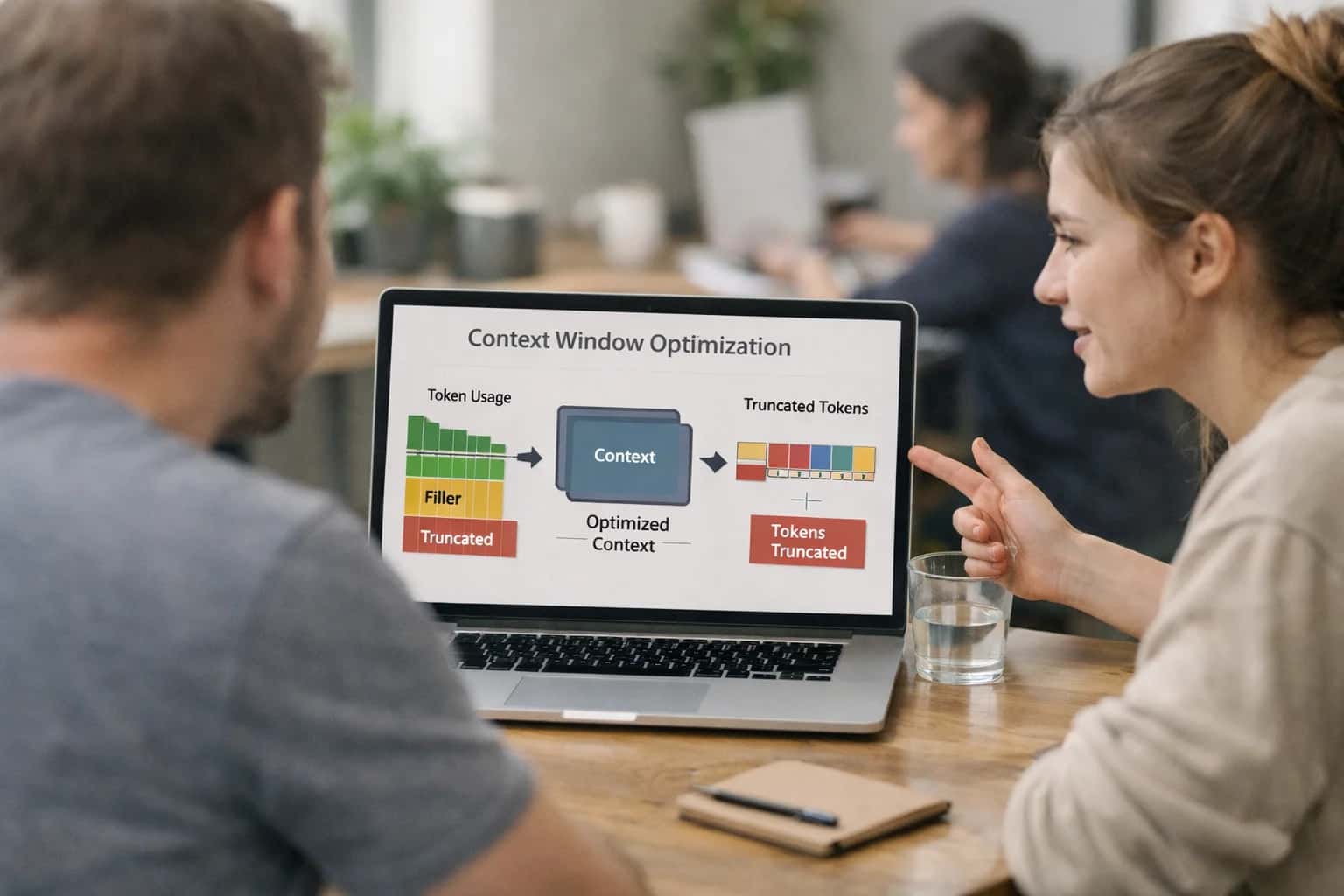
The context window defines the maximum number of tokens a model can process in a single forward pass, establishing the hard upper boundary for chunk size and retrieval granularity in semantic indexing pipelines.
The window size governs the trade-off between local precision and global context. A larger window, such as 32K tokens, allows a chunk to capture broad document-level semantics but may dilute the specificity of individual facts during dense retrieval. Conversely, a smaller 512-token window yields highly focused chunks ideal for precise cosine similarity matching but risks fragmenting coherent ideas across arbitrary boundaries.
ARCHITECTURAL CONSTRAINTS
Key Characteristics of Context Windows
The context window defines the maximum token capacity an embedding or language model can process in a single forward pass, establishing the fundamental boundary for chunk size, retrieval granularity, and conversational memory.
01
Token Capacity as a Hard Boundary
The context window represents an absolute computational limit—not a soft guideline. For embedding models, this dictates the maximum input length for generating a single vector representation. For language models, it governs how much text can be attended to simultaneously. Exceeding this limit triggers truncation errors or requires chunking strategies.
- Embedding models: Typically 512–8192 tokens (e.g.,
text-embedding-3-largesupports 8191) - Language models: Range from 4K tokens (older GPT models) to 1M+ tokens (Gemini 1.5 Pro)
- Token ≠ word: A token averages ~0.75 words in English, meaning a 512-token window holds roughly 380 words
512–1M+
Token Range Across Models
~0.75
Words per Token (English)
02
Chunk Size Derivation
The context window directly determines the maximum chunk size in semantic indexing pipelines. Chunks must fit entirely within the embedding model's window, but optimal chunk size is often smaller to preserve semantic coherence.
- Upper bound: Chunk size ≤ embedding model's context window
- Practical sizing: 256–512 tokens for dense retrieval; 1024–2048 for generative context
- Overlap margin: Typically 10–20% of chunk size to prevent context fragmentation at boundaries
- Trade-off: Larger chunks capture more context but dilute semantic specificity in vector search
256–512
Optimal Chunk Size (tokens)
10–20%
Recommended Overlap Margin
03
Attention Mechanism Scaling
The context window size is constrained by the quadratic complexity of self-attention. Standard transformer attention requires O(n²) computation and memory relative to sequence length n, making long contexts extremely resource-intensive.
- Quadratic bottleneck: Doubling context length quadruples attention computation
- Mitigation strategies: FlashAttention, ring attention, and sparse attention patterns reduce memory footprint
- Position encoding limits: Models like RoPE (Rotary Position Embedding) must be configured for the target context length during training
- KV-cache memory: Long contexts consume substantial GPU memory for storing key-value pairs during autoregressive generation
O(n²)
Attention Complexity
4×
Compute Increase When Doubling Context
04
Retrieval Granularity Implications
The context window shapes retrieval strategy design. When the generative model's window is large enough to hold dozens of retrieved chunks, retrieval can prioritize high recall. When windows are constrained, precision becomes paramount.
- Large windows (128K+): Enable dumping entire documents into context, reducing reliance on precise chunking
- Small windows (4K–8K): Require aggressive chunking and re-ranking to fit only the most relevant passages
- Parent-child retrieval: Small chunks for semantic matching, larger parent documents for context delivery
- Multi-hop reasoning: Requires sufficient window space to hold intermediate retrieval results alongside the original query
128K+
Large Context Threshold
4K–8K
Constrained Window Range
05
Conversational Memory Budgeting
In multi-turn agentic systems, the context window must be budgeted across conversation history, retrieved documents, system prompts, and the current query. Mismanagement leads to catastrophic forgetting of earlier instructions or relevant context.
- System prompt overhead: Can consume 500–2000+ tokens before any user input
- History accumulation: Each turn adds query-response pairs, rapidly consuming available space
- Sliding window strategies: Dropping oldest messages when the budget is exceeded
- Summarization compression: Periodically condensing conversation history into a summary to reclaim tokens
- Context window exhaustion: Results in models "forgetting" early instructions or retrieved facts
500–2000+
System Prompt Token Cost
100%
Window Utilization Target
06
Model-Specific Window Constraints
Different model families impose distinct context window limits that directly influence architecture decisions. Selecting a model requires matching its window capacity to the application's context demands.
- OpenAI: GPT-4o supports 128K tokens;
text-embedding-3-largesupports 8191 tokens - Anthropic: Claude 3.5 Sonnet offers 200K tokens
- Google: Gemini 1.5 Pro reaches up to 1M tokens with near-perfect retrieval accuracy
- Open source: Llama 3.1 supports 128K; Mistral Large supports 128K
- Embedding-specific:
intfloat/e5-mistral-7b-instructsupports 32K tokens for long-document embedding
1M
Maximum Context (Gemini 1.5 Pro)
128K
Common Frontier Model Limit
TOKEN CAPACITY BENCHMARK
Context Window Comparison Across Models
A comparison of maximum context window sizes and architectural approaches across leading language and embedding models, illustrating the direct impact on chunking strategy and retrieval design.
| Feature | GPT-4 Turbo | Claude 3 Opus | Gemini 1.5 Pro |
|---|---|---|---|
Maximum Context Window | 128,000 tokens | 200,000 tokens | 1,000,000 tokens |
Effective Page Capacity | ~96,000 words | ~150,000 words | ~750,000 words |
Attention Mechanism | Grouped Query Attention | Sliding Window Attention | Ring Attention |
Supports Multi-Turn History | |||
Needle-in-a-Haystack Accuracy | 99.7% | 99.9% | 99.8% |
Recommended Max Chunk Size | 512-1024 tokens | 1024-2048 tokens | 2048-4096 tokens |
API Cost per 1M Input Tokens | $10.00 | $15.00 | $3.50 |
Native Multimodal Input |
CONTEXT WINDOW
Frequently Asked Questions
Clear, technical answers to the most common questions about the context window—the fundamental constraint governing how much information a model can process in a single pass.
A context window is the maximum sequence length of tokens that an embedding or language model can process in a single forward pass. It defines the upper boundary for chunk size in retrieval pipelines and the total amount of in-context information available for generation. The window operates as a sliding or fixed attention boundary: tokens beyond this limit are either truncated or require specialized techniques like positional interpolation to extend reach. In transformer architectures, the computational complexity of self-attention scales quadratically with context length, making the window a critical hardware and latency constraint. For retrieval-augmented generation (RAG), the context window determines how many retrieved chunks, conversation turns, and system instructions can be packed into a single prompt before exceeding the model's capacity.
Enabling Efficiency, Speed & Accuracy
Intelligent Analysis, Decision & Execution
We build AI systems for teams that need search across company data, workflow automation across tools, or AI features inside products and internal software.
Talk to Us
Search across company data
Give teams answers from docs, tickets, runbooks, and product data with sources and permissions.
Useful when people spend too long searching or get different answers from different systems.
Enterprise searchRAGPermissions
Read more
Automate internal workflows
Use AI to route work, draft outputs, trigger actions, and keep approvals and logs in place.
Useful when repetitive work moves across multiple tools and teams.
AI agentsWorkflow automationGovernance
Read more
Add AI to products and internal tools
Build assistants, guided actions, or decision support into the software your team or customers already use.
Useful when AI needs to be part of the product, not a separate tool.
AI integrationDecision supportModel routing
Read more
About the author
Prasad Kumkar
CEO & MD, Inference Systems
Prasad Kumkar is the CEO & MD of Inference Systems and writes about AI systems architecture, LLM infrastructure, model serving, evaluation, and production deployment. Over 5+ years, he has worked across computer vision models, L5 autonomous vehicle systems, and LLM research, with a focus on taking complex AI ideas into real-world engineering systems.
His work and writing cover AI systems, large language models, AI agents, multimodal systems, autonomous systems, inference optimization, RAG, evaluation, and production AI engineering.
LinkedIn
Limited slotsGet a Free AI Consultation
Partnered with leading AI, data, and software stack.





How We Work
Custom AI workflows for your Business
One-fit-all AI don't work for modern businesses. At Inferensys, we aim to understand your business & custom requirements; which we use to define most efficient agentic workflows, the data, and the tools for your business.
01
Review the use case
We understand the task, the users, and where AI can actually help.
Read more02
Pick the right approach
We define what needs search, automation, or product integration.
Read more03
Build the first useful version
We implement the part that proves the value first.
Read more04
Improve from there
We add the checks and visibility needed to keep it useful.
Read moreThe first call is a practical review of your use case and the right next step.
Talk to Us