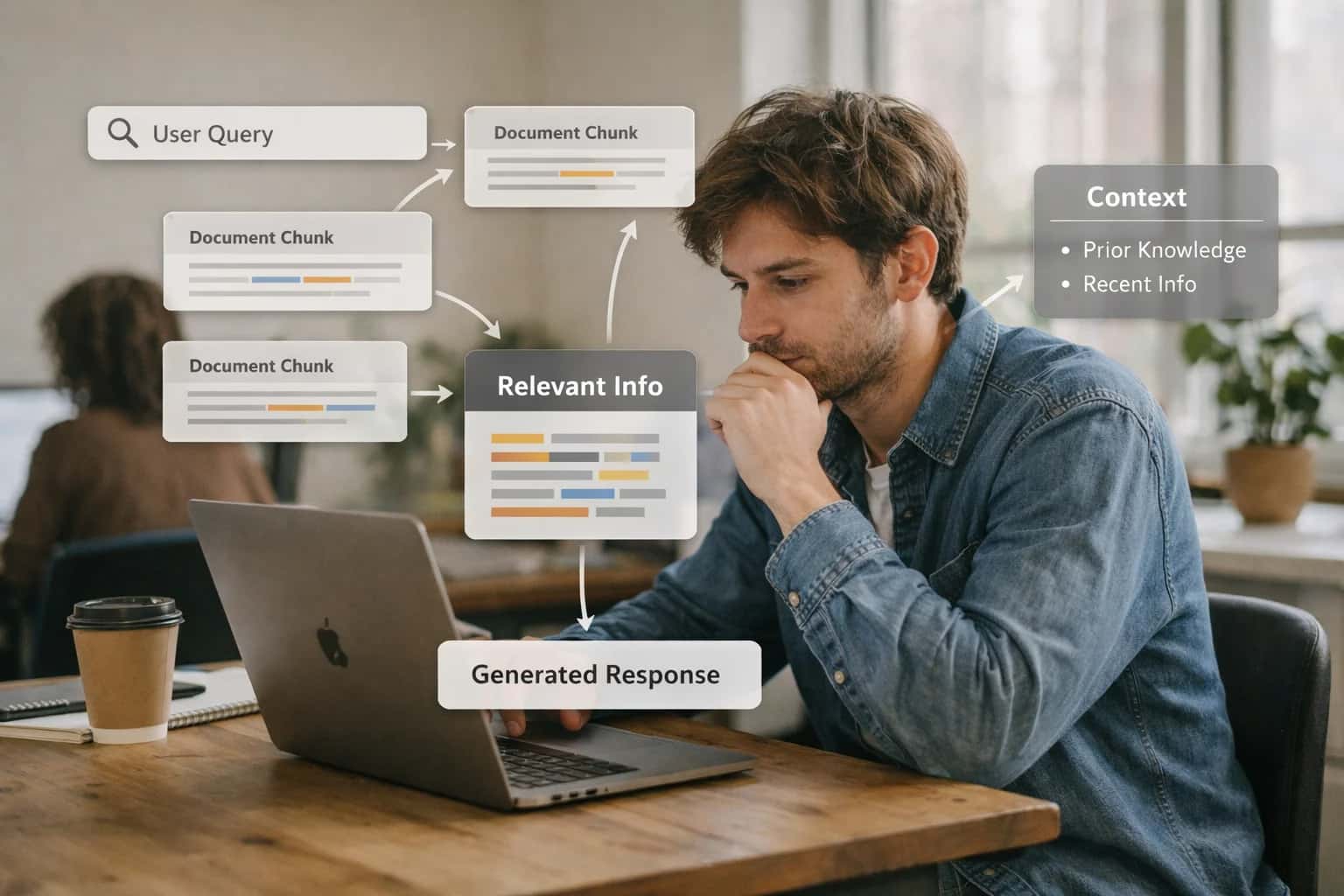
Document Expansion is a pre-indexing process where a generative model, often a sequence-to-sequence transformer, enriches a document's textual representation with additional, contextually relevant terms. This bridges the vocabulary gap between a document's original wording and the diverse language users employ in queries, directly improving recall for sparse retrieval algorithms like BM25 Scoring.

Glossary
Document Expansion
A technique for improving sparse retrieval by using a generative model to add relevant terms to a document's representation before indexing, increasing its likelihood of matching future queries.
SPARSE RETRIEVAL OPTIMIZATION
What is Document Expansion?
Document Expansion is a technique for improving sparse retrieval by using a generative model to add relevant terms to a document's representation before indexing, increasing its likelihood of matching future queries.
Unlike Query Expansion, which modifies the search input, document expansion shifts the computational burden to indexing time. A model like doc2query predicts queries the document might answer, appending them to the text. This creates a more robust, keyword-rich inverted index entry, ensuring the document is surfaced even when the user's query contains no exact lexical overlap with the original source material.
Core Mechanisms
Key Characteristics of Document Expansion
Document expansion bridges the lexical gap between user queries and indexed content by enriching document representations with additional, relevant terms before indexing. This shifts the computational burden to ingestion time, ensuring faster, more accurate retrieval.
01
Pre-Indexing Enrichment
Unlike query expansion, which modifies the user's input at search time, document expansion processes the entire corpus offline. A generative model analyzes each document and appends relevant terms, synonyms, or even full hypothetical sentences directly to the document's text or sparse representation. This ensures the expanded terms are indexed and immediately searchable via standard inverted indexes like BM25, without adding latency to the retrieval pipeline.
02
Bridging the Lexical Gap
The core problem solved is vocabulary mismatch. A user searching for 'cardiac arrest' might miss a document only containing 'myocardial infarction'. Document expansion uses a model to predict that these terms are contextually related and adds 'cardiac arrest' to the document's index entry. This improves recall for sparse retrieval methods by creating a denser, more semantically rich term space without abandoning the efficiency of keyword matching.
03
Generative Expansion with Doc2Query
A prominent technique uses a sequence-to-sequence model, often a fine-tuned T5 variant, trained to generate potential queries that a given document can answer. For each document, the model predicts multiple queries (e.g., 5-10), which are then appended to the document. This is known as Doc2Query. The expanded document is then indexed normally, making it highly likely to match a user's future, similarly phrased question.
04
Sparse Neural Representations
An alternative to generative text expansion is Learned Sparse Retrieval, where a neural model like SPLADE directly predicts term importance weights for the entire vocabulary. This creates a high-dimensional, sparse vector for each document where terms not originally present can have a non-zero weight. This effectively performs document expansion in a latent, weighted space, combining the interpretability of sparse vectors with the semantic power of neural models.
05
Controlled Vocabulary Augmentation
Expansion can be guided by structured knowledge. Using an enterprise knowledge graph or a domain-specific ontology, a document mentioning 'Apple' can be unambiguously expanded with 'AAPL', 'Cupertino', and 'Tim Cook' if the entity is resolved to the technology company. This entity linking step ensures high-precision expansion, adding only verified, disambiguated terms and avoiding the noise that can be introduced by purely generative models.
06
Trade-off: Recall vs. Precision
The primary risk of document expansion is query drift or a loss of precision. Adding too many loosely related terms can cause a document to be retrieved for irrelevant queries. For example, expanding a document about 'python' (the snake) with terms like 'programming' and 'script' would be incorrect. Effective deployment requires careful model tuning, often using pseudo-relevance feedback signals, to balance the significant gains in recall against the potential degradation in precision.
RETRIEVAL OPTIMIZATION STRATEGIES
Document Expansion vs. Query Expansion
A technical comparison of the two primary vocabulary gap bridging techniques, contrasting when terms are added to the index versus when they are added to the search request.
| Feature | Document Expansion | Query Expansion | Hybrid Expansion |
|---|---|---|---|
Processing Target | Document corpus (offline) | User query (online) | Both index and query |
Primary Goal | Increase recall for sparse retrieval | Increase recall for sparse retrieval | Maximize recall and precision |
Computational Cost | High (one-time indexing) | Low (per-query inference) | High (indexing) + Low (query) |
Latency Impact | None at query time | Adds 50-500ms per query | Minimal at query time |
Vocabulary Gap Solution | Adds terms to documents | Adds terms to query | Bidirectional term injection |
Risk of Query Drift | None | Moderate to High | Low |
Sparse Retrieval Compatibility | |||
Dense Retrieval Compatibility |
DOCUMENT EXPANSION
Frequently Asked Questions
Clear, technical answers to the most common questions about using generative models to enrich document representations for improved sparse retrieval.
Document expansion is a retrieval augmentation technique where a generative model adds relevant terms to a document's textual representation before it is indexed, rather than modifying the user's query. The process works by feeding the original document text to a sequence-to-sequence model, such as Doc2Query or a fine-tuned T5 model, which predicts a set of queries or keywords that the document can answer. These generated terms are appended to the document's indexed fields, effectively increasing its term overlap with potential future queries. This bridges the vocabulary gap between the precise language of a document and the diverse, often imprecise, language of a searcher, dramatically improving sparse retrieval metrics like recall without any change to the search infrastructure at query time.
Enabling Efficiency, Speed & Accuracy
Intelligent Analysis, Decision & Execution
We build AI systems for teams that need search across company data, workflow automation across tools, or AI features inside products and internal software.
Talk to Us
Search across company data
Give teams answers from docs, tickets, runbooks, and product data with sources and permissions.
Useful when people spend too long searching or get different answers from different systems.
Enterprise searchRAGPermissions
Read more
Automate internal workflows
Use AI to route work, draft outputs, trigger actions, and keep approvals and logs in place.
Useful when repetitive work moves across multiple tools and teams.
AI agentsWorkflow automationGovernance
Read more
Add AI to products and internal tools
Build assistants, guided actions, or decision support into the software your team or customers already use.
Useful when AI needs to be part of the product, not a separate tool.
AI integrationDecision supportModel routing
Read more
About the author
Prasad Kumkar
CEO & MD, Inference Systems
Prasad Kumkar is the CEO & MD of Inference Systems and writes about AI systems architecture, LLM infrastructure, model serving, evaluation, and production deployment. Over 5+ years, he has worked across computer vision models, L5 autonomous vehicle systems, and LLM research, with a focus on taking complex AI ideas into real-world engineering systems.
His work and writing cover AI systems, large language models, AI agents, multimodal systems, autonomous systems, inference optimization, RAG, evaluation, and production AI engineering.
LinkedIn
Limited slotsGet a Free AI Consultation
Partnered with leading AI, data, and software stack.





How We Work
Custom AI workflows for your Business
One-fit-all AI don't work for modern businesses. At Inferensys, we aim to understand your business & custom requirements; which we use to define most efficient agentic workflows, the data, and the tools for your business.
01
Review the use case
We understand the task, the users, and where AI can actually help.
Read more02
Pick the right approach
We define what needs search, automation, or product integration.
Read more03
Build the first useful version
We implement the part that proves the value first.
Read more04
Improve from there
We add the checks and visibility needed to keep it useful.
Read moreThe first call is a practical review of your use case and the right next step.
Talk to Us