Chain-of-Thought (CoT) Retrieval is a reasoning paradigm where a language model generates intermediate rationales and retrieves supporting evidence for each discrete step, interleaving retrieval with the generation of a logical path to the final answer. Unlike standard retrieval-augmented generation, which performs a single retrieval before generation, CoT Retrieval dynamically queries external knowledge sources based on the model's evolving chain of thought.

Glossary
Chain-of-Thought (CoT) Retrieval
A reasoning paradigm where a model generates intermediate rationales and retrieves supporting evidence for each step, interleaving retrieval with the generation of a logical path to the final answer.
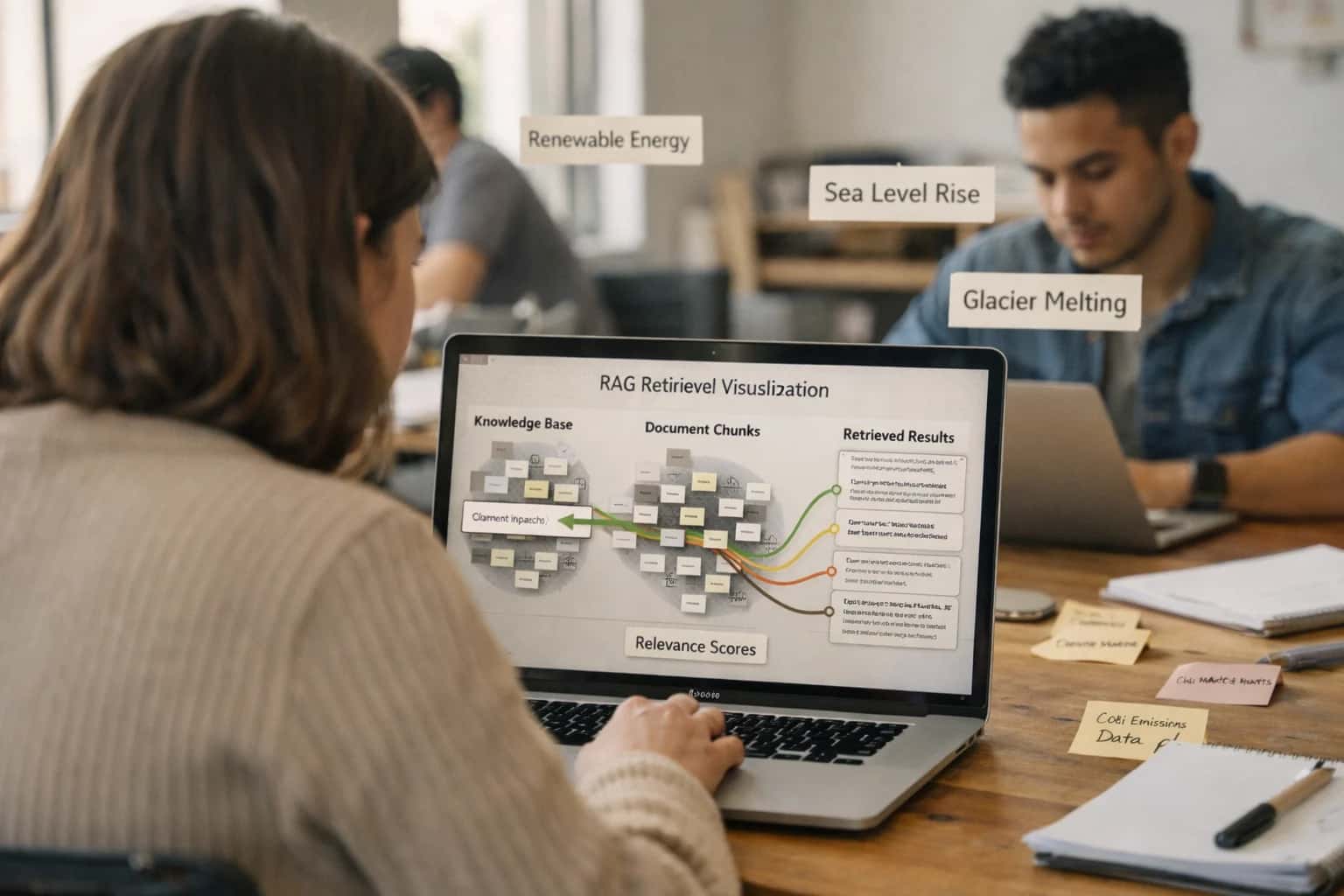
INTERLEAVED REASONING
What is Chain-of-Thought (CoT) Retrieval?
A reasoning paradigm that interleaves step-by-step logical generation with targeted evidence retrieval to solve complex, multi-hop queries.
This approach, exemplified by frameworks like IRCoT, uses each generated sentence as a query to gather new context, bridging information gaps across multiple documents. By grounding each reasoning step in retrieved evidence, CoT Retrieval significantly improves factual accuracy on complex tasks requiring multi-hop reasoning and compositional generalization, mitigating hallucination through iterative verification.
INTERLEAVED REASONING
Key Characteristics of CoT Retrieval
Chain-of-Thought Retrieval integrates logical step generation with dynamic evidence gathering, creating a feedback loop where each reasoning step informs the next retrieval query.
01
Interleaved Retrieval and Reasoning
Unlike standard RAG which retrieves once, CoT Retrieval alternates between generating a reasoning step and querying a knowledge base. The model produces a partial rationale, uses it to formulate a targeted search query, retrieves supporting evidence, and then conditions the next reasoning step on that evidence. This creates a tight feedback loop where retrieval is guided by the evolving logical path, not just the original user query. The IRCoT (Interleaving Retrieval with Chain-of-Thought) method exemplifies this by using each generated sentence as a query.
02
Step-by-Step Evidence Grounding
Each discrete reasoning step is independently grounded in retrieved documents, dramatically reducing hallucination. The model must cite supporting passages for each inferential leap. This transforms the answer from an opaque generation into an auditable trail of evidence. Key benefits:
- Granular fact-checking: Each sub-claim can be verified against its source
- Provenance tracking: The exact origin of every logical deduction is recorded
- Error localization: Incorrect reasoning steps are isolated to specific retrieval failures
03
Dynamic Query Reformulation
The system autonomously rewrites its search queries as understanding deepens. An initial query like "What caused the supply chain disruption?" might first retrieve general event data, then reformulate to "What was the specific supplier bottleneck in the 2024 semiconductor shortage?" based on intermediate findings. This iterative refinement mirrors human research behavior, where each discovered fact reshapes the next question. The model learns to generate queries that bridge identified information gaps.
04
Decomposition into Sub-Problems
Complex queries are implicitly or explicitly broken into a sequence of simpler, answerable sub-questions. The model identifies that answering "Which supplier has the lowest risk profile?" requires first resolving:
- What are the candidate suppliers?
- What are their financial health metrics?
- What are their geographic risk factors?
- What is their historical delivery performance? Each sub-problem triggers its own retrieval cycle, building a dependency graph of information needs.
05
Contrast with Standard RAG
Standard RAG performs a single retrieval round based on the original query embedding, then generates an answer from that fixed context. CoT Retrieval performs multiple, adaptive retrievals. This distinction is critical for multi-hop questions where the first retrieval cannot possibly contain all necessary information. Standard RAG fails when evidence is distributed across documents; CoT Retrieval succeeds by following the trail of logic across multiple retrieval steps, each informed by prior discoveries.
06
Faithful Reasoning Guarantee
CoT Retrieval enforces causal fidelity between evidence and output. The generated rationale is not a post-hoc rationalization but the actual mechanism by which the answer was derived. Because each reasoning step is causally dependent on retrieved text, the explanation faithfully represents the model's decision process. This satisfies the faithful reasoning criterion: the logical chain is strictly determined by the provided context, making the system suitable for regulated domains requiring auditable AI decisions.
CHAIN-OF-THOUGHT RETRIEVAL
Frequently Asked Questions
Explore the mechanics of interleaving logical reasoning with evidence gathering to solve complex, multi-step queries.
Chain-of-Thought (CoT) Retrieval is a reasoning paradigm where a language model generates intermediate rationales and retrieves supporting evidence for each step, interleaving retrieval with the generation of a logical path to the final answer. Unlike standard retrieval-augmented generation (RAG) that performs a single retrieval step before generation, CoT Retrieval dynamically queries external knowledge sources at multiple points during the reasoning process. The mechanism operates by decomposing a complex query into a sequence of reasoning steps, where each step's output determines the next retrieval query. This creates a tight feedback loop between the model's internal reasoning trace and external evidence, ensuring each logical hop is grounded in retrieved facts rather than parametric memory. The process continues iteratively until the model synthesizes a complete, evidence-backed answer.
REASONING PARADIGM COMPARISON
CoT Retrieval vs. Standard RAG vs. ReAct
A technical comparison of three distinct approaches for integrating retrieval with language model generation to answer complex queries.
| Feature | CoT Retrieval | Standard RAG | ReAct |
|---|---|---|---|
Core Mechanism | Interleaves retrieval with step-by-step rationale generation | Single-shot retrieval then generation | Interleaves reasoning traces with tool-use actions |
Retrieval Trigger | Each generated reasoning step | Initial query only | Explicit action commands |
Multi-Hop Support | |||
Query Reformulation | Implicit via rationale chaining | None or single rewrite | Explicit via reasoning traces |
External Tool Use | |||
Hallucination Risk | Moderate | High | Low |
Latency Profile | High (sequential retrievals) | Low (single retrieval) | High (sequential actions) |
Optimal Use Case | Complex multi-step reasoning with evidence grounding | Factoid lookup and simple QA | Interactive tasks requiring API calls |
Enabling Efficiency, Speed & Accuracy
Intelligent Analysis, Decision & Execution
We build AI systems for teams that need search across company data, workflow automation across tools, or AI features inside products and internal software.
Talk to Us
Search across company data
Give teams answers from docs, tickets, runbooks, and product data with sources and permissions.
Useful when people spend too long searching or get different answers from different systems.
Enterprise searchRAGPermissions
Read more
Automate internal workflows
Use AI to route work, draft outputs, trigger actions, and keep approvals and logs in place.
Useful when repetitive work moves across multiple tools and teams.
AI agentsWorkflow automationGovernance
Read more
Add AI to products and internal tools
Build assistants, guided actions, or decision support into the software your team or customers already use.
Useful when AI needs to be part of the product, not a separate tool.
AI integrationDecision supportModel routing
Read more
About the author
Prasad Kumkar
CEO & MD, Inference Systems
Prasad Kumkar is the CEO & MD of Inference Systems and writes about AI systems architecture, LLM infrastructure, model serving, evaluation, and production deployment. Over 5+ years, he has worked across computer vision models, L5 autonomous vehicle systems, and LLM research, with a focus on taking complex AI ideas into real-world engineering systems.
His work and writing cover AI systems, large language models, AI agents, multimodal systems, autonomous systems, inference optimization, RAG, evaluation, and production AI engineering.
LinkedIn
Limited slotsGet a Free AI Consultation
Partnered with leading AI, data, and software stack.





How We Work
Custom AI workflows for your Business
One-fit-all AI don't work for modern businesses. At Inferensys, we aim to understand your business & custom requirements; which we use to define most efficient agentic workflows, the data, and the tools for your business.
01
Review the use case
We understand the task, the users, and where AI can actually help.
Read more02
Pick the right approach
We define what needs search, automation, or product integration.
Read more03
Build the first useful version
We implement the part that proves the value first.
Read more04
Improve from there
We add the checks and visibility needed to keep it useful.
Read moreThe first call is a practical review of your use case and the right next step.
Talk to Us