Multi-Stage Retrieval is a cascading pipeline architecture that balances recall and precision by dividing the search process into sequential phases. An initial, lightweight retriever—often a bi-encoder or BM25 sparse model—efficiently scans the full corpus to generate a broad candidate set of hundreds of documents. This high-recall stage prioritizes speed over exact relevance, using techniques like approximate nearest neighbor (ANN) search to avoid exhaustive computation.

Glossary
Multi-Stage Retrieval
A cascading pipeline architecture where an initial, computationally cheap first-pass retrieval stage generates a broad set of candidates, which is then progressively refined and pruned by more expensive and precise downstream scoring stages.
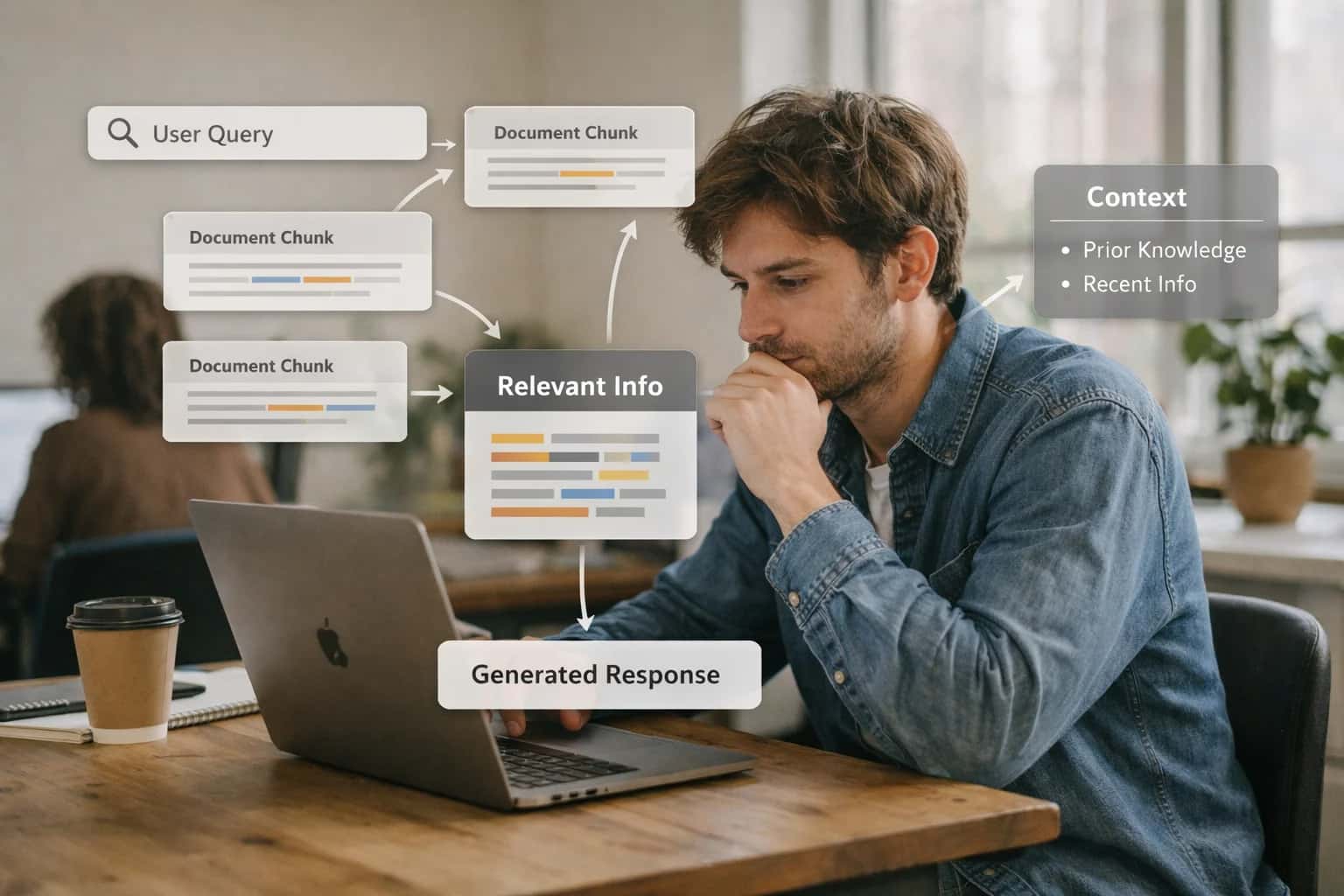
CASCADING PIPELINE ARCHITECTURE
What is Multi-Stage Retrieval?
A cascading pipeline architecture where an initial, computationally cheap first-pass retrieval stage generates a broad set of candidates, which is then progressively refined and pruned by more expensive and precise downstream scoring stages.
Subsequent stages apply progressively more expensive and precise models to prune and re-rank the candidate set. A cross-encoder reranker may score the top-k candidates by processing the concatenated query and document text through a deep transformer, capturing fine-grained semantic interaction. The final stage typically selects a handful of documents for answer synthesis, ensuring the generative model receives only the most relevant context.
MULTI-STAGE RETRIEVAL
Key Architectural Characteristics
A cascading pipeline architecture where an initial, computationally cheap first-pass retrieval stage generates a broad set of candidates, which is then progressively refined and pruned by more expensive and precise downstream scoring stages.
01
Cascading Pipeline Architecture
Multi-stage retrieval operates as a sequential funnel where each successive stage is more computationally expensive but more precise than the last. The pipeline typically begins with a lightweight candidate generation phase using fast vector search or inverted index lookup, then passes the top-k results to a re-ranking stage using cross-encoders or more sophisticated models.
- Stage 1 (Recall): Retrieves 100-1000 candidates using bi-encoders or BM25
- Stage 2 (Re-rank): Scores top candidates with a cross-encoder
- Stage 3 (Optional): Applies metadata filtering or business logic
1000→10
Typical Candidate Reduction
02
Recall-Oriented First Pass
The initial retrieval stage prioritizes high recall over precision, casting a wide net to ensure no relevant documents are missed. This stage typically employs bi-encoders for dense vector search or BM25 for sparse lexical matching, both optimized for speed via Approximate Nearest Neighbor (ANN) algorithms like HNSW.
- Latency target: typically < 50ms for the first pass
- Index structures are pre-built offline for sub-linear search
- Trade-off: accepts some noise to guarantee relevant candidates survive
< 50ms
First-Pass Latency
03
Precision-Oriented Re-Ranking
The downstream re-ranking stage applies a cross-encoder that processes the query and candidate document jointly through full transformer attention, producing a fine-grained relevance score. Unlike bi-encoders that encode independently, cross-encoders capture nuanced semantic interactions at the cost of being too slow to run over the entire corpus.
- Cross-encoder models: BERT-based architectures fine-tuned for relevance
- Computes query-document pair scores with full cross-attention
- Typically re-ranks 50-200 candidates from the first stage
10-50x
Compute Cost vs Bi-Encoder
04
Score Fusion and Normalization
When multiple retrieval sources contribute candidates, their raw scores must be normalized onto a common scale before merging. Techniques include Min-Max normalization, Z-Score normalization, or rank-based fusion like Reciprocal Rank Fusion (RRF) which avoids score calibration entirely by using only rank positions.
- RRF: Assigns score = 1/(k + rank) for each result list
- Weighted Sum Fusion: Combines normalized scores with learned weights
- Critical for combining dense, sparse, and metadata-filtered results
RRF
Calibration-Free Method
05
Latency Budgeting and Optimization
Each stage in the pipeline consumes a portion of the total latency budget, requiring careful allocation to meet end-to-end response time targets. Techniques like caching frequent query embeddings, pre-computing document representations, and using Matryoshka embeddings for flexible dimensionality reduction help stay within budget.
- Stage 1 budget: 30-50ms for ANN search
- Stage 2 budget: 100-300ms for cross-encoder re-ranking
- Caching strategies: Query embeddings, popular results, session context
< 500ms
End-to-End Target
06
Negative Sampling and Training Dynamics
Training effective multi-stage systems requires careful negative sampling strategies. Hard negative mining identifies documents that are superficially similar to the query but irrelevant, forcing embedding models to learn finer-grained distinctions. These hard negatives are often sourced from the first-pass retrieval results of a previous model iteration.
- In-batch negatives: Reuse other queries' positives as negatives
- Hard negatives: Top-ranked irrelevant docs from current model
- Critical for preventing collapse in bi-encoder training
MULTI-STAGE RETRIEVAL
Frequently Asked Questions
Clear, technical answers to the most common questions about cascading retrieval pipelines, candidate generation, and re-ranking architectures.
Multi-stage retrieval is a cascading pipeline architecture that progressively refines a large corpus of documents into a small set of highly relevant results by chaining together increasingly sophisticated and computationally expensive scoring models. The pipeline begins with a candidate generation stage—typically using fast, scalable methods like BM25 or Approximate Nearest Neighbor (ANN) search—to efficiently narrow millions of documents down to hundreds. This initial set is then passed to one or more re-ranking stages, which apply more precise but costlier models like cross-encoders to produce the final ordering. The core insight is computational budgeting: cheap models handle volume, expensive models handle precision, ensuring both high recall and low latency.
Enabling Efficiency, Speed & Accuracy
Intelligent Analysis, Decision & Execution
We build AI systems for teams that need search across company data, workflow automation across tools, or AI features inside products and internal software.
Talk to Us
Search across company data
Give teams answers from docs, tickets, runbooks, and product data with sources and permissions.
Useful when people spend too long searching or get different answers from different systems.
Enterprise searchRAGPermissions
Read more
Automate internal workflows
Use AI to route work, draft outputs, trigger actions, and keep approvals and logs in place.
Useful when repetitive work moves across multiple tools and teams.
AI agentsWorkflow automationGovernance
Read more
Add AI to products and internal tools
Build assistants, guided actions, or decision support into the software your team or customers already use.
Useful when AI needs to be part of the product, not a separate tool.
AI integrationDecision supportModel routing
Read more
About the author
Prasad Kumkar
CEO & MD, Inference Systems
Prasad Kumkar is the CEO & MD of Inference Systems and writes about AI systems architecture, LLM infrastructure, model serving, evaluation, and production deployment. Over 5+ years, he has worked across computer vision models, L5 autonomous vehicle systems, and LLM research, with a focus on taking complex AI ideas into real-world engineering systems.
His work and writing cover AI systems, large language models, AI agents, multimodal systems, autonomous systems, inference optimization, RAG, evaluation, and production AI engineering.
LinkedIn
Limited slotsGet a Free AI Consultation
Partnered with leading AI, data, and software stack.





How We Work
Custom AI workflows for your Business
One-fit-all AI don't work for modern businesses. At Inferensys, we aim to understand your business & custom requirements; which we use to define most efficient agentic workflows, the data, and the tools for your business.
01
Review the use case
We understand the task, the users, and where AI can actually help.
Read more02
Pick the right approach
We define what needs search, automation, or product integration.
Read more03
Build the first useful version
We implement the part that proves the value first.
Read more04
Improve from there
We add the checks and visibility needed to keep it useful.
Read moreThe first call is a practical review of your use case and the right next step.
Talk to Us