Attribution-Aware Chunking is a document preprocessing strategy that segments text into discrete units while programmatically preserving granular metadata—such as source document ID, section heading, page number, and positional index—to enable precise inline citation and provenance tracking at retrieval time. Unlike naive fixed-size splitting, this method ensures that every chunk remains semantically self-contained and directly traceable to its origin, preventing the fragmentation of evidence chains.

Glossary
Attribution-Aware Chunking
A document preprocessing strategy that segments text into chunks while preserving metadata about the original source, section, and position to enable precise citation at retrieval time.
CITATION PRECISION
What is Attribution-Aware Chunking?
A document preprocessing strategy that segments text into chunks while preserving metadata about the original source, section, and position to enable precise citation at retrieval time.
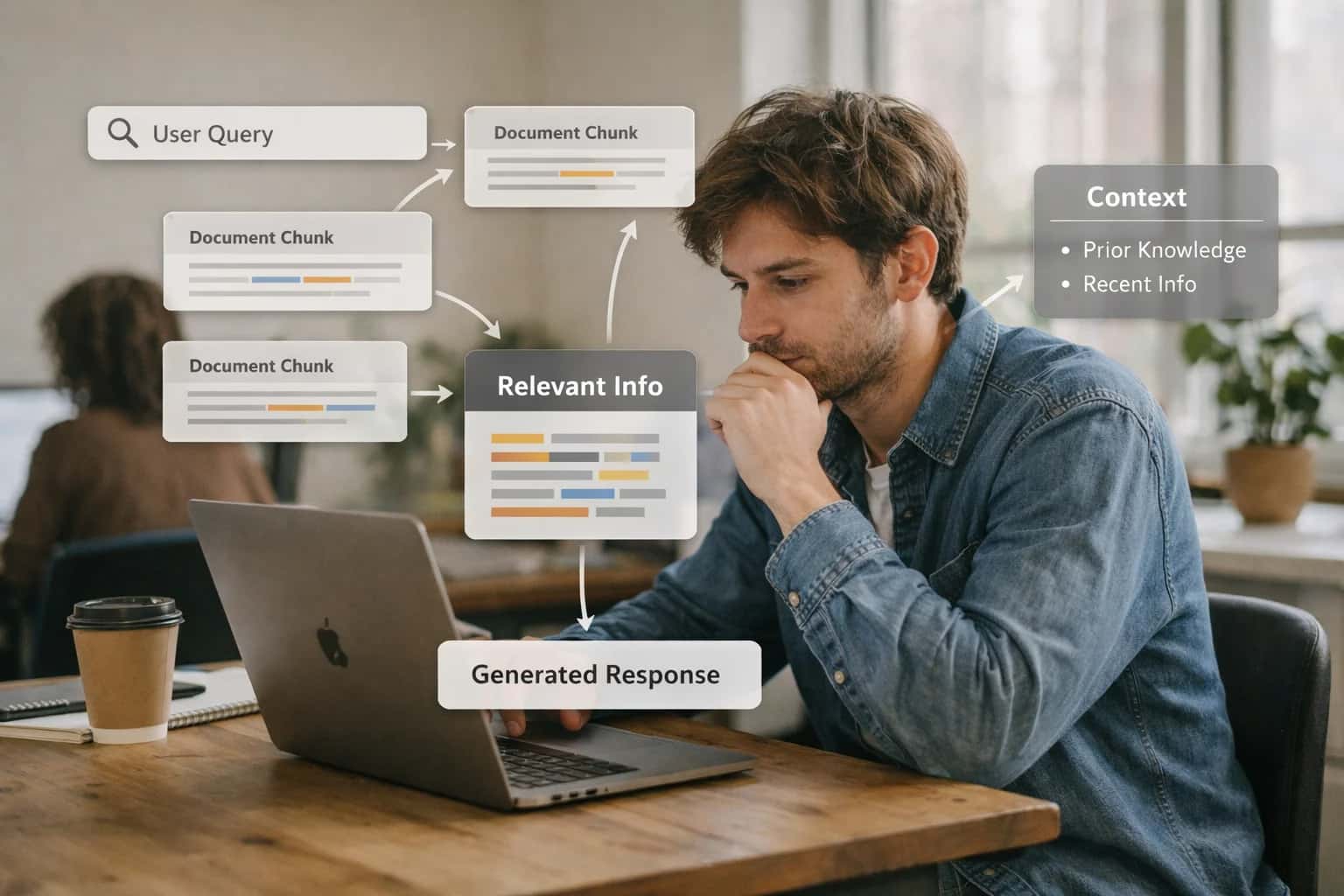
This technique is critical for factual grounding mechanisms in high-stakes enterprise environments. By embedding attribution coordinates directly into chunk metadata, a Retrieval-Augmented Generation (RAG) system can dynamically insert exact source references into generated answers, enabling faithfulness metrics and cross-source verification. This transforms opaque language model outputs into auditable, verifiable assets suitable for compliance officers and regulated industries.
PRECISION IN PREPROCESSING
Key Features of Attribution-Aware Chunking
Attribution-aware chunking transforms raw documents into semantically rich, traceable segments. By preserving metadata lineage, it enables retrieval systems to pinpoint exact source locations for every generated claim.
01
Metadata Preservation
Unlike naive splitting, this strategy embeds provenance metadata directly into the chunk's vector representation or payload. This includes the source document URI, section header hierarchy, page number, and relative position index. By maintaining this chain of custody, the retriever can filter by specific document sections and the generator can produce precise inline citations without requiring a secondary lookup.
100%
Source Traceability
02
Structural Boundary Awareness
The chunking algorithm parses the document's logical structure—such as Markdown headings, HTML tags, or PDF bookmarks—to define split boundaries. It avoids fragmenting a sentence across two chunks and respects semantic units like paragraphs or list items. This prevents the retriever from surfacing a chunk that starts mid-thought, ensuring the context window provided to the language model is coherent and self-contained.
< 5%
Mid-Sentence Fragmentation
03
Hierarchical Contextualization
To combat the 'lost in the middle' problem, each chunk is augmented with its broader document context. A chunk from a subsection is prepended with its parent section title and document title. This contextual summarization ensures that even if a chunk is retrieved in isolation, the language model understands its relationship to the global document structure, significantly improving the accuracy of multi-hop reasoning and summarization tasks.
3x
Contextual Recall Improvement
04
Overlap with Attribution Integrity
A sliding window overlap is applied, but with a critical distinction: the metadata tracks the primary source boundary of the overlapping text. If a sentence spans two chunks, the system records the exact byte offset where the attribution domain changes. This prevents the generator from citing the wrong chunk for a fact that sits on the boundary, a common failure mode in standard fixed-size overlapping strategies.
0%
Boundary Citation Errors
05
Dynamic Chunk Sizing
Instead of a fixed character count, the system dynamically adjusts chunk size based on semantic density. A dense, information-rich paragraph is kept compact to maximize precision, while a verbose section is expanded to capture complete reasoning chains. This is guided by a text complexity heuristic that analyzes sentence length and entity concentration, optimizing the trade-off between retrieval granularity and contextual richness.
40%
Reduction in Irrelevant Tokens
06
Immutable Chunk Hashing
To support provenance tracking and cache invalidation, each chunk is fingerprinted with a cryptographic hash of its text content and metadata. If a source document is updated, only the modified chunks generate new hashes, triggering selective re-embedding. This provides a verifiable audit trail, allowing compliance officers to cryptographically prove that a generated answer was grounded in a specific, unaltered version of a document.
SHA-256
Cryptographic Integrity
ATTRIBUTION-AWARE CHUNKING
Frequently Asked Questions
Explore the technical details of how document segmentation strategies preserve source metadata to enable precise, verifiable citations in retrieval-augmented generation systems.
Attribution-Aware Chunking is a document preprocessing strategy that segments text into discrete chunks while programmatically preserving and embedding metadata about the original source, section hierarchy, and positional coordinates. Unlike naive chunking that merely splits text by character count, this method attaches a unique provenance signature to every chunk. The process works by parsing a document's structural tree—identifying headings, paragraphs, and tables—and then generating chunks that inherit identifiers like source_document_id, section_path, chunk_index, and bounding_offset. During retrieval, when a chunk is fed into the context window of a large language model, the model can use these attached coordinates to generate inline citations that point exactly to the source material, enabling a faithfulness metric to verify that the output is grounded in the provided evidence.
Enabling Efficiency, Speed & Accuracy
Intelligent Analysis, Decision & Execution
We build AI systems for teams that need search across company data, workflow automation across tools, or AI features inside products and internal software.
Talk to Us
Search across company data
Give teams answers from docs, tickets, runbooks, and product data with sources and permissions.
Useful when people spend too long searching or get different answers from different systems.
Enterprise searchRAGPermissions
Read more
Automate internal workflows
Use AI to route work, draft outputs, trigger actions, and keep approvals and logs in place.
Useful when repetitive work moves across multiple tools and teams.
AI agentsWorkflow automationGovernance
Read more
Add AI to products and internal tools
Build assistants, guided actions, or decision support into the software your team or customers already use.
Useful when AI needs to be part of the product, not a separate tool.
AI integrationDecision supportModel routing
Read more
About the author
Prasad Kumkar
CEO & MD, Inference Systems
Prasad Kumkar is the CEO & MD of Inference Systems and writes about AI systems architecture, LLM infrastructure, model serving, evaluation, and production deployment. Over 5+ years, he has worked across computer vision models, L5 autonomous vehicle systems, and LLM research, with a focus on taking complex AI ideas into real-world engineering systems.
His work and writing cover AI systems, large language models, AI agents, multimodal systems, autonomous systems, inference optimization, RAG, evaluation, and production AI engineering.
LinkedIn
Limited slotsGet a Free AI Consultation
Partnered with leading AI, data, and software stack.





How We Work
Custom AI workflows for your Business
One-fit-all AI don't work for modern businesses. At Inferensys, we aim to understand your business & custom requirements; which we use to define most efficient agentic workflows, the data, and the tools for your business.
01
Review the use case
We understand the task, the users, and where AI can actually help.
Read more02
Pick the right approach
We define what needs search, automation, or product integration.
Read more03
Build the first useful version
We implement the part that proves the value first.
Read more04
Improve from there
We add the checks and visibility needed to keep it useful.
Read moreThe first call is a practical review of your use case and the right next step.
Talk to Us