Conversation branching is the ability to fork a dialogue from a specific prior turn to explore alternative paths without corrupting the original session state. It treats the conversation as a tree structure rather than a linear sequence, where each node represents a turn. When a branch is created, the system preserves the parent context immutably, allowing users or agents to backtrack and pursue a different line of inquiry from the same divergence point.

Glossary
Conversation Branching
Conversation branching is the ability to fork a dialogue from a specific prior turn to explore alternative paths without corrupting the original session state.
DIALOGUE STATE MANAGEMENT
What is Conversation Branching?
Conversation branching is a state management technique that creates a non-destructive fork in a dialogue, allowing exploration of alternative paths from a specific turn without corrupting the original session state.
This mechanism relies on immutable context window snapshots and pointer-based state management. Rather than overwriting the dialogue history, the system duplicates the KV-cache and message array at the branch point, assigning a new session identifier to the fork. This is critical for debugging agentic reasoning loops, A/B testing prompt strategies, and enabling users to navigate complex decision trees without losing conversational context.
NON-LINEAR DIALOGUE STRUCTURES
Key Characteristics of Conversation Branching
Conversation branching introduces a tree-like topology to dialogue management, enabling the exploration of alternative paths from a specific prior turn without corrupting the original session state.
01
Immutable State Forking
The core mechanism that creates a copy-on-write snapshot of the entire session state at a specific conversation turn. Instead of modifying the original linear history, the system duplicates the KV-Cache, message array, and dialogue state tracking variables. This ensures the parent branch remains pristine while the child branch explores a hypothetical user query or agent action. The fork is identified by a unique branch ID and a pointer to its parent node, forming a directed acyclic graph of dialogue possibilities.
02
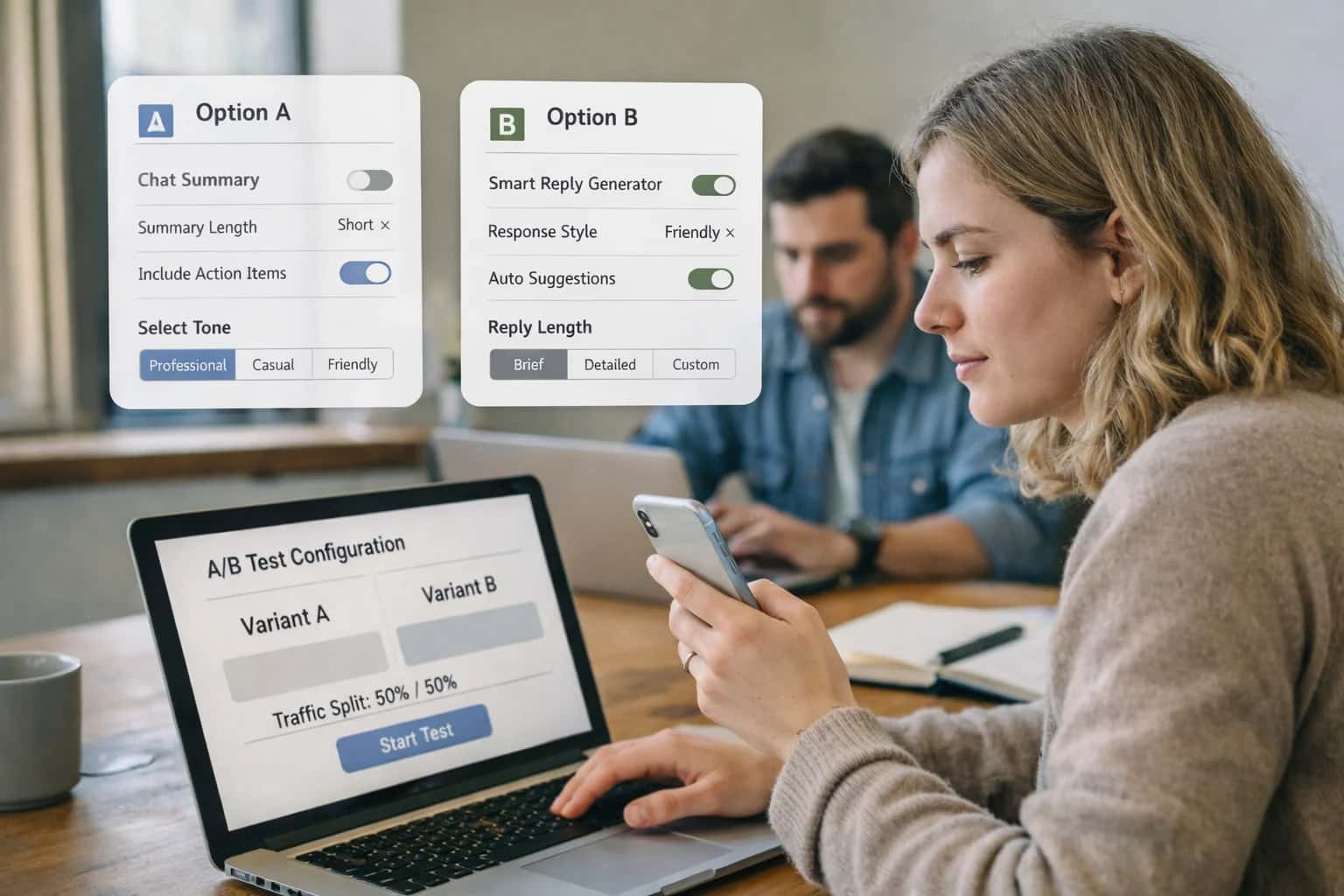
Hypothetical Exploration & A/B Testing
Branching allows developers to test prompt engineering strategies against identical historical context. Common use cases include:
- Response Comparison: Generating two completions from the same turn using different system prompts or model temperatures.
- Regret Detection: Allowing an agent to backtrack to a prior state if a tool call returns an error, effectively implementing a 'try-catch' for dialogue.
- User Simulation: Running 'what-if' scenarios where the user asks a different follow-up question to evaluate the robustness of contextual guardrails.
03
Tree Traversal & Merge Conflicts
Navigating a branched conversation requires explicit path selection. The UI or API must specify the target node ID for the next turn. Key challenges include:
- Context Collapse Prevention: The attention mask must be reconstructed to ensure the model only attends to the linear path from the root to the current node, ignoring sibling branches.
- Merge Logic: Merging two branches back into a single canonical thread is a complex state reconciliation problem, often requiring a user or heuristic to resolve conflicting slot filling values.
04
Memory & Storage Optimization
Storing full copies of the context window for every branch is computationally prohibitive. Efficient implementations use structural sharing, where immutable data structures allow branches to share references to common ancestors. For the KV-Cache, this means storing only the delta of Keys and Values generated after the fork point. This drastically reduces the memory footprint when maintaining hundreds of parallel conversational threads in a distributed session store.
05
User Experience & Annotation
Branching transforms the chat interface from a simple scroll to a navigable tree. Best practices include:
- Visual Cues: Rendering branches as indented threads or color-coded timelines.
- Metadata Tagging: Annotating branches with auto-generated summaries (e.g., 'Path where user asked for a refund') to facilitate human review.
- Garbage Collection: Pruning abandoned or resolved branches to prevent context drift and manage the contextual token budget of the persistent session.
CONVERSATION BRANCHING
Frequently Asked Questions
Explore the mechanics of forking dialogue states to enable parallel exploration and A/B testing in conversational AI without corrupting the primary session history.
Conversation branching is the programmatic ability to fork a dialogue from a specific prior turn to explore alternative paths without corrupting the original session state. It works by treating the conversation as an immutable tree data structure rather than a linear log. When a branch is created, the system clones the message array up to the branch point and appends a new user or assistant message to the clone. The original branch remains pristine, allowing the user or an evaluator to compare divergent outcomes. This mechanism relies on session state isolation, where each branch maintains its own conversation_id and pointer to the parent node, ensuring that the KV-cache and context window of one fork do not bleed into another.
STATE MANAGEMENT
Practical Applications of Conversation Branching
Conversation branching is not merely a chat feature; it is a critical architectural primitive for managing non-linear reasoning, A/B testing prompts, and maintaining deterministic session integrity in production AI systems.
01
Non-Destructive Prompt Engineering
Branching allows developers to fork a conversation from a specific turn to test different system prompts or few-shot examples without losing the original baseline. This is essential for evaluation-driven development where you need to compare the efficacy of various context engineering strategies against an identical dialogue history. By preserving the parent node, you maintain a clean audit trail for prompt versioning.
02
Hypothetical Reasoning & 'What-If' Analysis
In complex multi-turn dialogue, users often want to explore alternative scenarios without corrupting the primary task. Branching enables agentic cognitive architectures to simulate different decision paths from a single strategic waypoint. For example, an autonomous agent can fork a session to evaluate the outcome of a risky tool call versus a safe one, comparing the results in isolated session states before committing to an action in the main thread.
03
User-Initiated Error Correction
When a user provides a mid-conversation correction (e.g., 'No, I meant the Q3 report, not Q2'), a naive system might suffer from context collapse. Branching solves this by creating a new fork from the turn before the error was introduced. This allows the dialogue state tracking (DST) to update the slot filling for 'report_period' without the model being confused by the contradictory entity in the immediate history, effectively resolving coreference conflicts.
04
Parallelized Agent Task Decomposition
In multi-agent system orchestration, a supervisor agent can use branching to delegate sub-tasks. The main conversation forks into multiple isolated context windows, each assigned to a specialized agent (e.g., one for web search, one for data analysis). The supervisor later merges the terminal outputs from these branches. This prevents the individual agent's chain-of-thought reasoning from polluting the global session state with intermediate noise.
05
Synthetic Data Generation for Fine-Tuning
Branching is a powerful tool for creating synthetic data. A single high-quality prompt can be forked into multiple branches, each steered toward a different rejection, acceptance, or clarification path. This generates a diverse tree of conversational outcomes from a single seed, which is invaluable for parameter-efficient fine-tuning of models that need to handle varied user behaviors without requiring thousands of manually scripted dialogues.
06
Compliance and Audit Trail Integrity
In regulated industries, deleting a message to fix a mistake breaks the audit trail. Branching provides an immutable solution. The original, non-compliant or erroneous path is preserved as a read-only record, while the active conversation continues on a corrected fork. This maintains data provenance and satisfies enterprise AI governance requirements by ensuring that no interaction history is ever truly destroyed, only deprecated.
Enabling Efficiency, Speed & Accuracy
Intelligent Analysis, Decision & Execution
We build AI systems for teams that need search across company data, workflow automation across tools, or AI features inside products and internal software.
Talk to Us
Search across company data
Give teams answers from docs, tickets, runbooks, and product data with sources and permissions.
Useful when people spend too long searching or get different answers from different systems.
Enterprise searchRAGPermissions
Read more
Automate internal workflows
Use AI to route work, draft outputs, trigger actions, and keep approvals and logs in place.
Useful when repetitive work moves across multiple tools and teams.
AI agentsWorkflow automationGovernance
Read more
Add AI to products and internal tools
Build assistants, guided actions, or decision support into the software your team or customers already use.
Useful when AI needs to be part of the product, not a separate tool.
AI integrationDecision supportModel routing
Read moreCONVERSATIONAL STATE MANAGEMENT
Branching vs. Linear Dialogue vs. Context Collapse
Comparative analysis of dialogue topology strategies for maintaining coherent multi-turn interactions in autonomous agent systems.
| Feature | Conversation Branching | Linear Dialogue | Context Collapse |
|---|---|---|---|
Dialogue Topology | Tree/DAG structure with multiple forks from prior turns | Single sequential chain of turns | Flattened, undifferentiated amalgamation of all threads |
Session State Integrity | Preserves original session state; each branch is an isolated derivative | Maintains single contiguous state | Original state boundaries destroyed; threads merge incoherently |
Exploratory Capacity | Enables parallel exploration of alternative paths without contamination | Requires sequential backtracking or session restart | Prevents coherent exploration; all paths conflated |
Context Window Utilization | Efficient; only active branch tokens consumed | Linear accumulation of all turns | Inefficient; redundant and contradictory tokens compete for attention |
Temporal Disambiguation | Explicit fork-point metadata distinguishes turn chronology | Implicit ordering by sequence position | Temporal ordering lost; past and present states indistinguishable |
Anaphora Resolution Accuracy | High; referents scoped to specific branch lineage | Moderate; referents scoped to linear history | Low; referents ambiguous due to merged contexts |
Implementation Complexity | Requires DAG-based session store and fork-point indexing | Simple linked-list or array-based history | N/A; represents a failure state, not an architecture |
Recovery from Failure | Rollback to any prior fork point without data loss | Rollback to checkpoint or full session restart | Requires full session reset; all state corrupted |

About the author
Prasad Kumkar
CEO & MD, Inference Systems
Prasad Kumkar is the CEO & MD of Inference Systems and writes about AI systems architecture, LLM infrastructure, model serving, evaluation, and production deployment. Over 5+ years, he has worked across computer vision models, L5 autonomous vehicle systems, and LLM research, with a focus on taking complex AI ideas into real-world engineering systems.
His work and writing cover AI systems, large language models, AI agents, multimodal systems, autonomous systems, inference optimization, RAG, evaluation, and production AI engineering.
LinkedIn
Limited slotsGet a Free AI Consultation
Partnered with leading AI, data, and software stack.





How We Work
Custom AI workflows for your Business
One-fit-all AI don't work for modern businesses. At Inferensys, we aim to understand your business & custom requirements; which we use to define most efficient agentic workflows, the data, and the tools for your business.
01
Review the use case
We understand the task, the users, and where AI can actually help.
Read more02
Pick the right approach
We define what needs search, automation, or product integration.
Read more03
Build the first useful version
We implement the part that proves the value first.
Read more04
Improve from there
We add the checks and visibility needed to keep it useful.
Read moreThe first call is a practical review of your use case and the right next step.
Talk to Us