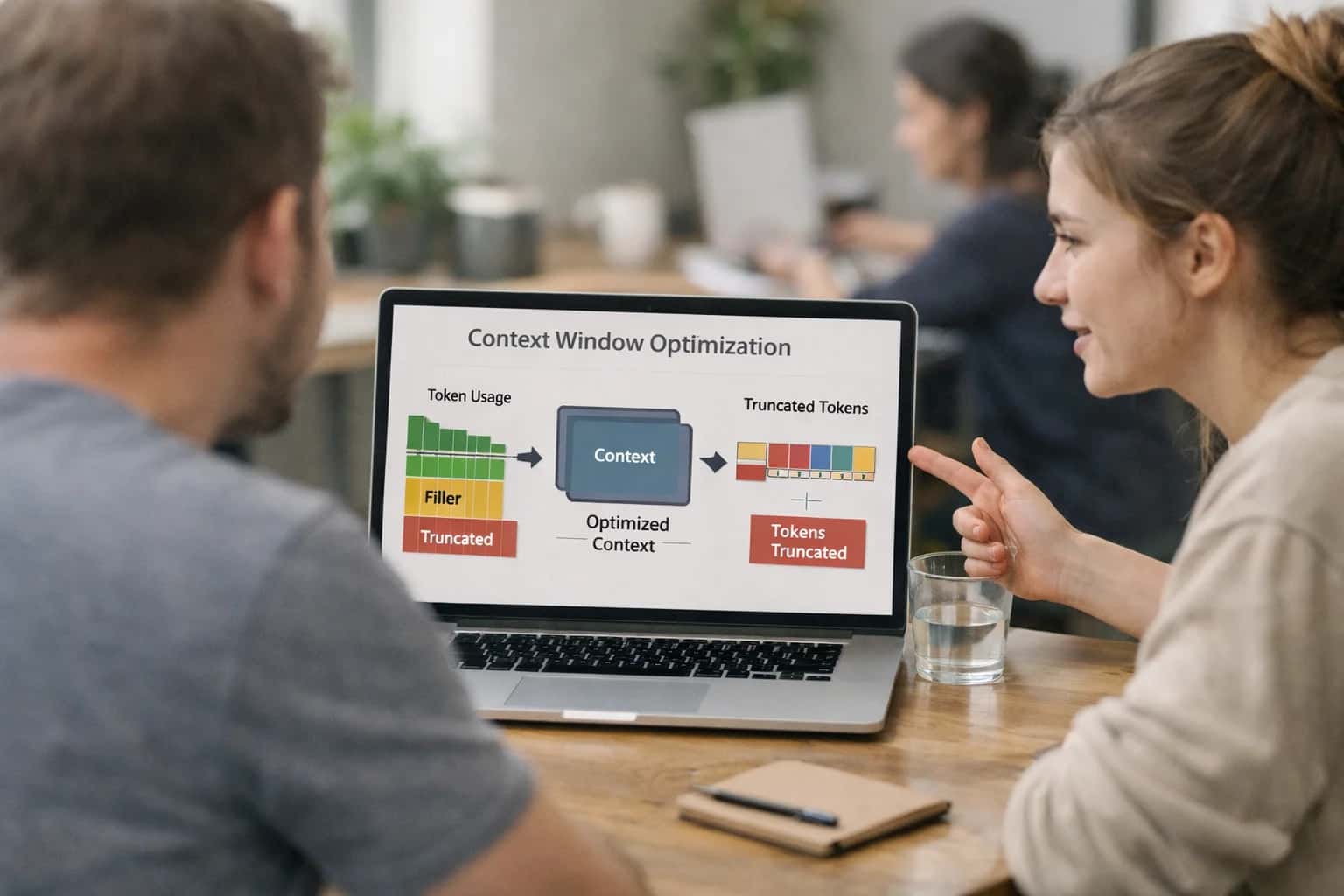
Context window truncation is a forced memory management event triggered when the cumulative tokens of a prompt, conversation history, and generated output surpass the model's fixed context window limit. Because transformer architectures have quadratic computational complexity relative to sequence length, the system must strictly enforce a maximum token capacity. The truncation algorithm typically removes tokens from the beginning of the sequence, discarding the system prompt, initial instructions, or early conversational turns to make room for newer, more recent tokens.

Glossary
Context Window Truncation
The process of discarding the oldest tokens from a context window when the token limit is exceeded, often resulting in the loss of initial instructions or early dialogue.
MEMORY MANAGEMENT
What is Context Window Truncation?
Context window truncation is the automated process of discarding the oldest tokens from a model's input buffer when the total token count exceeds the architecture's maximum limit, often resulting in the irreversible loss of initial instructions or early dialogue history.
This process introduces significant architectural risk, as critical grounding instructions or identity parameters embedded in the system prompt may be silently deleted. Effective mitigation relies on contextual compression, sliding window attention mechanisms, or prompt caching to preserve high-priority static prefixes. Without these safeguards, truncation directly causes context collapse, where the model loses its behavioral constraints and begins generating unmoored, incoherent, or hallucinated responses based solely on the most recent user input.
MECHANISMS AND FAILURE MODES
Key Characteristics of Context Window Truncation
Context window truncation is a deterministic memory management process, not a learning mechanism. When the token limit is breached, the system discards the oldest tokens, creating a strict recency bias that can catastrophically dismantle agentic behavior.
01
FIFO Eviction Policy
The fundamental mechanism is a strict First-In, First-Out queue. The model does not semantically evaluate what is being discarded; it simply removes the oldest tokens from the left side of the sequence. This means a system prompt or critical initial instructions are the first data to be permanently lost. This is not a bug but a hard architectural constraint of the Transformer's quadratic attention complexity, where memory requirements scale with sequence length squared.
O(n²)
Attention Complexity
02
Recency Bias Induction
Truncation artificially induces a severe recency bias. Once the oldest tokens are evicted, the model's entire decision-making foundation shifts to only the most recent information. This can cause the model to forget its original objective and hyper-fixate on the last few turns of a conversation. For an autonomous agent, this often manifests as goal drift, where a long debugging session causes the agent to forget the primary task it was assigned to complete.
100%
Oldest Data Loss
03
Catastrophic Instruction Forgetting
In agentic architectures, the system prompt often defines the tool-use schema, safety guardrails, and persona. Truncation silently shears off these instructions. The model does not throw an exception; it simply reverts to its base pre-training behavior. This is a primary failure mode for autonomous agents running long loops, where the agent suddenly stops using tools correctly or violates its safety constraints because the system prompt has been pushed out of the context window.
System Prompt
First to be Evicted
04
Sliding Window vs. Rolling Summary
A naive sliding window approach discards discrete chunks of text, often breaking sentences or code blocks mid-structure, leading to syntactic incoherence. A more advanced mitigation is a rolling summary, where a secondary model compresses the oldest dialogue turns into a dense summary before eviction. This preserves semantic intent but loses precise wording. The trade-off is between verbatim fidelity and semantic continuity.
Verbatim vs. Semantic
Core Trade-off
05
Lost in the Middle Amplification
Truncation directly interacts with the Lost in the Middle phenomenon. As a conversation progresses, the most critical context (like a user's initial complex requirements) migrates to the middle of the window. If the window is not yet full, the model struggles to attend to it. If the window becomes full, that critical middle information is the next to be evicted after the oldest tokens. This creates a double-bind where mid-context information is either ignored or destroyed.
Mid-Context
Highest Risk Zone
06
KV-Cache Invalidation
When truncation occurs, the corresponding KV-Cache entries for the evicted tokens must be discarded to free GPU memory. This is a destructive operation; the computational work spent generating those keys and values is lost. Efficient inference engines trigger a partial cache purge at the truncation boundary. Without this, the cache would continue to grow until it exhausts available VRAM, causing an Out-of-Memory error.
VRAM
Protected Resource
CONTEXT WINDOW TRUNCATION
Frequently Asked Questions
Explore the mechanics and consequences of discarding tokens when a language model's input exceeds its maximum context length, a critical challenge in maintaining long-running agentic sessions.
Context window truncation is the automated process of discarding the oldest tokens from a sequence when the total input length exceeds a language model's predefined maximum context window. This mechanism operates on a first-in, first-out basis, where the system removes tokens from the beginning of the prompt to make room for new input at the end. The process is typically governed by the model's max_tokens parameter, which defines the absolute ceiling for the combined input and output. When truncation occurs, the model loses access to the earliest parts of the conversation, which often include the critical system prompt, initial user instructions, and early dialogue turns. This can lead to a phenomenon known as catastrophic forgetting within the session, where the agent suddenly reverts to generic behavior because its foundational behavioral constraints have been pushed out of the active attention window.
Enabling Efficiency, Speed & Accuracy
Intelligent Analysis, Decision & Execution
We build AI systems for teams that need search across company data, workflow automation across tools, or AI features inside products and internal software.
Talk to Us
Search across company data
Give teams answers from docs, tickets, runbooks, and product data with sources and permissions.
Useful when people spend too long searching or get different answers from different systems.
Enterprise searchRAGPermissions
Read more
Automate internal workflows
Use AI to route work, draft outputs, trigger actions, and keep approvals and logs in place.
Useful when repetitive work moves across multiple tools and teams.
AI agentsWorkflow automationGovernance
Read more
Add AI to products and internal tools
Build assistants, guided actions, or decision support into the software your team or customers already use.
Useful when AI needs to be part of the product, not a separate tool.
AI integrationDecision supportModel routing
Read more
About the author
Prasad Kumkar
CEO & MD, Inference Systems
Prasad Kumkar is the CEO & MD of Inference Systems and writes about AI systems architecture, LLM infrastructure, model serving, evaluation, and production deployment. Over 5+ years, he has worked across computer vision models, L5 autonomous vehicle systems, and LLM research, with a focus on taking complex AI ideas into real-world engineering systems.
His work and writing cover AI systems, large language models, AI agents, multimodal systems, autonomous systems, inference optimization, RAG, evaluation, and production AI engineering.
LinkedIn
Limited slotsGet a Free AI Consultation
Partnered with leading AI, data, and software stack.





How We Work
Custom AI workflows for your Business
One-fit-all AI don't work for modern businesses. At Inferensys, we aim to understand your business & custom requirements; which we use to define most efficient agentic workflows, the data, and the tools for your business.
01
Review the use case
We understand the task, the users, and where AI can actually help.
Read more02
Pick the right approach
We define what needs search, automation, or product integration.
Read more03
Build the first useful version
We implement the part that proves the value first.
Read more04
Improve from there
We add the checks and visibility needed to keep it useful.
Read moreThe first call is a practical review of your use case and the right next step.
Talk to Us