Retrieval-Augmented Attribution is an architectural pattern that requires a language model to explicitly cite the specific passages from retrieved documents that informed its generated response. Unlike standard RAG, which silently injects context, this protocol creates a direct, auditable link between each factual claim and its source, enabling a user to verify the model's output against the original text.

Glossary
Retrieval-Augmented Attribution
An architectural pattern where a language model explicitly cites the specific passages from retrieved documents that were used to generate a response, enabling direct source verification.
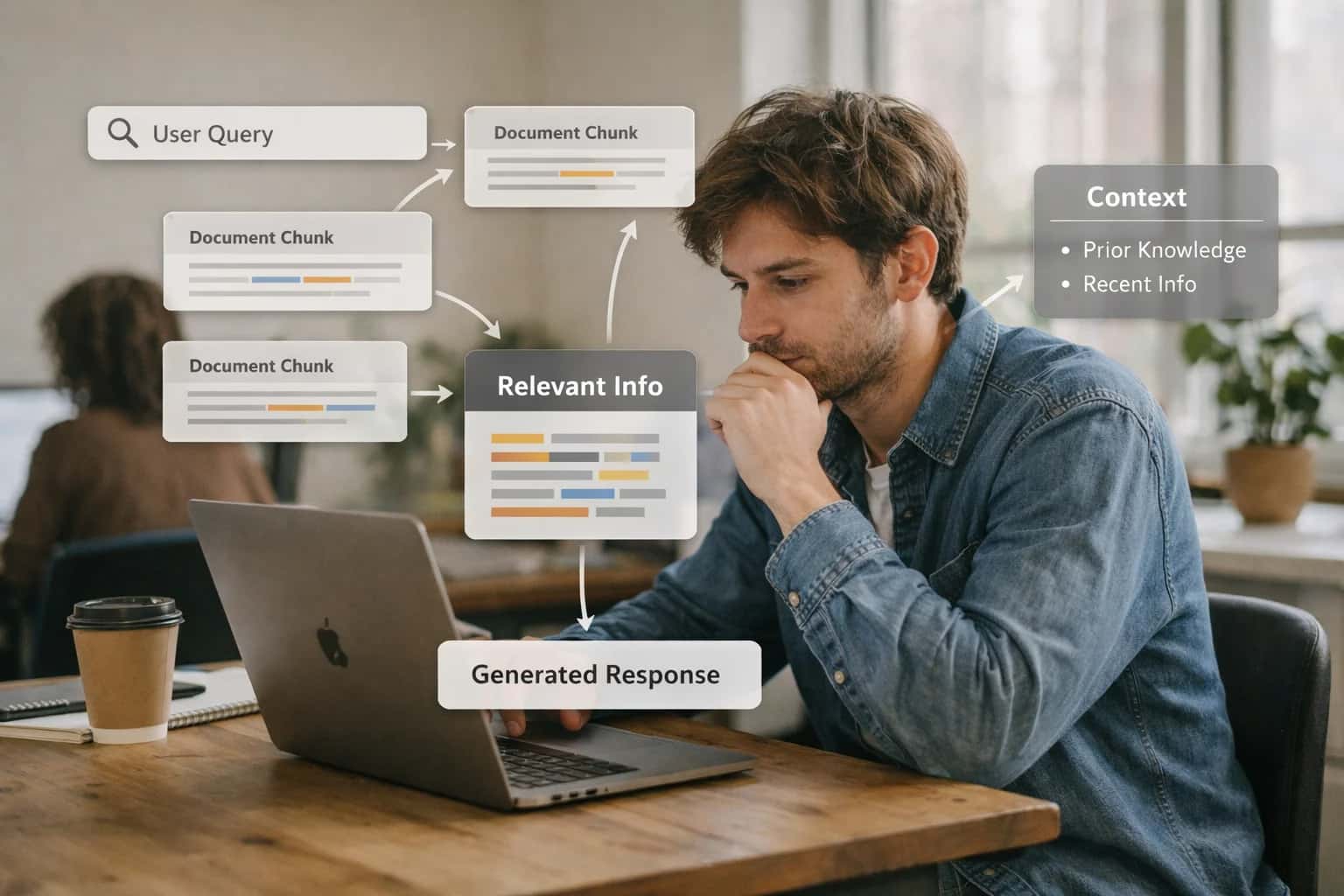
CITATION ARCHITECTURE
What is Retrieval-Augmented Attribution?
Retrieval-Augmented Attribution is an architectural pattern where a language model explicitly cites the specific passages from retrieved documents that were used to generate a response, enabling direct source verification.
The mechanism relies on fine-grained citation precision and attribution fidelity to prevent hallucinated references. By anchoring every assertion to a verifiable chunk of text, the system transforms the model from an opaque oracle into a traceable research assistant, directly supporting rigorous fact-checking automation and building algorithmic trust.
ARCHITECTURAL COMPONENTS
Key Features of Retrieval-Augmented Attribution
Retrieval-Augmented Attribution (RAA) is an architectural pattern that extends standard RAG by mandating that a language model explicitly cite the specific retrieved passages that ground each claim in its response. This enables direct, granular source verification.
01
Fine-Grained Citation Spanning
Unlike document-level attribution, RAA requires the model to link a specific claim to a specific text span within a retrieved passage. This is often achieved through post-hoc Natural Language Inference (NLI) models that verify textual entailment between the generated sentence and the candidate source. The output is a direct, auditable mapping from a generated statement to its exact evidentiary origin, enabling pixel-perfect verification.
02
Attribution Fidelity Scoring
A core metric in RAA systems that measures whether a citation accurately reflects the source. It decomposes into two sub-metrics:
- Citation Recall: The proportion of generated claims that are supported by a citation.
- Citation Precision: The proportion of provided citations that are relevant and non-hallucinated. High fidelity requires the model to abstain from generating unsupported claims rather than fabricating plausible-sounding citations.
03
Post-Hoc Retrieval Verification
An architectural variant where attribution is not generated simultaneously with the text. Instead, a separate verifier model takes the initial generated response and a corpus of retrieved documents, then re-aligns each factual statement to its most probable source. This decoupling allows for the use of specialized, high-precision NLI models that are too computationally expensive for real-time generation, maximizing attribution precision at the cost of latency.
04
Abstention Mechanisms
A critical failure mode of RAA is hallucinated attribution, where a model cites a real document but misrepresents its content. Robust RAA systems implement an abstention policy that forces the model to output a 'no evidence found' token when the retrieval corpus lacks sufficient support for a claim. This is a direct trade-off between answer coverage and attribution fidelity, prioritizing trustworthiness over completeness.
05
Hierarchical Attribution
Advanced RAA architectures decompose attribution into a hierarchy:
- Document-level: Which document is relevant.
- Passage-level: Which specific paragraph.
- Span-level: Which exact phrase. This granularity enables counterfactual editing, where a user can click a citation, see the source text, and identify exactly where the model's interpretation diverged from the original evidence, closing the loop on verification.
06
AutoAIS Benchmarking
The AutoAIS (Automatic Attribution Score) framework is the standard for evaluating RAA systems. It uses a fine-tuned NLI model to compare a generated statement against its cited source passage. A statement is deemed 'attributable' if the NLI model predicts entailment. This automated metric correlates strongly with human judgment and allows for rapid iteration on RAA architectures without expensive manual evaluation.
RETRIEVAL-AUGMENTED ATTRIBUTION
Frequently Asked Questions
Clear, concise answers to the most common questions about how AI systems cite their sources, verify factual claims, and establish trust through explicit attribution protocols.
Retrieval-Augmented Attribution (RAA) is an architectural pattern where a language model explicitly cites the specific passages from retrieved documents that were used to generate a response, enabling direct source verification. Unlike standard RAG, which focuses on factual grounding, RAA prioritizes citation fidelity by mapping each generated claim to a precise span of text in a source document. The process works in three stages: first, a retriever fetches candidate documents from a vector store or knowledge base; second, the generator produces a response conditioned on those documents; third, an attribution module aligns generated claims with their source passages, often using n-gram provenance techniques or attention-weight analysis. This creates a verifiable attribution chain that allows users to click through to the original text and confirm accuracy, directly combating hallucination by making every assertion auditable.
ARCHITECTURAL COMPARISON
Retrieval-Augmented Attribution vs. Standard RAG
A feature-level comparison of standard Retrieval-Augmented Generation against Retrieval-Augmented Attribution, highlighting the explicit citation and verifiability mechanisms that distinguish the latter.
| Feature | Standard RAG | Retrieval-Augmented Attribution |
|---|---|---|
Primary Objective | Improve factual accuracy by grounding generation in retrieved context | Enable explicit source verification by citing specific passages that support each claim |
Citation Granularity | Document-level or passage-level (implicit) | Sentence-level or claim-level (explicit) |
In-Context Citation Generation | ||
Attribution Fidelity Scoring | ||
N-gram Provenance Tracking | ||
Citation Precision Measurement | ||
Citation Recall Measurement | ||
Null Attribution Handling | Not addressed | Flagged as a critical failure state |
Enabling Efficiency, Speed & Accuracy
Intelligent Analysis, Decision & Execution
We build AI systems for teams that need search across company data, workflow automation across tools, or AI features inside products and internal software.
Talk to Us
Search across company data
Give teams answers from docs, tickets, runbooks, and product data with sources and permissions.
Useful when people spend too long searching or get different answers from different systems.
Enterprise searchRAGPermissions
Read more
Automate internal workflows
Use AI to route work, draft outputs, trigger actions, and keep approvals and logs in place.
Useful when repetitive work moves across multiple tools and teams.
AI agentsWorkflow automationGovernance
Read more
Add AI to products and internal tools
Build assistants, guided actions, or decision support into the software your team or customers already use.
Useful when AI needs to be part of the product, not a separate tool.
AI integrationDecision supportModel routing
Read more
About the author
Prasad Kumkar
CEO & MD, Inference Systems
Prasad Kumkar is the CEO & MD of Inference Systems and writes about AI systems architecture, LLM infrastructure, model serving, evaluation, and production deployment. Over 5+ years, he has worked across computer vision models, L5 autonomous vehicle systems, and LLM research, with a focus on taking complex AI ideas into real-world engineering systems.
His work and writing cover AI systems, large language models, AI agents, multimodal systems, autonomous systems, inference optimization, RAG, evaluation, and production AI engineering.
LinkedIn
Limited slotsGet a Free AI Consultation
Partnered with leading AI, data, and software stack.





How We Work
Custom AI workflows for your Business
One-fit-all AI don't work for modern businesses. At Inferensys, we aim to understand your business & custom requirements; which we use to define most efficient agentic workflows, the data, and the tools for your business.
01
Review the use case
We understand the task, the users, and where AI can actually help.
Read more02
Pick the right approach
We define what needs search, automation, or product integration.
Read more03
Build the first useful version
We implement the part that proves the value first.
Read more04
Improve from there
We add the checks and visibility needed to keep it useful.
Read moreThe first call is a practical review of your use case and the right next step.
Talk to Us