A provenance trail is the complete, cryptographically verifiable record of a data point's lifecycle, documenting its origin, all transformations, and every access event. It functions as an immutable audit log, often modeled as a directed acyclic graph (DAG) , where nodes represent data states and edges represent the processes or agents that caused a state change. This structure allows an auditor to walk backward from a final AI-generated output to its raw source material, verifying the integrity of the entire pipeline.

Glossary
Provenance Trail
The complete, auditable history of a data point's origin and all subsequent transformations, movements, and accesses, often visualized as a directed acyclic graph.
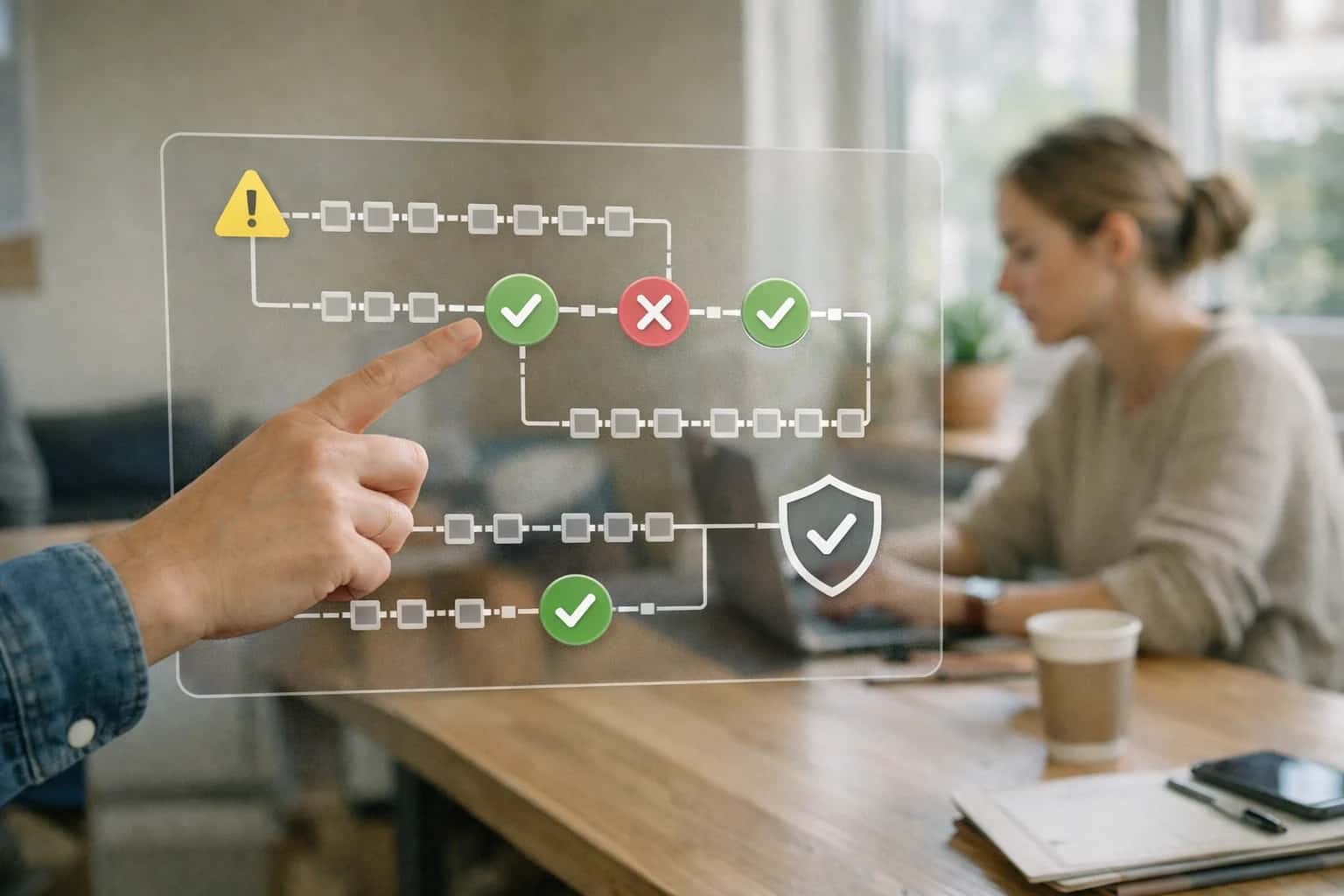
DATA LINEAGE & AUDITABILITY
What is Provenance Trail?
A provenance trail is the complete, auditable history of a data point's origin and all subsequent transformations, movements, and accesses, often visualized as a directed acyclic graph.
In enterprise AI systems, a robust provenance trail is critical for hallucination risk assessment and regulatory compliance. By linking a model's output to a specific row in a database or a passage in a source document via a lineage graph, engineers can perform root-cause analysis on factual errors. This capability transforms a generated claim from an opaque assertion into a traceable, defensible conclusion, underpinning the technical implementation of source grounding and attribution fidelity protocols.
DATA LINEAGE ARCHITECTURE
Key Features of a Provenance Trail
A provenance trail is the complete, auditable history of a data point's origin and all subsequent transformations, movements, and accesses. It is often visualized as a directed acyclic graph (DAG) and forms the backbone of verifiable AI systems.
01
Immutable Lineage Graph
The provenance trail is structured as a directed acyclic graph (DAG), where nodes represent data entities, activities, or agents, and edges represent dependencies. This structure prevents circular references and ensures a clear, queryable path from final output back to raw origin. Each transformation—whether a SQL query, a model inference step, or a human edit—is recorded as a distinct node with a cryptographic hash of its inputs and outputs, making the graph tamper-evident.
02
Cryptographic Chaining
Each step in the trail is linked using hash-based integrity checks, often implemented as a Merkle chain. The output hash of one step becomes the input reference for the next, creating a cascading verification mechanism. If any intermediate record is altered, all subsequent hashes break. This allows auditors to detect tampering without inspecting the entire dataset, and enables selective disclosure where only relevant portions of the lineage are revealed to a verifier.
03
Temporal Ordering via Trusted Timestamping
A provenance trail requires a verifiable temporal sequence. Trusted timestamping—issued by a Time Stamp Authority (TSA) or anchored to a distributed ledger—cryptographically proves that a specific data state existed at a precise moment. This is critical for regulatory compliance (e.g., SEC Rule 17a-4, GDPR Article 30) and for resolving disputes about data precedence in multi-party workflows. Without it, the 'when' of a transformation is merely a mutable metadata field.
04
Agent and Activity Attribution
Every node in the graph is bound to an agent (a user, service, or automated process) and an activity (the specific operation performed). This follows the W3C PROV data model's core structure of Entity-Activity-Agent. Attribution is enforced through signed assertions—cryptographic signatures that non-repudiably link an agent to their action. This enables precise accountability: a hallucinated AI output can be traced not just to the model, but to the specific prompt, retrieval query, and training data slice.
05
Granular N-gram Provenance
Advanced provenance trails support fine-grained attribution down to the token or n-gram level. Instead of citing an entire document, the system records which specific passages or data cells contributed to a generated claim. This is essential for Retrieval-Augmented Attribution architectures, where a language model must demonstrate exactly which retrieved text spans support each sentence in its output. It transforms the trail from a coarse document-level log into a surgical audit tool.
06
Interoperability via W3C PROV
To prevent vendor lock-in and enable cross-system auditing, provenance trails should serialize to the W3C PROV standard. This provides a common ontology (Entity, Activity, Agent) and serialization formats (PROV-O, PROV-N, PROV-JSON) that allow trails generated by different platforms—ETL tools, model training pipelines, content management systems—to be merged and queried uniformly. This interoperability is foundational for enterprise Data Observability and Quality Posture.
PROVENANCE TRAIL
Frequently Asked Questions
Explore the fundamental concepts behind tracking the complete, auditable history of data—from its origin through every transformation—to establish unshakeable trust in AI systems.
A provenance trail is the complete, auditable history of a data point's origin and all subsequent transformations, movements, and accesses, often visualized as a directed acyclic graph (DAG). It works by capturing metadata at each stage of the data lifecycle—creation, modification, aggregation, and deletion—and linking these events in a cryptographically verifiable chain. Each node in the graph represents an entity (a dataset, a model output), while each edge represents a process or activity (a transformation, a query). This creates an immutable record that answers the questions: Who created this data? What processes modified it? When and where did these events occur? In AI systems, provenance trails are critical for debugging hallucinations, ensuring regulatory compliance, and establishing the algorithmic authority of generated content by proving its factual lineage back to trusted, original sources.
Enabling Efficiency, Speed & Accuracy
Intelligent Analysis, Decision & Execution
We build AI systems for teams that need search across company data, workflow automation across tools, or AI features inside products and internal software.
Talk to Us
Search across company data
Give teams answers from docs, tickets, runbooks, and product data with sources and permissions.
Useful when people spend too long searching or get different answers from different systems.
Enterprise searchRAGPermissions
Read more
Automate internal workflows
Use AI to route work, draft outputs, trigger actions, and keep approvals and logs in place.
Useful when repetitive work moves across multiple tools and teams.
AI agentsWorkflow automationGovernance
Read more
Add AI to products and internal tools
Build assistants, guided actions, or decision support into the software your team or customers already use.
Useful when AI needs to be part of the product, not a separate tool.
AI integrationDecision supportModel routing
Read more
About the author
Prasad Kumkar
CEO & MD, Inference Systems
Prasad Kumkar is the CEO & MD of Inference Systems and writes about AI systems architecture, LLM infrastructure, model serving, evaluation, and production deployment. Over 5+ years, he has worked across computer vision models, L5 autonomous vehicle systems, and LLM research, with a focus on taking complex AI ideas into real-world engineering systems.
His work and writing cover AI systems, large language models, AI agents, multimodal systems, autonomous systems, inference optimization, RAG, evaluation, and production AI engineering.
LinkedIn
Limited slotsGet a Free AI Consultation
Partnered with leading AI, data, and software stack.





How We Work
Custom AI workflows for your Business
One-fit-all AI don't work for modern businesses. At Inferensys, we aim to understand your business & custom requirements; which we use to define most efficient agentic workflows, the data, and the tools for your business.
01
Review the use case
We understand the task, the users, and where AI can actually help.
Read more02
Pick the right approach
We define what needs search, automation, or product integration.
Read more03
Build the first useful version
We implement the part that proves the value first.
Read more04
Improve from there
We add the checks and visibility needed to keep it useful.
Read moreThe first call is a practical review of your use case and the right next step.
Talk to Us