Retrieval-Augmented Generation (RAG) is an AI framework that combines an information retrieval system with a generative large language model (LLM) to produce outputs grounded in an external, authoritative knowledge source. The architecture first queries a vector database or document store for semantically relevant data, then injects the retrieved context directly into the model's prompt window, constraining generation to the provided evidence.

Glossary
Retrieval-Augmented Generation (RAG)
A framework that enhances large language model output by first retrieving relevant information from an external knowledge base, then providing that context to the model to ground its response in verifiable facts.
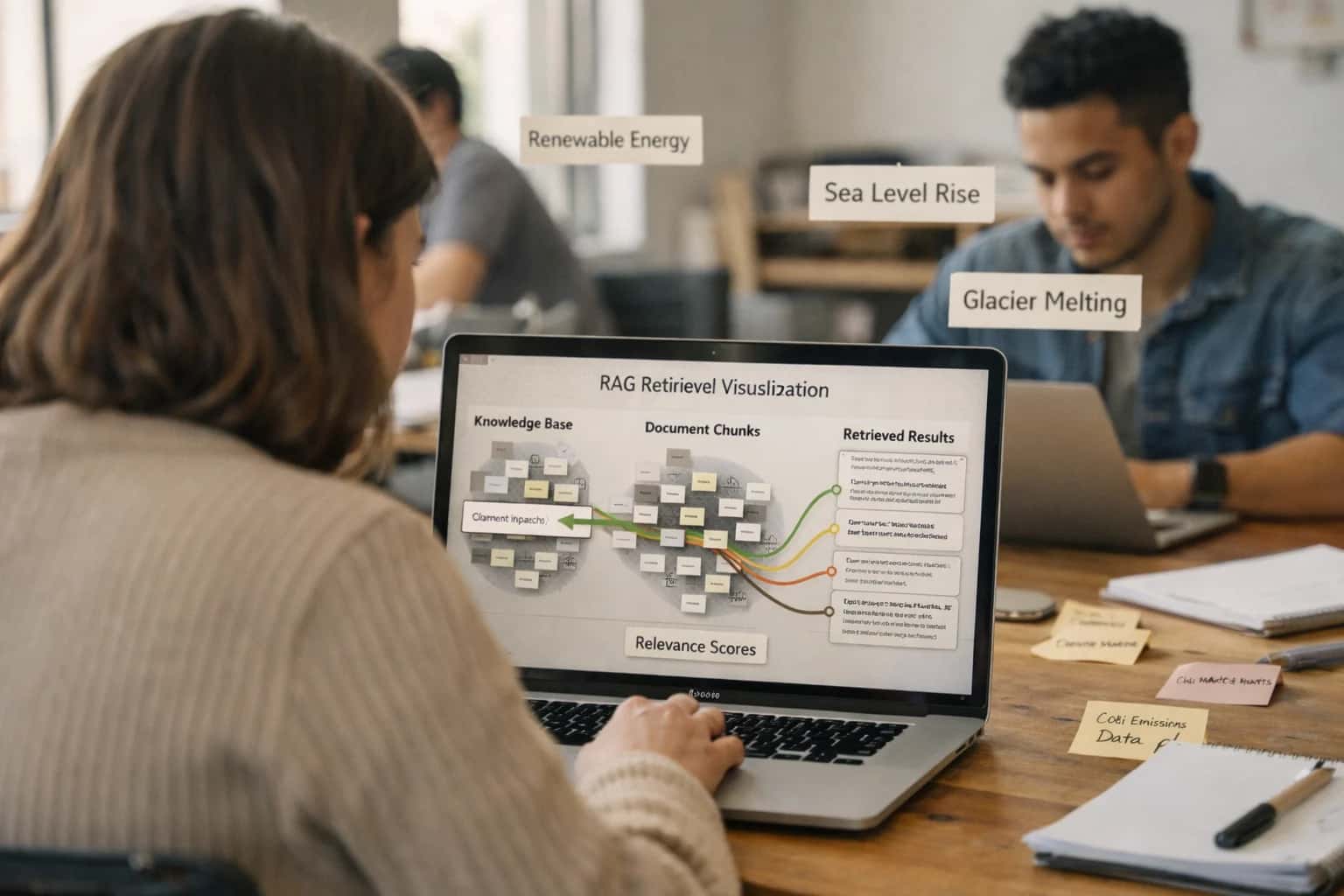
AI ARCHITECTURE
What is Retrieval-Augmented Generation (RAG)?
A framework that enhances large language model output by first retrieving relevant information from an external knowledge base, then providing that context to the model to ground its response in verifiable facts.
This design pattern mitigates hallucination by decoupling parametric memory from non-parametric, updatable knowledge. Unlike fine-tuning, RAG allows real-time data injection without retraining, making it essential for enterprise applications requiring factual consistency and verifiable source attribution in high-stakes domains.
ARCHITECTURAL FOUNDATIONS
Core Characteristics of RAG
Retrieval-Augmented Generation is not a single technique but a composite architecture. Its power derives from the precise orchestration of several distinct, verifiable sub-systems that collectively ground a language model's output in external facts.
01
The Retrieval Engine
The front-end of the pipeline responsible for fetching relevant context from an external knowledge base. This is not a simple keyword match; modern RAG systems rely on dense vector search to capture semantic meaning. The engine typically uses a bi-encoder architecture to embed a query and documents into the same high-dimensional space, enabling a fast similarity search via cosine distance. The quality of this step is measured by Retrieval Precision and Mean Reciprocal Rank (MRR).
Bi-Encoder
Standard Architecture
Cosine Similarity
Core Metric
02
Contextual Grounding
The defining mechanism that separates RAG from pure generation. Retrieved documents are prepended to the user's prompt as explicit context. The LLM is instructed to base its response only on this provided context. This process directly attacks hallucination by anchoring the model's statistical predictions to a specific, verifiable text. The success of this step is measured by the Faithfulness Metric, which checks if every claim in the output is entailed by the provided source.
Faithfulness
Primary Guardrail
Entailment
Logical Check
03
The Re-Ranking Cascade
A two-stage retrieval pipeline that balances speed and accuracy. The first stage uses a fast bi-encoder to retrieve a broad set of candidate documents (e.g., top 100). The second stage employs a computationally intensive cross-encoder that processes the query and each candidate document jointly through a transformer. This provides a highly precise relevance score, re-ordering the list to ensure only the most pertinent context reaches the LLM's limited context window.
Cross-Encoder
Precision Stage
NDCG
Ranking Metric
04
Agentic Self-Reflection
Advanced RAG architectures like Self-RAG and Corrective RAG (CRAG) transform the system from a static pipeline into a dynamic agent. The model is trained to generate special reflection tokens that critique the relevance and support of retrieved passages. If the initial retrieval is deemed irrelevant, the agent can autonomously trigger a new web search or reformulate its query. This creates a self-correcting loop that dramatically improves factual accuracy on complex, multi-hop questions.
Self-RAG
Adaptive Framework
CRAG
Corrective Loop
05
Hypothetical Document Embeddings (HyDE)
A novel retrieval technique that bridges the gap between a user's brief query and the detailed language of source documents. Instead of embedding the query directly, the system first prompts an LLM to generate a hypothetical ideal document that would answer the query. The vector embedding of this synthetic text is then used to search for genuinely similar documents in the knowledge base. This method significantly improves recall by aligning the search vector with the target document space.
HyDE
Query-to-Document Bridge
Recall
Primary Improvement
06
Source Attribution & Citation
The final, critical layer of a trustworthy RAG system. It is not enough to generate a correct answer; the system must prove it. Source Attribution mechanisms force the model to explicitly map every factual claim back to a specific span in a source document. This is evaluated by Citation Precision, which measures the proportion of cited statements that are fully supported by their linked source. This transforms the LLM from an oracle into an auditable research assistant.
Citation Precision
Auditability Metric
Evidence Extraction
Core Task
RAG FUNDAMENTALS
Frequently Asked Questions
Clear, technically precise answers to the most common questions about Retrieval-Augmented Generation, its mechanisms, and its role in grounding AI outputs in verifiable facts.
Retrieval-Augmented Generation (RAG) is an AI framework that enhances large language model (LLM) output by first retrieving relevant information from an external, authoritative knowledge base, then providing that context to the model to ground its response in verifiable facts. The process operates in two distinct phases: retrieval and generation. In the retrieval phase, a user query is converted into a vector embedding and used to search a vector database for semantically similar documents. The top-k most relevant chunks are fetched. In the generation phase, these retrieved documents are injected into the LLM's context window alongside the original query, and the model synthesizes a response that is explicitly conditioned on this provided evidence. This architecture mitigates hallucination by constraining the model's generative space to the supplied data, making it ideal for enterprise applications requiring high factual accuracy.
Enabling Efficiency, Speed & Accuracy
Intelligent Analysis, Decision & Execution
We build AI systems for teams that need search across company data, workflow automation across tools, or AI features inside products and internal software.
Talk to Us
Search across company data
Give teams answers from docs, tickets, runbooks, and product data with sources and permissions.
Useful when people spend too long searching or get different answers from different systems.
Enterprise searchRAGPermissions
Read more
Automate internal workflows
Use AI to route work, draft outputs, trigger actions, and keep approvals and logs in place.
Useful when repetitive work moves across multiple tools and teams.
AI agentsWorkflow automationGovernance
Read more
Add AI to products and internal tools
Build assistants, guided actions, or decision support into the software your team or customers already use.
Useful when AI needs to be part of the product, not a separate tool.
AI integrationDecision supportModel routing
Read moreARCHITECTURAL COMPARISON
RAG vs. Fine-Tuning vs. Standard LLM
A feature-level comparison of three approaches for grounding language model outputs in factual, domain-specific knowledge.
| Feature | RAG | Fine-Tuning | Standard LLM |
|---|---|---|---|
Knowledge Source | External vector DB / knowledge base queried at inference | Internalized into model weights during training | Static training data cutoff only |
Factual Grounding | |||
Real-Time Data Access | |||
Hallucination Risk | Low (constrained by retrieved context) | Medium (reduced via domain adaptation) | High (unconstrained generation) |
Source Attribution | |||
Update Latency | < 1 sec (re-index documents) | Hours to days (retraining cycle) | Months (new base model release) |
Compute Cost at Inference | Medium (retrieval + generation) | Low (single forward pass) | Low (single forward pass) |
Domain Adaptation Cost | Low (curate knowledge base) | High (curate dataset + GPU training) |
PRODUCTION ARCHITECTURES
Enterprise Use Cases for RAG
How leading organizations deploy Retrieval-Augmented Generation to ground AI in verifiable facts, eliminate hallucinations, and unlock proprietary knowledge bases.
01
Customer Support Automation
RAG transforms support by grounding chatbots in product manuals, troubleshooting guides, and historical ticket resolutions. The system retrieves the exact procedure for a specific error code and synthesizes a step-by-step response with source citations.
- Reduces hallucinated answers by anchoring to approved documentation
- Enables real-time policy updates without model retraining
- Example: A telecom provider reduced escalations by 40% by connecting their LLM to a vectorized knowledge base of 50,000 technical documents
40%
Escalation Reduction
< 2 sec
Retrieval Latency
02
Legal Document Analysis
Law firms and corporate legal departments use RAG to query massive contract repositories and case law databases. The system retrieves relevant clauses, precedents, and jurisdictional rulings to draft memos or assess risk with citation integrity.
- Eliminates manual review of thousands of pages
- Ensures every claim is traceable to a specific paragraph or ruling
- Multi-hop reasoning connects disparate statutes to answer complex regulatory questions
90%
Review Time Reduction
03
Clinical Decision Support
Healthcare systems deploy RAG to provide physicians with evidence-based recommendations at the point of care. The model retrieves the latest clinical guidelines, drug interaction data, and peer-reviewed studies to suggest treatment pathways.
- Grounds differential diagnoses in current medical literature
- Reduces risk of outdated or fabricated medical advice
- Integrates with Electronic Health Records (EHR) for patient-specific context
99.9%
Source Traceability
04
Financial Research & Compliance
Investment banks and auditors use RAG to synthesize insights from SEC filings, earnings transcripts, and market data streams. Analysts query natural language questions and receive answers backed by specific financial documents.
- Automates due diligence and regulatory compliance checks
- Prevents hallucination of financial figures by forcing retrieval
- Enables real-time analysis of breaking news against portfolio holdings
10M+
Documents Indexed
05
Internal Knowledge Management
Global enterprises deploy RAG to unlock tribal knowledge trapped in wikis, Slack channels, emails, and legacy intranets. Employees query a single interface that retrieves and synthesizes answers from across the organization's entire proprietary corpus.
- Breaks down silos between departments and tools
- Maintains access control so sensitive documents are only retrieved by authorized personnel
- Reduces onboarding time by providing instant, verified answers to new hires
60%
Faster Onboarding
06
E-Commerce Product Discovery
Retailers implement RAG to power semantic search and conversational shopping assistants. The system retrieves products based on vague natural language queries by matching intent to product specifications, reviews, and inventory data.
- Handles long-tail queries like 'a lightweight jacket for rainy spring hikes'
- Synthesizes comparison tables from structured and unstructured product data
- Increases conversion by providing factually grounded recommendations
25%
Conversion Uplift

About the author
Prasad Kumkar
CEO & MD, Inference Systems
Prasad Kumkar is the CEO & MD of Inference Systems and writes about AI systems architecture, LLM infrastructure, model serving, evaluation, and production deployment. Over 5+ years, he has worked across computer vision models, L5 autonomous vehicle systems, and LLM research, with a focus on taking complex AI ideas into real-world engineering systems.
His work and writing cover AI systems, large language models, AI agents, multimodal systems, autonomous systems, inference optimization, RAG, evaluation, and production AI engineering.
LinkedIn
Limited slotsGet a Free AI Consultation
Partnered with leading AI, data, and software stack.





How We Work
Custom AI workflows for your Business
One-fit-all AI don't work for modern businesses. At Inferensys, we aim to understand your business & custom requirements; which we use to define most efficient agentic workflows, the data, and the tools for your business.
01
Review the use case
We understand the task, the users, and where AI can actually help.
Read more02
Pick the right approach
We define what needs search, automation, or product integration.
Read more03
Build the first useful version
We implement the part that proves the value first.
Read more04
Improve from there
We add the checks and visibility needed to keep it useful.
Read moreThe first call is a practical review of your use case and the right next step.
Talk to Us