Graph RAG is a retrieval-augmented generation architecture that grounds a language model's responses in a structured knowledge graph rather than unstructured text chunks. By traversing nodes and edges during retrieval, it captures explicit, multi-hop relationships between entities, enabling deterministic reasoning over interconnected facts and significantly reducing hallucination on relational queries.

Glossary
Graph RAG
A retrieval-augmented generation architecture that uses a knowledge graph as the primary data source to provide structured, relational context to a language model.
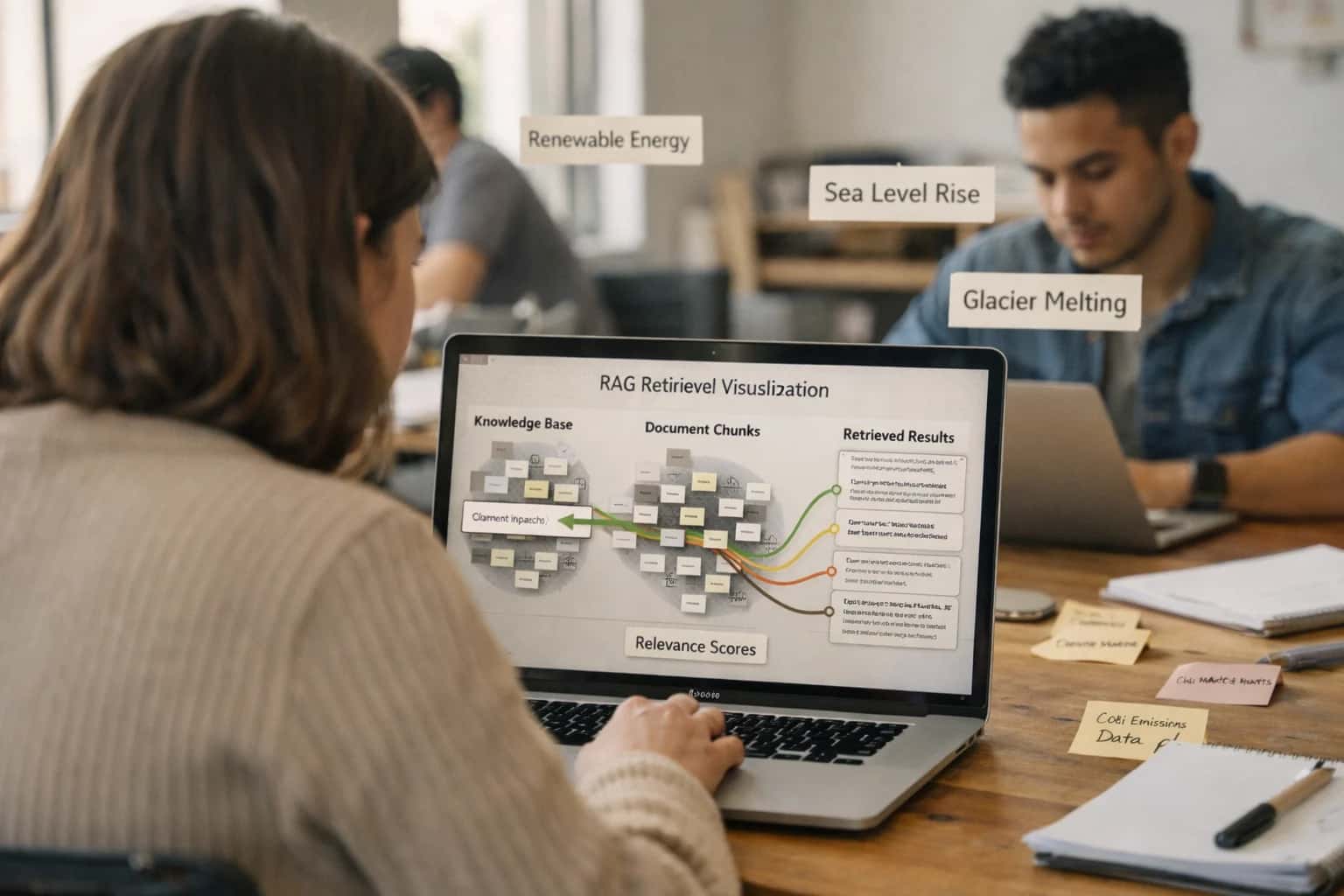
RETRIEVAL-AUGMENTED GENERATION
What is Graph RAG?
Graph RAG is a retrieval-augmented generation architecture that uses a knowledge graph as its primary data source to provide structured, relational context to a language model, enabling deterministic, multi-hop reasoning.
Unlike standard vector-based RAG, which retrieves semantically similar text blocks, Graph RAG executes graph traversal algorithms to gather context. This allows the system to answer complex questions requiring aggregation, pathfinding, or logical inference across a domain ontology, making it ideal for enterprise applications demanding high factual precision and auditability.
ARCHITECTURAL COMPONENTS
Key Features of Graph RAG
Graph RAG integrates structured knowledge with language models to produce factually grounded, contextually rich outputs. These core features distinguish it from naive RAG implementations.
01
Structured Context Retrieval
Unlike vector-only RAG that retrieves text chunks based on semantic similarity, Graph RAG queries a knowledge graph to fetch structured, relational data. This process involves:
- Translating a user query into a graph query language like Cypher or SPARQL.
- Traversing explicit relationships (edges) between entities (nodes).
- Returning a deterministic subgraph of facts, not probabilistic text snippets. This ensures the LLM receives high-precision, interconnected context, eliminating the noise of irrelevant text chunks.
02
Multi-Hop Reasoning
Graph RAG excels at answering complex questions that require synthesizing information across multiple steps. By leveraging graph traversal algorithms, the system can:
- Navigate from a starting entity through a chain of relationships.
- Aggregate information from distant nodes to infer a new, non-obvious conclusion.
- Example: "What drug targets the protein expressed by the gene linked to disease X?" requires traversing
Disease -> Gene -> Protein -> Drugpaths. This capability is fundamental to Knowledge Graph Question Answering (KGQA) and is difficult to achieve with flat document retrieval.
03
Hallucination Mitigation via Grounding
A primary failure mode of LLMs is generating plausible but factually incorrect statements. Graph RAG directly counters this by anchoring generation to a deterministic knowledge base. The mechanism works by:
- Constraining the model's attention to the retrieved subgraph of verified facts.
- Providing explicit data provenance for every fact, allowing the system to cite its source.
- Enabling a fact verification step where generated statements are cross-checked against the graph before being shown to the user. This transforms the LLM from a source of truth into a reasoning engine over a trusted source of truth.
04
Dynamic Knowledge Integration
Graph RAG systems can be designed to query live, evolving knowledge graphs rather than static, pre-indexed vector stores. This enables:
- Real-time access to the latest data without re-indexing or re-training.
- Integration with transactional graph databases like Neo4j that support constant updates.
- A unified architecture where the same graph supports both operational applications and analytical AI queries. This is a critical advantage for enterprise use cases in finance, supply chain, and e-commerce where data freshness is non-negotiable.
05
Explainable Retrieval Paths
A key trust mechanism in Graph RAG is the full auditability of its retrieval process. Unlike the opaque similarity scores of vector search, a graph traversal produces a clear, human-readable path. This provides:
- Citation Integrity: The exact sequence of
Entity -> Relationship -> Entitythat led to an answer can be displayed. - Algorithmic Explainability: Users and auditors can inspect why a specific fact was retrieved, tracing it back to the query logic.
- Debugging capabilities for developers to refine the underlying ontology and query templates when incorrect paths are taken.
06
Hybrid Retrieval Fusion
Production Graph RAG systems often combine the strengths of structured and unstructured retrieval. A common pattern is Hybrid Retrieval Fusion:
- A graph query retrieves precise, relational facts (e.g., a list of entities).
- A vector similarity search retrieves relevant paragraphs from documents that provide descriptive context about those entities.
- Both results are fused into a single, enriched prompt for the LLM. This approach marries the high precision of a knowledge graph with the semantic richness of natural language documents, providing a complete picture.
GRAPH RAG EXPLAINED
Frequently Asked Questions
Clear, technically precise answers to the most common questions about Graph Retrieval-Augmented Generation, its mechanisms, and its role in grounding AI outputs to deterministic facts.
Graph RAG (Graph Retrieval-Augmented Generation) is an architectural pattern that grounds a language model's outputs by retrieving structured, relational context from a knowledge graph rather than from unstructured text chunks. The process works in two phases: first, a retrieval module converts a user query into a graph traversal or query (e.g., using Text-to-SPARQL or Cypher), extracting a subgraph of relevant entities and their relationships. Second, this structured context—often serialized as triples or a summarized graph neighborhood—is injected into the model's prompt window alongside the original query. This provides the model with deterministic, high-precision facts about how entities relate to one another, enabling multi-hop reasoning that vector-based RAG systems struggle to perform reliably. Unlike semantic search over text embeddings, Graph RAG retrieves explicit, verifiable connections, such as [Company] - acquired_by -> [ParentCorp], which drastically reduces hallucination for queries requiring relational precision.
Enabling Efficiency, Speed & Accuracy
Intelligent Analysis, Decision & Execution
We build AI systems for teams that need search across company data, workflow automation across tools, or AI features inside products and internal software.
Talk to Us
Search across company data
Give teams answers from docs, tickets, runbooks, and product data with sources and permissions.
Useful when people spend too long searching or get different answers from different systems.
Enterprise searchRAGPermissions
Read more
Automate internal workflows
Use AI to route work, draft outputs, trigger actions, and keep approvals and logs in place.
Useful when repetitive work moves across multiple tools and teams.
AI agentsWorkflow automationGovernance
Read more
Add AI to products and internal tools
Build assistants, guided actions, or decision support into the software your team or customers already use.
Useful when AI needs to be part of the product, not a separate tool.
AI integrationDecision supportModel routing
Read more
About the author
Prasad Kumkar
CEO & MD, Inference Systems
Prasad Kumkar is the CEO & MD of Inference Systems and writes about AI systems architecture, LLM infrastructure, model serving, evaluation, and production deployment. Over 5+ years, he has worked across computer vision models, L5 autonomous vehicle systems, and LLM research, with a focus on taking complex AI ideas into real-world engineering systems.
His work and writing cover AI systems, large language models, AI agents, multimodal systems, autonomous systems, inference optimization, RAG, evaluation, and production AI engineering.
LinkedIn
Limited slotsGet a Free AI Consultation
Partnered with leading AI, data, and software stack.





How We Work
Custom AI workflows for your Business
One-fit-all AI don't work for modern businesses. At Inferensys, we aim to understand your business & custom requirements; which we use to define most efficient agentic workflows, the data, and the tools for your business.
01
Review the use case
We understand the task, the users, and where AI can actually help.
Read more02
Pick the right approach
We define what needs search, automation, or product integration.
Read more03
Build the first useful version
We implement the part that proves the value first.
Read more04
Improve from there
We add the checks and visibility needed to keep it useful.
Read moreThe first call is a practical review of your use case and the right next step.
Talk to Us