Data lineage is the comprehensive map of a dataset's journey, documenting its origin, intermediate processing steps, and final destination. It captures the sequence of transformations, aggregations, and forks that data undergoes as it flows through pipelines, enabling engineers to trace any analytical result back to its raw source.

Glossary
Data Lineage
Data lineage is the lifecycle tracking of data's origins, transformations, and movements across systems, providing a complete audit trail from source to consumption.
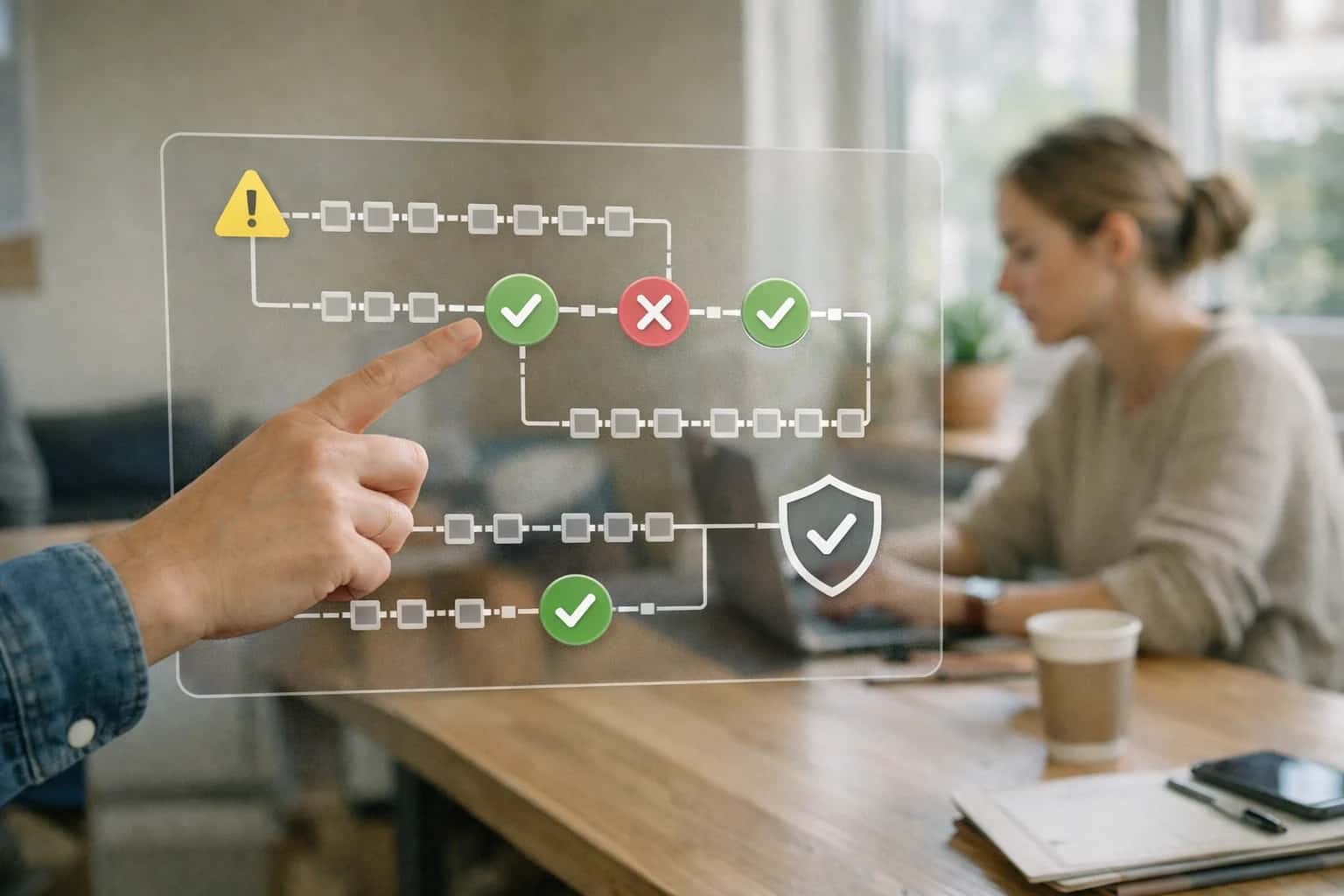
INFORMATION LIFECYCLE TRACKING
What is Data Lineage?
Data lineage is the lifecycle tracking of data's origins, transformations, and movements across systems, providing a complete audit trail from source to consumption.
This capability is foundational for impact analysis, debugging, and regulatory compliance. By visualizing upstream dependencies and downstream consumers, organizations can assess the blast radius of schema changes and verify that critical reports are built on trusted, unbroken chains of data provenance.
FOUNDATIONAL CAPABILITIES
Key Characteristics of Data Lineage
Data lineage provides a complete, auditable map of data's journey from origin to consumption. These characteristics define a robust lineage implementation.
01
Granularity: Column-Level Tracking
The most precise form of lineage traces data at the column level, mapping how a single field in a report is derived from specific source columns through a chain of transformations. This contrasts with table-level lineage, which only tracks whole datasets.
- Example: A
customer_lifetime_valuefield in a dashboard is traced back through a dbt model toorders.totalandcustomers.acquisition_costin the raw ingestion layer. - Benefit: Enables precise impact analysis and regulatory compliance for sensitive fields like PII.
02
Automated Discovery via Parsing
Modern lineage systems automatically extract relationships by parsing the code that transforms data, rather than relying on manual documentation. They analyze SQL queries, Python scripts, and ETL job configurations to build a dependency graph.
- SQL Parsing: Identifies source and target columns in
SELECT,INSERT, andMERGEstatements. - OpenLineage Standard: An open framework where job schedulers like Apache Airflow emit lineage metadata as events to a central collector.
- Benefit: Eliminates the drift between documented and actual data flows.
03
End-to-End Visibility Across Heterogeneous Systems
A complete lineage graph stitches together flows across disparate systems—from streaming platforms like Apache Kafka to data warehouses like Snowflake and BI tools like Looker. It captures both batch and real-time pipelines.
- Cross-System Edges: A lineage tool must correlate a Kafka topic's schema to a Spark job's input and then to a dashboard's dataset.
- Benefit: Provides a single pane of glass for data observability, allowing engineers to trace an error in a report back to a failed sensor ingestion in seconds.
04
Temporal Versioning and Time Travel
Lineage is not static; it must capture the state of data and its transformations at specific points in time. This is achieved through data versioning and table formats like Delta Lake or Apache Iceberg.
- Time Travel Queries: Allow users to query a table as it existed at a specific timestamp or transaction ID.
- Lineage Snapshots: The lineage graph itself must be versioned to show how transformation logic changed between releases.
- Benefit: Enables reproducibility for audits and debugging, allowing teams to see exactly what code produced a now-erroneous report.
05
Impact Analysis and Root Cause Diagnosis
Lineage is the engine for both forward-looking impact analysis and backward-looking root cause analysis. It answers 'What will break if I change this?' and 'What caused this error?'
- Forward Trace: Before deprecating a source column, an engineer can instantly see every downstream model, dashboard, and ML feature that depends on it.
- Backward Trace: When a CFO's report shows a null value, the lineage graph is traversed upstream to identify the exact transformation step that introduced the null.
- Benefit: Reduces incident resolution time from hours to minutes.
06
Integration with Data Contracts
Lineage enforces data contracts by making dependencies explicit. A contract defines a producer's schema and quality guarantees; lineage monitors whether consumers are adhering to the contract and alerts on violations.
- Schema Enforcement: If a producer changes a column type, lineage identifies all downstream consumers that will break, triggering a contract violation alert before deployment.
- Ownership Mapping: Lineage graphs associate datasets with the owning teams, clarifying who is responsible for fixing a pipeline failure.
- Benefit: Prevents the silent breakage of critical data products in a decentralized data mesh.
DATA LINEAGE FAQ
Frequently Asked Questions
Clear, technically precise answers to the most common questions about tracking data's complete lifecycle from origin to consumption.
Data lineage is the lifecycle tracking of data's origins, transformations, and movements across systems, providing a complete audit trail from source to consumption. It works by capturing metadata at each processing step—extraction, cleansing, aggregation, and loading—and linking these steps into a directed graph. Modern implementations use frameworks like OpenLineage to automatically collect this metadata from job schedulers and query engines, while column-level lineage traces how individual fields in a target table derive from specific source columns. The result is a visual or programmatic map showing exactly how data flows, who touched it, and what logic was applied at each stage.
INFORMATION LIFECYCLE DISCIPLINES
Data Lineage vs. Data Provenance vs. Data Observability
A comparison of three distinct but complementary disciplines for managing data trust, history, and health in enterprise pipelines.
| Feature | Data Lineage | Data Provenance | Data Observability |
|---|---|---|---|
Primary Focus | Tracing data movement and transformation logic across systems | Documenting the historical context, ownership, and authenticity of data | Monitoring the real-time operational health and state of data pipelines |
Core Question Answered | "How was this data created and where did it go?" | "Where did this data originate and who touched it?" | "Is the data fresh, complete, and reliable right now?" |
Temporal Orientation | Past and present (forward and backward tracing) | Past (historical record and chain of custody) | Present (real-time monitoring and anomaly detection) |
Granularity | Column-level, table-level, and system-level transformation logic | Dataset-level, business process-level, and agent-level documentation | Pipeline-level, table-level, and field-level metrics and distributions |
Key Metadata Captured | Input/output schemas, transformation code, job execution logs | Data creator, timestamps, processing steps, custodians, licenses | Freshness, volume, schema changes, null rates, distribution drift |
Primary Use Case | Impact analysis, debugging pipelines, regulatory compliance | Auditability, reproducibility, intellectual property attribution | Incident prevention, SLA enforcement, pipeline reliability |
Standard/Protocol | OpenLineage, SQL parser outputs, DAG definitions | W3C PROV, Dublin Core, custom provenance records | Data quality metrics, statistical profiling, anomaly scores |
Typical Consumer | Data engineers, analytics engineers | Compliance officers, data stewards, auditors | Data reliability engineers, platform operators |
Enabling Efficiency, Speed & Accuracy
Intelligent Analysis, Decision & Execution
We build AI systems for teams that need search across company data, workflow automation across tools, or AI features inside products and internal software.
Talk to Us
Search across company data
Give teams answers from docs, tickets, runbooks, and product data with sources and permissions.
Useful when people spend too long searching or get different answers from different systems.
Enterprise searchRAGPermissions
Read more
Automate internal workflows
Use AI to route work, draft outputs, trigger actions, and keep approvals and logs in place.
Useful when repetitive work moves across multiple tools and teams.
AI agentsWorkflow automationGovernance
Read more
Add AI to products and internal tools
Build assistants, guided actions, or decision support into the software your team or customers already use.
Useful when AI needs to be part of the product, not a separate tool.
AI integrationDecision supportModel routing
Read more
About the author
Prasad Kumkar
CEO & MD, Inference Systems
Prasad Kumkar is the CEO & MD of Inference Systems and writes about AI systems architecture, LLM infrastructure, model serving, evaluation, and production deployment. Over 5+ years, he has worked across computer vision models, L5 autonomous vehicle systems, and LLM research, with a focus on taking complex AI ideas into real-world engineering systems.
His work and writing cover AI systems, large language models, AI agents, multimodal systems, autonomous systems, inference optimization, RAG, evaluation, and production AI engineering.
LinkedIn
Limited slotsGet a Free AI Consultation
Partnered with leading AI, data, and software stack.





How We Work
Custom AI workflows for your Business
One-fit-all AI don't work for modern businesses. At Inferensys, we aim to understand your business & custom requirements; which we use to define most efficient agentic workflows, the data, and the tools for your business.
01
Review the use case
We understand the task, the users, and where AI can actually help.
Read more02
Pick the right approach
We define what needs search, automation, or product integration.
Read more03
Build the first useful version
We implement the part that proves the value first.
Read more04
Improve from there
We add the checks and visibility needed to keep it useful.
Read moreThe first call is a practical review of your use case and the right next step.
Talk to Us