A side-channel attack is a security exploit that extracts secrets from a system by measuring and analyzing physical information leakage—such as timing variations, power consumption, electromagnetic emissions, or acoustic signals—rather than breaking the underlying cryptographic algorithm mathematically. Unlike direct attacks on code or ciphertext, side-channel attacks observe the physical implementation of a computation to infer sensitive data like private keys.

Glossary
Side-Channel Attack
An attack that exploits physical information leakage from a computer system—such as timing, power consumption, or electromagnetic emissions—to extract secrets rather than attacking the algorithm directly.
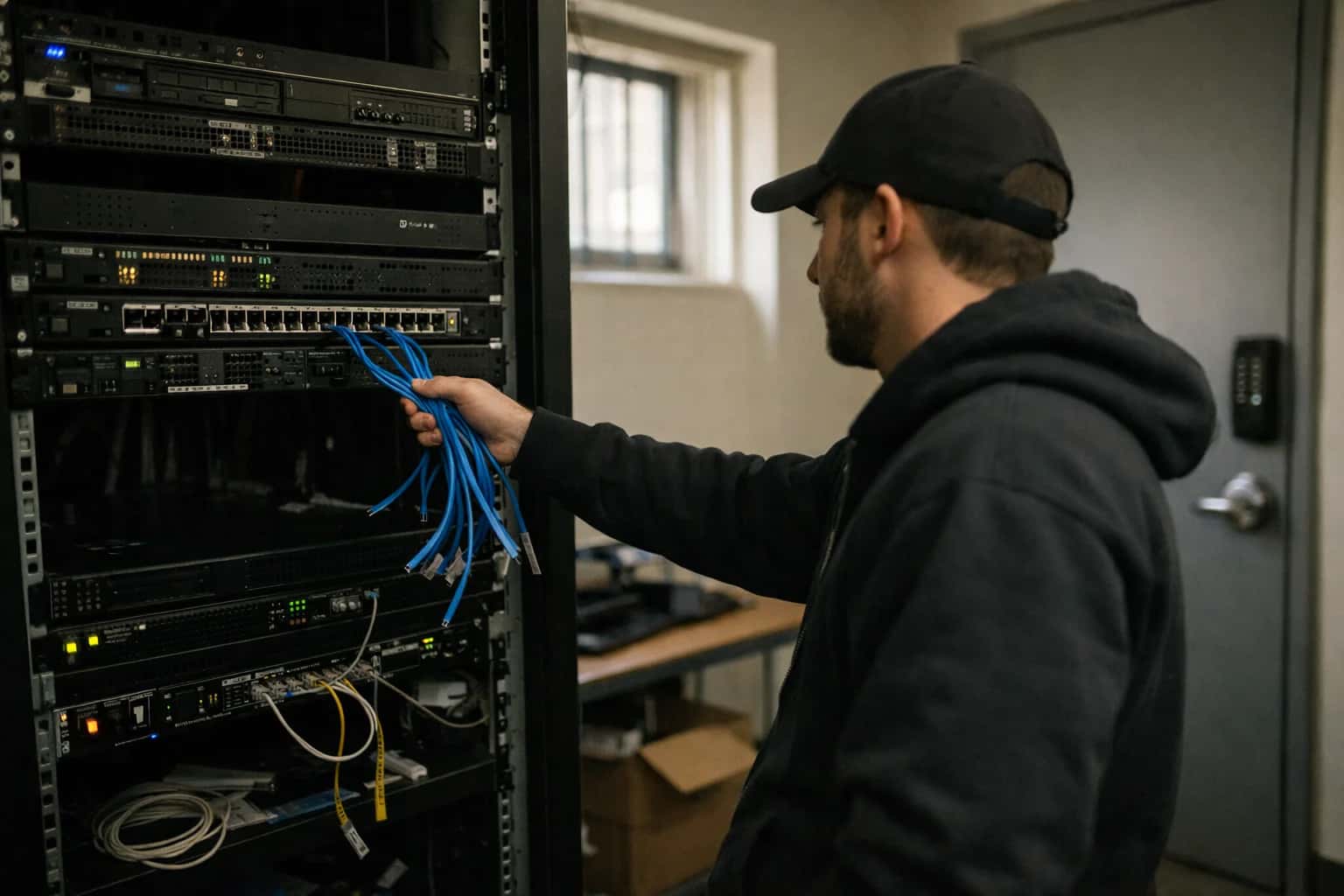
PHYSICAL LEAKAGE EXPLOITATION
What is a Side-Channel Attack?
A side-channel attack bypasses mathematical cryptography by exploiting unintended physical emissions from a computing system during algorithm execution.
Common vectors include cache-timing attacks that measure memory access latency to deduce cryptographic keys, power analysis using oscilloscopes to correlate processor energy draw with secret data processing, and electromagnetic analysis that captures radio frequency emissions from circuits. Defenses require hardware-level countermeasures such as constant-time programming, power consumption balancing, and physical shielding to eliminate the correlation between secret data and observable physical phenomena.
PHYSICAL LEAKAGE EXPLOITATION
Core Characteristics of Side-Channel Attacks
Side-channel attacks bypass mathematical cryptography by observing the physical byproducts of computation. Rather than attacking the algorithm, they exploit the implementation's unintended emissions to extract secrets.
01
Timing Analysis
Exploits variations in execution time to infer secret data. Cryptographic operations often take different amounts of time depending on the key bits being processed.
- Example: An attacker measures how long a server takes to respond to carefully crafted queries, revealing private key bits through statistical analysis of timing deltas.
- Target: RSA, ECDSA, and AES implementations without constant-time guarantees.
- Mitigation: Constant-time programming techniques that ensure all code paths execute in identical cycles regardless of input values.
02
Power Analysis (SPA/DPA)
Monitors a device's power consumption during cryptographic operations. Simple Power Analysis (SPA) visually interprets a single trace, while Differential Power Analysis (DPA) uses statistical methods across thousands of traces.
- SPA: Directly observes instruction sequences in a power trace to distinguish key-dependent branches.
- DPA: Correlates power consumption patterns with hypothetical intermediate values to extract keys even from noisy measurements.
- Target: Smart cards, hardware security modules, and embedded devices.
03
Electromagnetic Emanations
Captures electromagnetic radiation emitted by processors, memory buses, and cryptographic accelerators during computation. Provides higher spatial resolution than power analysis.
- Technique: Using near-field probes positioned over specific chip regions to isolate the activity of individual components.
- Van Eck phreaking: A classic example reconstructing display contents from electromagnetic emissions.
- Advantage: Can be performed at a distance without direct physical contact with the target device.
04
Cache-Based Attacks
Exploits the shared CPU cache to leak information across security boundaries. By measuring memory access latencies, an attacker determines which cache lines were accessed by a victim process.
- Prime+Probe: Attacker fills cache, waits for victim to evict lines, then probes to see which lines were evicted.
- Flush+Reload: Attacker flushes shared memory from cache, then measures reload time to detect victim access.
- Spectre/Meltdown: Catastrophic examples using speculative execution side-channels to read arbitrary kernel memory.
05
Acoustic Cryptanalysis
Analyzes sound emissions produced by electronic components. Capacitors and coils vibrate at frequencies correlated with the current draw of cryptographic operations.
- Historical example: Researchers extracted 4096-bit RSA keys by recording the high-pitched sounds of a laptop's voltage regulation circuitry during decryption.
- Frequency range: Typically 10-150 kHz, often above human hearing but capturable with standard microphones.
- Modern relevance: Extends to fan speed modulation and mechanical hard drive seek patterns as information channels.
06
Optical Side-Channels
Observes visual indicators of computation, including LED status lights, screen reflections, or photon emissions from transistors.
- LED exfiltration: Modulating device indicator LEDs at frequencies imperceptible to humans but readable by photodetectors.
- Photon emission analysis: Detecting individual photon bursts from switching transistors using sensitive cameras to reconstruct logic states.
- Reflective attacks: Capturing screen content from reflections on eyeglasses, windows, or other glossy surfaces in the environment.
SIDE-CHANNEL ATTACKS
Frequently Asked Questions
Explore the mechanisms, vectors, and mitigation strategies for side-channel attacks that exploit physical information leakage from computing systems to extract secrets.
A side-channel attack is a security exploit that extracts secrets from a system by measuring and analyzing physical information leakage—such as timing variations, power consumption, electromagnetic emissions, or acoustic signals—rather than attacking the cryptographic algorithm directly. Unlike brute-force attacks that target mathematical weaknesses, side-channel attacks observe the physical implementation of a computation. For example, an attacker might measure the precise time it takes a CPU to perform cryptographic operations; the execution time often varies depending on the secret key bits being processed. By collecting thousands of these timing measurements and applying statistical analysis, the attacker can reconstruct the private key. The fundamental principle is that every computational operation has a physical manifestation, and these manifestations create observable side channels that leak information about the internal state of the system.
ATTACK VECTOR COMPARISON
Side-Channel Attacks vs. Other Attack Vectors
A comparison of side-channel attacks against other common attack vectors targeting machine learning systems, highlighting differences in target, access requirements, and exploitation mechanisms.
| Feature | Side-Channel Attack | Model Inversion Attack | Membership Inference Attack |
|---|---|---|---|
Primary Target | Physical emanations (timing, power, EM) | Training data features or prototypes | Individual record membership status |
Access Required | Physical proximity or shared hardware | Model API access (black-box or white-box) | Model API access with confidence scores |
Exploited Mechanism | Implementation leakage, not algorithmic flaw | Model parameter overfitting to training data | Statistical differences in model behavior |
Attacks Algorithm Directly | |||
Requires Model Queries | |||
Reconstructs Training Data | |||
Typical Defense | Constant-time code, shielding, noise injection | Differential privacy, DP-SGD | Differential privacy, output perturbation |
Threat Model | Hardware/implementation level | Model/application level | Model/application level |
Enabling Efficiency, Speed & Accuracy
Intelligent Analysis, Decision & Execution
We build AI systems for teams that need search across company data, workflow automation across tools, or AI features inside products and internal software.
Talk to Us
Search across company data
Give teams answers from docs, tickets, runbooks, and product data with sources and permissions.
Useful when people spend too long searching or get different answers from different systems.
Enterprise searchRAGPermissions
Read more
Automate internal workflows
Use AI to route work, draft outputs, trigger actions, and keep approvals and logs in place.
Useful when repetitive work moves across multiple tools and teams.
AI agentsWorkflow automationGovernance
Read more
Add AI to products and internal tools
Build assistants, guided actions, or decision support into the software your team or customers already use.
Useful when AI needs to be part of the product, not a separate tool.
AI integrationDecision supportModel routing
Read more
About the author
Prasad Kumkar
CEO & MD, Inference Systems
Prasad Kumkar is the CEO & MD of Inference Systems and writes about AI systems architecture, LLM infrastructure, model serving, evaluation, and production deployment. Over 5+ years, he has worked across computer vision models, L5 autonomous vehicle systems, and LLM research, with a focus on taking complex AI ideas into real-world engineering systems.
His work and writing cover AI systems, large language models, AI agents, multimodal systems, autonomous systems, inference optimization, RAG, evaluation, and production AI engineering.
LinkedIn
Limited slotsGet a Free AI Consultation
Partnered with leading AI, data, and software stack.





How We Work
Custom AI workflows for your Business
One-fit-all AI don't work for modern businesses. At Inferensys, we aim to understand your business & custom requirements; which we use to define most efficient agentic workflows, the data, and the tools for your business.
01
Review the use case
We understand the task, the users, and where AI can actually help.
Read more02
Pick the right approach
We define what needs search, automation, or product integration.
Read more03
Build the first useful version
We implement the part that proves the value first.
Read more04
Improve from there
We add the checks and visibility needed to keep it useful.
Read moreThe first call is a practical review of your use case and the right next step.
Talk to Us