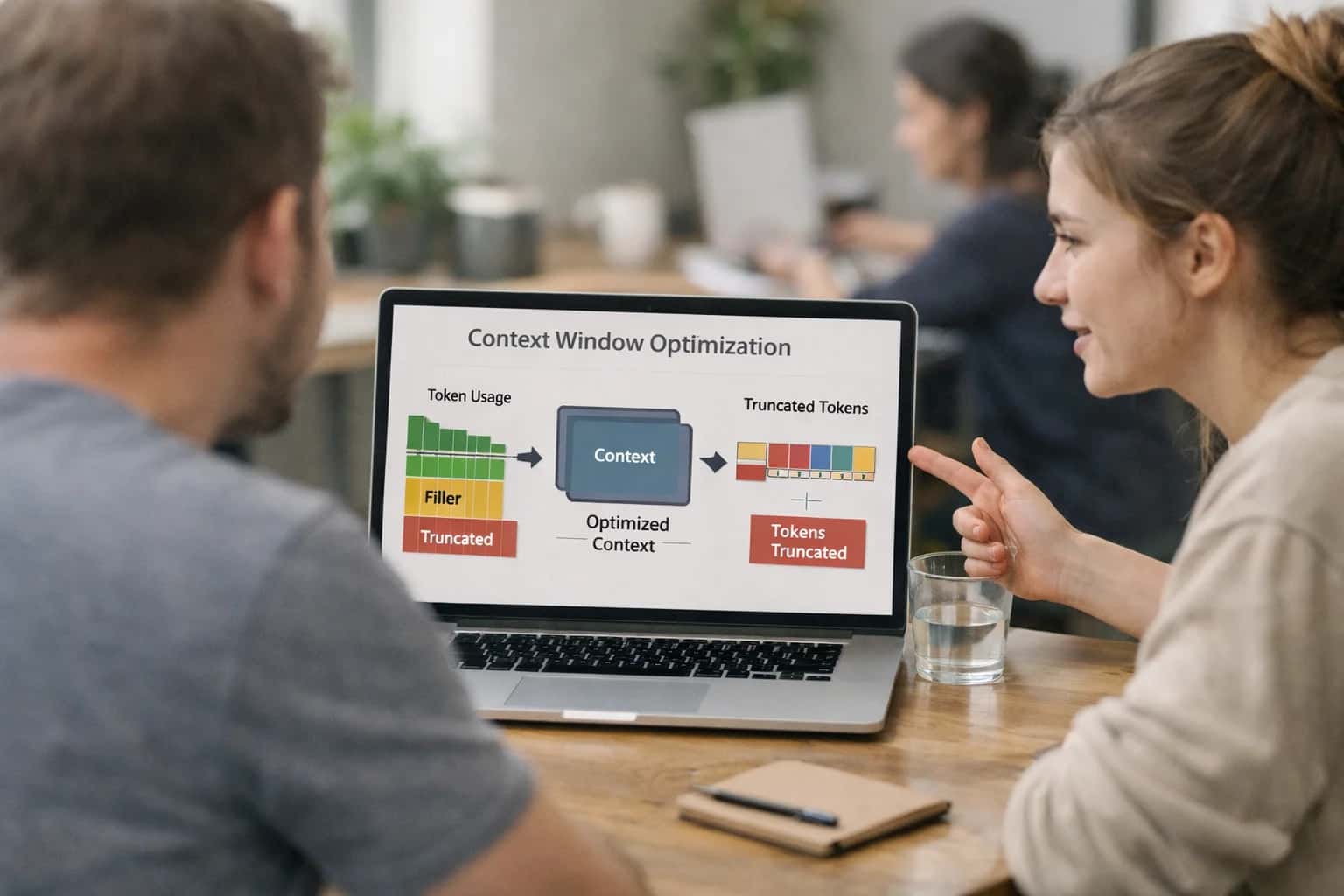
Context Window Overflow is an adversarial attack that deliberately exceeds an LLM's maximum token limit by injecting a high volume of low-value or filler text into the input stream. This forces the model's positional attention mechanism to truncate earlier, often critical, content—such as system prompts, safety guardrails, or few-shot examples—from the effective context. The attack exploits the architectural constraint of fixed context windows, where tokens beyond the limit are irretrievably dropped before inference begins.

Glossary
Context Window Overflow
An attack that exploits token limits by flooding the context window with irrelevant data to displace critical system prompts, safety instructions, or few-shot examples.
TOKEN BUDGET EXHAUSTION ATTACK
What is Context Window Overflow?
A denial-of-service or manipulation technique that exploits the finite token capacity of a language model's context window by flooding it with irrelevant data, forcing the displacement of critical system prompts, safety instructions, or few-shot examples.
The attack serves dual purposes: as a denial-of-service vector that degrades agent performance by removing grounding instructions, and as a privilege escalation mechanism that strips safety constraints to enable subsequent prompt injection. Mitigation strategies include context-aware chunking, instruction anchoring through repetition at multiple positions, and sliding window attention with prioritized memory management to ensure critical directives remain resident regardless of input length.
ATTACK VECTOR ANATOMY
Core Characteristics of Context Window Overflow
Context Window Overflow is a structural attack on the finite attention span of large language models. By exploiting token limits, adversaries displace critical safety instructions and reasoning context with irrelevant data.
01
The Token Budget Exhaustion Mechanism
Every LLM has a finite context window—a maximum number of tokens it can process at once. A Context Window Overflow attack floods this window with adversarial filler content, consuming the available token budget. This forces the model's attention mechanism to truncate or dilute system prompts, safety guardrails, and few-shot examples that were positioned earlier in the sequence. The attack exploits the positional encoding architecture of transformers, where tokens compete for a fixed attention budget. Once critical instructions are pushed beyond the model's effective attention horizon, the agent operates with degraded or absent safety constraints.
128K–1M+
Typical Token Limits
Attention Decay
Primary Exploit Vector
03
System Prompt Displacement Attack
The most direct form of Context Window Overflow targets the system prompt—the foundational instruction set that defines an agent's identity, constraints, and safety boundaries. The attack works by:
- Injecting a massive volume of text before the user query reaches the model
- Pushing the system prompt beyond the model's maximum context length
- Causing the model to process the query with no safety instructions in active memory Once displaced, the agent reverts to its base model behavior, which lacks the application-specific guardrails, role constraints, and tool-use restrictions that were defined in the now-truncated system prompt.
Full Bypass
Safety Impact
Pre-Query
Injection Timing
04
Recursive Summarization Poisoning
When an agent uses recursive summarization to compress long conversation histories into a manageable context, a Context Window Overflow attack can corrupt this compression step. The attacker floods the conversation with adversarial content that, when summarized, produces a distorted representation of the interaction history. Key safety events, user corrections, or override commands may be:
- Omitted entirely from the summary
- Reframed with attacker-intended meaning
- Deprioritized below injected false priorities This creates a persistent corruption that cascades through all subsequent turns, as the agent operates on a falsified memory of its own interaction history.
05
Tool Output Buffer Flooding
Agents that call external tools or APIs are vulnerable to overflow through tool output channels. An attacker who controls a data source can:
- Return an excessively large response from a compromised API endpoint
- Flood the context with garbage data that displaces the original task context
- Embed hidden instructions within the flood that the agent processes as trusted tool output Because agents typically treat tool outputs as high-trust context, the overflow payload bypasses standard input filters. The agent then acts on the injected instructions as if they were legitimate API responses, leading to tool output poisoning and unauthorized action execution.
06
Chunk Boundary Injection Technique
This precision attack exploits how document chunking works in RAG pipelines. Attackers craft content that:
- Sits precisely at chunk boundaries in source documents
- Gets retrieved as a standalone context fragment during semantic search
- Appears authoritative because it lacks surrounding contradictory context When combined with overflow, the attacker floods the retrieval pipeline with many such boundary-crafted chunks. The re-ranking model may select these adversarial fragments, and the overflow condition ensures the agent cannot see the broader document context that would reveal the manipulation. The isolated chunk is processed as a complete, trustworthy fact.
ATTACK VECTOR COMPARISON
Context Window Overflow vs. Related Attacks
Distinguishing context window overflow from adjacent adversarial techniques that exploit token limits, attention mechanisms, and context management vulnerabilities in agentic systems.
| Feature | Context Window Overflow | Token Budget Attack | Lost-in-the-Middle Exploit |
|---|---|---|---|
Primary Mechanism | Flooding context with irrelevant data to displace critical instructions | Consuming token budget to force truncation of safety guardrails | Placing malicious payload in positional attention blind spot |
Attack Goal | Displacement of system prompts and few-shot examples | Denial-of-service on reasoning capacity | Covert instruction execution with reduced scrutiny |
Target Layer | Context assembly pipeline | Token counting and truncation logic | Transformer attention distribution |
Requires Token Limit Knowledge | |||
Exploits Positional Bias | |||
Persistence Across Turns | |||
Detection Difficulty | Low | Medium | High |
Mitigation Approach | Context sanitization and priority anchoring | Dynamic budget allocation and safety token reservation | Position-invariant attention mechanisms |
CONTEXT WINDOW OVERFLOW
Frequently Asked Questions
Explore the mechanics, risks, and mitigations for attacks that exploit token limits to displace critical agent instructions.
A Context Window Overflow is an adversarial attack that exploits the finite token capacity of a language model's context window by flooding it with massive amounts of irrelevant or junk data. The primary objective is to forcibly displace critical system prompts, safety guardrails, or few-shot examples from the model's active attention. When the context limit is exceeded, the model's internal truncation mechanisms typically discard the earliest tokens—which often contain the most critical foundational instructions—allowing the attacker's payload to hijack the agent's behavior. This attack is a form of denial-of-service against the model's alignment layer, effectively blinding the agent to its original programming by exceeding its working memory capacity.
Enabling Efficiency, Speed & Accuracy
Intelligent Analysis, Decision & Execution
We build AI systems for teams that need search across company data, workflow automation across tools, or AI features inside products and internal software.
Talk to Us
Search across company data
Give teams answers from docs, tickets, runbooks, and product data with sources and permissions.
Useful when people spend too long searching or get different answers from different systems.
Enterprise searchRAGPermissions
Read more
Automate internal workflows
Use AI to route work, draft outputs, trigger actions, and keep approvals and logs in place.
Useful when repetitive work moves across multiple tools and teams.
AI agentsWorkflow automationGovernance
Read more
Add AI to products and internal tools
Build assistants, guided actions, or decision support into the software your team or customers already use.
Useful when AI needs to be part of the product, not a separate tool.
AI integrationDecision supportModel routing
Read more
About the author
Prasad Kumkar
CEO & MD, Inference Systems
Prasad Kumkar is the CEO & MD of Inference Systems and writes about AI systems architecture, LLM infrastructure, model serving, evaluation, and production deployment. Over 5+ years, he has worked across computer vision models, L5 autonomous vehicle systems, and LLM research, with a focus on taking complex AI ideas into real-world engineering systems.
His work and writing cover AI systems, large language models, AI agents, multimodal systems, autonomous systems, inference optimization, RAG, evaluation, and production AI engineering.
LinkedIn
Limited slotsGet a Free AI Consultation
Partnered with leading AI, data, and software stack.





How We Work
Custom AI workflows for your Business
One-fit-all AI don't work for modern businesses. At Inferensys, we aim to understand your business & custom requirements; which we use to define most efficient agentic workflows, the data, and the tools for your business.
01
Review the use case
We understand the task, the users, and where AI can actually help.
Read more02
Pick the right approach
We define what needs search, automation, or product integration.
Read more03
Build the first useful version
We implement the part that proves the value first.
Read more04
Improve from there
We add the checks and visibility needed to keep it useful.
Read moreThe first call is a practical review of your use case and the right next step.
Talk to Us