An air-gapped network is a security measure that physically isolates a computer or network from all unsecured external connections, including the public internet, to prevent unauthorized data exfiltration and remote command-and-control. This isolation creates a literal 'air gap' that electromagnetic signals cannot traverse, making it impossible for remote attackers to access the system without physical proximity.

Glossary
Air-Gapped Network
A network security measure that physically isolates an agent's execution environment from all external networks, including the internet, to prevent data exfiltration and remote command-and-control.
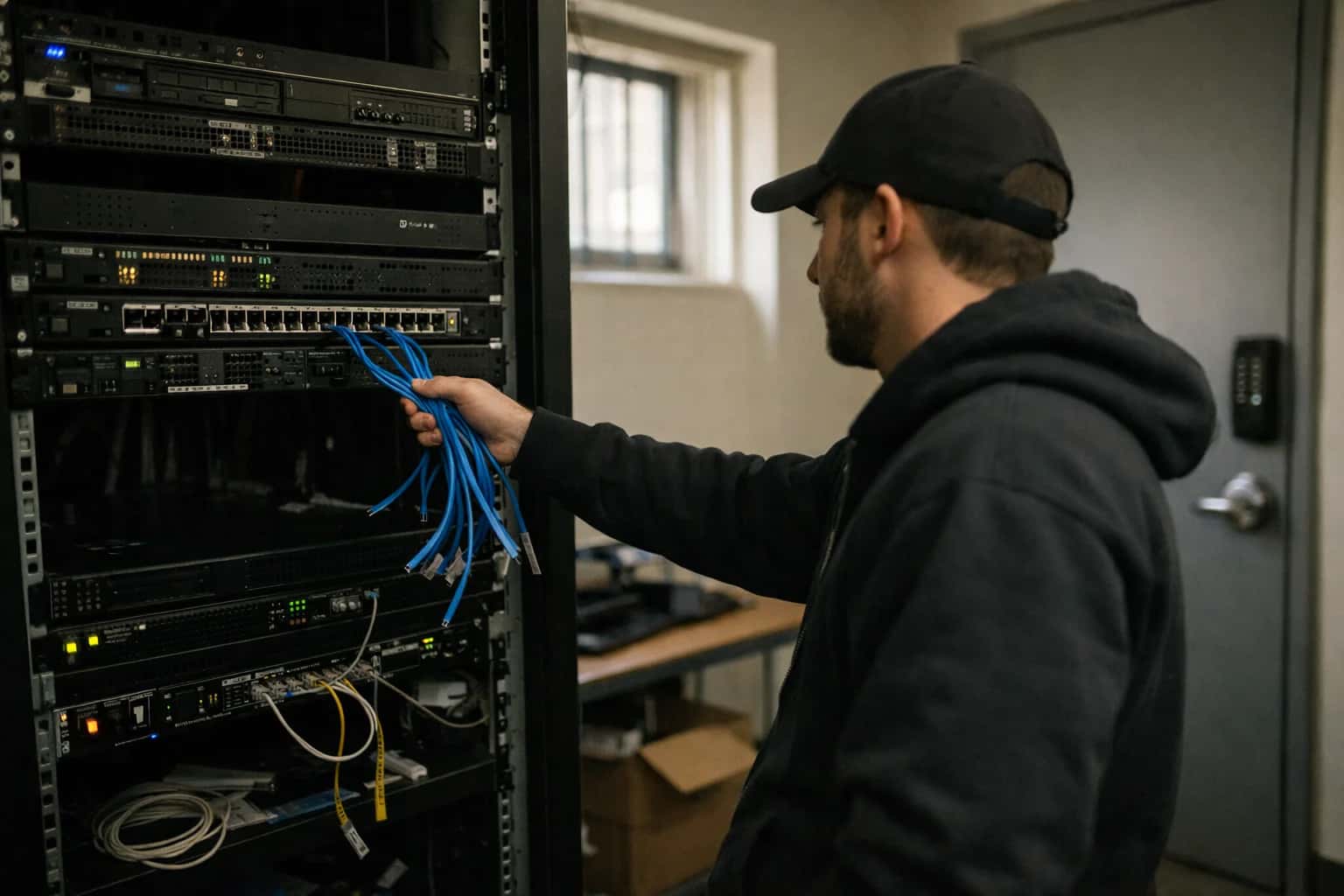
PHYSICAL ISOLATION SECURITY
What is Air-Gapped Network?
A foundational security architecture that physically disconnects a computing environment from all external networks to create an impenetrable barrier against remote cyber threats.
In the context of autonomous agent sandboxing, an air-gapped environment serves as the ultimate containment strategy for high-risk agents handling sensitive data or executing dangerous tool calls. By eliminating all inbound and outbound network pathways, the architecture guarantees that even a fully compromised agent cannot establish a covert channel to an external command-and-control server, enforcing a strict data-at-rest security posture.
PHYSICAL ISOLATION PRINCIPLES
Core Characteristics of an Air-Gapped Architecture
An air-gapped network is not merely a firewall configuration; it is a physical and logical architecture that creates an impassable boundary between a secure execution environment and all untrusted networks. The following characteristics define a robust implementation for autonomous agent sandboxing.
01
Physical Unidirectional Data Diodes
Enforces a strict one-way flow of information using hardware, not software. A data diode ensures that data can enter the secure enclave for analysis but absolutely no packets can egress back to the source network.
- Optical Isolation: Uses fiber optic transmitters on the sending side and receivers on the receiving side, making physical reverse communication impossible.
- Protocol Break: Terminates TCP/IP connections on both sides, preventing link-layer manipulation and session hijacking.
- Use Case: Allowing a threat intelligence feed into an air-gapped agent lab without creating a covert exfiltration channel.
02
Sneakernet and Removable Media Controls
The controlled, procedural transfer of data via physical storage devices. This is the only method for importing software updates or exporting sanitized logs in a true air-gap.
- Media Sanitization: All inbound media must be scanned and sterilized in a dedicated 'sheep-dip' station before crossing the air gap.
- Write-Protect Hardware: Use physical write-blockers to prevent malware on the secure system from infecting the transfer media.
- Chain of Custody: Strict logging of every device serial number, the individual who handled it, and the exact time of transfer.
03
Electromagnetic Emission Security (TEMPEST)
Protection against data leakage through unintentional radio frequency (RF) emissions, sound waves, or optical signals generated by electronic equipment.
- Faraday Shielding: Enclosing the entire agent execution environment in a conductive mesh to block electromagnetic radiation.
- Red/Black Separation: Strict physical distance between 'red' (classified/secure) cables and 'black' (untrusted) cables to prevent inductive coupling.
- Optical Audio Exfiltration: Mitigating malware that modulates data into inaudible frequencies emitted by speakers or hard drive activity LEDs.
04
Dedicated Supply Chain and Power
A true air-gapped architecture must be self-sufficient, eliminating dependencies on external infrastructure that could be compromised or act as a bridge.
- Isolated Power Distribution: Using dedicated power conditioners and uninterruptible power supplies (UPS) that are not shared with general IT infrastructure to prevent power-line communication attacks.
- Strict Hardware Provenance: Procuring servers and networking gear through trusted supply chains with verified chain of custody to prevent pre-implanted hardware trojans.
- Localized Time Sources: Relying on a local Stratum 0 GPS clock or atomic clock instead of external NTP servers to prevent time-based side-channel attacks.
05
Human Interface Gap
The physical and procedural separation between the human operator and the secure environment, often the weakest point in the architecture.
- KVM Switch Isolation: Using secure, tamper-evident Keyboard-Video-Mouse switches that prevent data leakage between the administrative workstation and the air-gapped system.
- Optical Surveillance: Continuous video monitoring of the air-gapped facility to detect unauthorized device introduction or screen photography.
- No Wireless Peripherals: A strict ban on any Bluetooth, Wi-Fi, or RF-based keyboards and mice, which are trivial to intercept.
06
Acoustic and Thermal Side-Channel Mitigation
Defending against exotic exfiltration methods that bridge the air gap using sound, heat, or vibration generated by the computing hardware itself.
- Acoustic Jamming: Generating white noise or ultrasonic interference to mask the sound of CPU fans or hard drives being modulated to transmit data.
- Thermal Throttling Monitoring: Detecting anomalous CPU temperature fluctuations that could indicate a thermal covert channel between two compromised systems.
- Vibration Sensors: Deploying accelerometers on server racks to detect mechanical hard drive read/write head movements being used for seismic communication.
Enabling Efficiency, Speed & Accuracy
Intelligent Analysis, Decision & Execution
We build AI systems for teams that need search across company data, workflow automation across tools, or AI features inside products and internal software.
Talk to Us
Search across company data
Give teams answers from docs, tickets, runbooks, and product data with sources and permissions.
Useful when people spend too long searching or get different answers from different systems.
Enterprise searchRAGPermissions
Read more
Automate internal workflows
Use AI to route work, draft outputs, trigger actions, and keep approvals and logs in place.
Useful when repetitive work moves across multiple tools and teams.
AI agentsWorkflow automationGovernance
Read more
Add AI to products and internal tools
Build assistants, guided actions, or decision support into the software your team or customers already use.
Useful when AI needs to be part of the product, not a separate tool.
AI integrationDecision supportModel routing
Read moreAIR-GAPPED NETWORK SECURITY
Frequently Asked Questions
Explore the critical architectural decisions and operational trade-offs involved in physically isolating autonomous agent execution environments from external networks.
An air-gapped network is a security architecture that physically and logically isolates a computer system or an autonomous agent's execution environment from all unsecured external networks, including the public internet. It works by creating an 'air gap'—a literal absence of a physical or wireless network interface connection to the outside world. Data transfer into or out of this environment requires a manual, human-mediated process, often involving strictly controlled sneakernet procedures using removable media that has been thoroughly sanitized. For autonomous agents, this ensures that even if a prompt injection attack succeeds in hijacking the agent's reasoning loop, the compromised agent cannot establish a remote command-and-control (C2) channel or exfiltrate sensitive data to an attacker-controlled server.

About the author
Prasad Kumkar
CEO & MD, Inference Systems
Prasad Kumkar is the CEO & MD of Inference Systems and writes about AI systems architecture, LLM infrastructure, model serving, evaluation, and production deployment. Over 5+ years, he has worked across computer vision models, L5 autonomous vehicle systems, and LLM research, with a focus on taking complex AI ideas into real-world engineering systems.
His work and writing cover AI systems, large language models, AI agents, multimodal systems, autonomous systems, inference optimization, RAG, evaluation, and production AI engineering.
LinkedIn
Limited slotsGet a Free AI Consultation
Partnered with leading AI, data, and software stack.





How We Work
Custom AI workflows for your Business
One-fit-all AI don't work for modern businesses. At Inferensys, we aim to understand your business & custom requirements; which we use to define most efficient agentic workflows, the data, and the tools for your business.
01
Review the use case
We understand the task, the users, and where AI can actually help.
Read more02
Pick the right approach
We define what needs search, automation, or product integration.
Read more03
Build the first useful version
We implement the part that proves the value first.
Read more04
Improve from there
We add the checks and visibility needed to keep it useful.
Read moreThe first call is a practical review of your use case and the right next step.
Talk to Us