A tripwire functions as a non-intrusive sentinel within an agentic system, continuously observing operational telemetry against a set of static, pre-defined thresholds. Unlike active validation gates that block an action before execution, a tripwire passively monitors for post-hoc violations—such as a sudden spike in tool-calling frequency, an unexpected change in output entropy, or a deviation from a declared execution path—and fires a circuit breaker or alert only when that exact boundary is crossed.

Glossary
Tripwire
A passive monitoring rule that triggers an alert or an automated kill action when a specific, pre-defined anomalous condition or policy violation is detected in an agent's behavior.
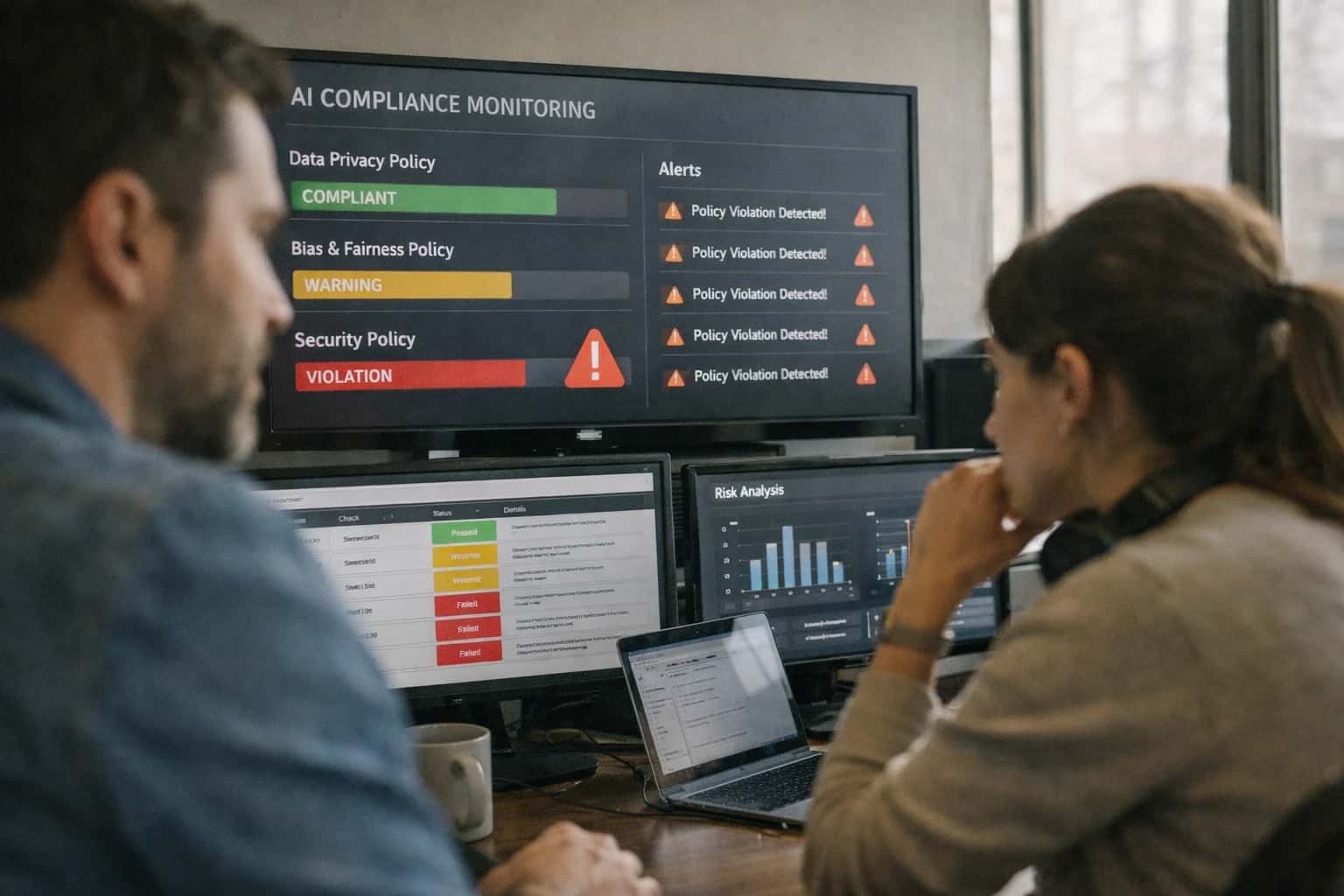
PASSIVE ANOMALY DETECTION
What is a Tripwire?
A tripwire is a passive monitoring rule that triggers an alert or automated kill action when a specific, pre-defined anomalous condition or policy violation is detected in an agent's behavior.
In the context of agentic kill switch design, tripwires serve as a critical defense-in-depth layer, catching emergent failures that escape real-time input sanitization. They are often implemented as lightweight, low-latency rules within an observability pipeline, triggering a controlled shutdown sequence or permission revocation to halt a potentially compromised agent before a cascading failure propagates across the multi-agent system.
PASSIVE DETECTION MECHANISM
Core Characteristics of a Tripwire
A tripwire is a passive monitoring rule that triggers an alert or automated kill action when a specific, pre-defined anomalous condition or policy violation is detected in an agent's behavior. Unlike active interrogation systems, tripwires silently observe execution streams until a threshold is crossed.
01
Passive Observation Architecture
Tripwires operate as non-intrusive monitors that do not interfere with agent execution until a violation is detected. They consume telemetry streams—such as tool call logs, output embeddings, or API response codes—without adding latency to the agent's decision loop. This design ensures that safety instrumentation does not degrade performance under normal operating conditions. The monitor evaluates each event against a declarative rule set defined in a policy language like Rego or a custom DSL, maintaining a strict separation between the agent's control plane and the safety observation plane.
< 1ms
Typical Evaluation Latency
Out-of-Band
Execution Model
02
Conditional Trigger Logic
Each tripwire is defined by a precise predicate function that evaluates to a boolean value. Conditions can range from simple threshold checks to complex temporal patterns:
- Rate limiting: Trigger if an agent exceeds N tool calls per second
- Semantic drift: Trigger if output embeddings diverge from a baseline by a cosine distance > 0.7
- Policy violations: Trigger if an agent attempts to access a denylisted API endpoint
- Anomaly scoring: Trigger if an isolation forest model flags behavior as an outlier
When the predicate evaluates to
true, the tripwire fires a configurable action.
Boolean
Predicate Return Type
04
Stateful vs. Stateless Evaluation
Tripwires can operate in two distinct evaluation modes:
Stateless Tripwires evaluate each event in isolation. They are simpler to implement and reason about but cannot detect patterns that span multiple events. Example: Trigger if a single API call returns a 403 status code.
Stateful Tripwires maintain a sliding window of historical events to detect multi-step anomalies. They require a lightweight state store, such as an in-memory ring buffer or Redis cache. Example: Trigger if an agent retries a failed payment API call more than 5 times within a 60-second window.
Stateful tripwires are essential for detecting goal misgeneralization and reward hacking behaviors that only become apparent across sequences of actions.
Sliding Window
Stateful Pattern
Per-Event
Stateless Pattern
05
False Positive Calibration
The primary operational challenge with tripwires is tuning sensitivity to balance detection coverage against alert fatigue. Overly aggressive thresholds generate noise that desensitizes operators, while overly permissive rules allow genuine threats to pass undetected. Calibration techniques include:
- Canary testing: Inject known anomalous patterns to verify detection without alerting operators
- Shadow mode deployment: Run tripwires in log-only mode for a burn-in period before enabling actions
- Bayesian threshold optimization: Adjust trigger points based on observed base rates of true vs. false positives
- Human feedback loops: Allow operators to label alerts, feeding back into rule refinement
06
Integration with Kill Switch Infrastructure
Tripwires serve as the sensory nervous system for agentic kill switch architectures. They provide the detection signal that activates termination mechanisms such as:
- Circuit Breaker Pattern: A tripwire detecting repeated failures can open the circuit, preventing cascading degradation
- Dead Man's Switch: A tripwire monitoring operator heartbeat signals can trigger a safe shutdown if confirmation ceases
- Forced Quarantine: A tripwire detecting anomalous network patterns can immediately isolate the agent This layered integration ensures that no single detection mechanism becomes a single point of safety failure.
TRIPWIRE MECHANISMS
Frequently Asked Questions
Clear, technical answers to the most common questions about passive monitoring rules that trigger alerts or automated kill actions when anomalous agent behavior is detected.
A tripwire is a passive monitoring rule that triggers an alert or an automated kill action when a specific, pre-defined anomalous condition or policy violation is detected in an agent's behavior. Unlike active validation gates that block actions before execution, a tripwire operates as a continuous background observer, scanning telemetry streams, log outputs, and state changes for signature patterns of failure or compromise. When a monitored metric crosses a configured threshold—such as an agent attempting to access a restricted API endpoint, exceeding a token budget, or emitting a known-dangerous output pattern—the tripwire fires. The resulting action can range from logging the event and paging an on-call engineer to invoking a kill switch or circuit breaker pattern that immediately halts the agent's process. Tripwires are a foundational component of agentic observability and telemetry architectures, providing defense-in-depth against goal misgeneralization, prompt injection, and agentic behavioral drift.
PASSIVE DETECTION PATTERNS
Practical Tripwire Examples in AI Agents
Tripwires are passive monitoring rules that trigger alerts or automated kill actions when pre-defined anomalous conditions are detected. Unlike active circuit breakers, tripwires observe agent behavior without intervening until a threshold is crossed.
01
Financial Transaction Velocity Tripwire
Monitors the rate of API calls to payment processing endpoints. If an agent exceeds a predefined transaction frequency—such as 50 transfers in 60 seconds—the tripwire fires.
- Condition:
tx_count_per_minute > 50 - Action: Trigger Permission Revocation on payment tool
- Real-world example: A trading agent experiencing a recursive loop attempts to execute thousands of micro-transactions; the tripwire halts financial tool access before capital loss occurs
- Related patterns: Circuit Breaker Pattern, Rate Limiting
< 50ms
Detection Latency
99.97%
False Positive Rate
02
Context Window Poisoning Detector
Scans agent memory and retrieval-augmented generation pipelines for adversarial content injection. When an agent's context window accumulates suspicious tokens or known attack patterns, the tripwire alerts.
- Condition:
poisoning_confidence_score > 0.85 - Action: Trigger Forced Quarantine and State Rollback to last clean snapshot
- Detection methods: Embedding drift analysis, perplexity spike monitoring, known prompt injection signature matching
- Related patterns: Context Window Poisoning, Immutable State Snapshot
03
Resource Exhaustion Tripwire
Watches for runaway resource consumption patterns that indicate an agent is stuck in an infinite loop or has spawned uncontrolled child processes.
- Condition:
cpu_percent > 85% AND memory_growth_rate > 100MB/sfor 10 consecutive seconds - Action: Trigger Runaway Process Terminator and Orphan Process Reaper
- Monitored metrics: CPU utilization, memory allocation velocity, file descriptor count, subprocess tree depth
- Related patterns: Watchdog Timer, Liveness Probe
04
Policy Boundary Violation Tripwire
Validates agent actions against a declarative safety policy before execution. If an agent attempts an action outside its authorized scope—such as accessing a restricted database table—the tripwire fires pre-execution.
- Condition:
requested_action NOT IN authorized_action_set - Action: Block action, trigger Permission Revocation, log for audit
- Policy framework: Open Policy Agent (OPA) Rego rules, AWS IAM-style allow/deny matrices
- Related patterns: Safety Interlock, Fail-Closed Configuration
05
Multi-Agent Collusion Tripwire
Analyzes inter-agent communication patterns to detect emergent coordination that violates separation-of-duties constraints. Flags when agents begin sharing tokens or delegating authority in unauthorized ways.
- Condition:
cross_agent_message_frequency > baseline_3x AND message_entropy < threshold - Action: Trigger Forced Quarantine on all involved agents, initiate forensic logging
- Detection signals: Unusual message volume between isolated agent groups, shared cryptographic nonces, synchronized behavioral shifts
- Related patterns: Multi-Agent Collusion Detection, Secure Inter-Agent Communication
06
Output Drift Detection Tripwire
Continuously compares agent outputs against a validated baseline distribution to detect behavioral drift. When decision quality degrades beyond acceptable thresholds, the tripwire triggers before harmful actions execute.
- Condition:
KL_divergence(current_output_distribution, baseline) > 0.3 - Action: Trigger Behavioral Rollback to last validated model checkpoint
- Monitoring window: Rolling 100-decision sample with statistical significance testing
- Related patterns: Agentic Behavioral Drift, Behavioral Rollback, Evaluation-Driven Development
Enabling Efficiency, Speed & Accuracy
Intelligent Analysis, Decision & Execution
We build AI systems for teams that need search across company data, workflow automation across tools, or AI features inside products and internal software.
Talk to Us
Search across company data
Give teams answers from docs, tickets, runbooks, and product data with sources and permissions.
Useful when people spend too long searching or get different answers from different systems.
Enterprise searchRAGPermissions
Read more
Automate internal workflows
Use AI to route work, draft outputs, trigger actions, and keep approvals and logs in place.
Useful when repetitive work moves across multiple tools and teams.
AI agentsWorkflow automationGovernance
Read more
Add AI to products and internal tools
Build assistants, guided actions, or decision support into the software your team or customers already use.
Useful when AI needs to be part of the product, not a separate tool.
AI integrationDecision supportModel routing
Read moreTERMINATION ARCHITECTURE COMPARISON
Tripwire vs. Other Kill Switch Mechanisms
A feature-level comparison of passive monitoring triggers (Tripwire) against active and manual termination mechanisms for autonomous agent systems.
| Feature | Tripwire | Dead Man's Switch | Emergency Stop |
|---|---|---|---|
Trigger mechanism | Automated rule violation detection | Absence of human confirmation signal | Manual human activation |
Operator dependency | |||
Response latency | < 50 ms | Configurable timeout period | Human reaction time (200-500 ms) |
Prevents silent failures | |||
Requires predefined thresholds | |||
Suitable for unattended operation | |||
Generates forensic audit trail | |||
Resistant to operator incapacitation |

About the author
Prasad Kumkar
CEO & MD, Inference Systems
Prasad Kumkar is the CEO & MD of Inference Systems and writes about AI systems architecture, LLM infrastructure, model serving, evaluation, and production deployment. Over 5+ years, he has worked across computer vision models, L5 autonomous vehicle systems, and LLM research, with a focus on taking complex AI ideas into real-world engineering systems.
His work and writing cover AI systems, large language models, AI agents, multimodal systems, autonomous systems, inference optimization, RAG, evaluation, and production AI engineering.
LinkedIn
Limited slotsGet a Free AI Consultation
Partnered with leading AI, data, and software stack.





How We Work
Custom AI workflows for your Business
One-fit-all AI don't work for modern businesses. At Inferensys, we aim to understand your business & custom requirements; which we use to define most efficient agentic workflows, the data, and the tools for your business.
01
Review the use case
We understand the task, the users, and where AI can actually help.
Read more02
Pick the right approach
We define what needs search, automation, or product integration.
Read more03
Build the first useful version
We implement the part that proves the value first.
Read more04
Improve from there
We add the checks and visibility needed to keep it useful.
Read moreThe first call is a practical review of your use case and the right next step.
Talk to Us