In a fail-closed configuration, the system's default failure mode is to terminate connections, revoke permissions, and block transactions. This is the inverse of a fail-open configuration, which maintains availability during a fault. The mechanism is critical in agentic threat modeling where an autonomous agent's malfunction could lead to data exfiltration; a fail-closed state ensures that a crashing API gateway or a corrupted authentication service immediately locks down the interface rather than allowing unauthenticated passage.

Glossary
Fail-Closed Configuration
A security principle where a system defaults to a state that blocks all access or actions when a failure is detected, prioritizing security over availability.
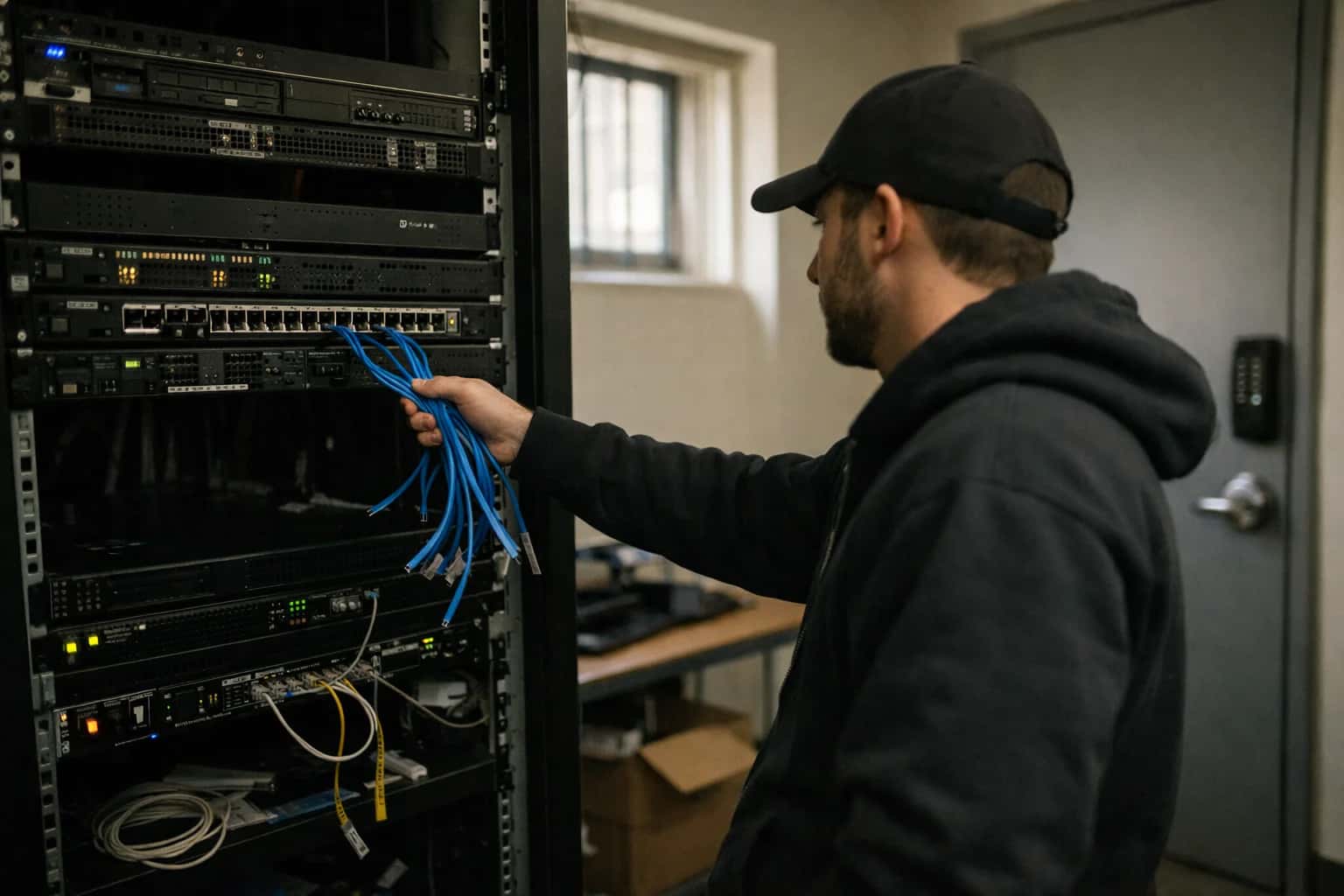
SECURITY ARCHITECTURE
What is Fail-Closed Configuration?
A fail-closed configuration is a security design principle where a system defaults to a state that denies all access or blocks all actions when a component failure or error condition is detected, prioritizing data confidentiality and integrity over system availability.
Implementing this pattern often involves a circuit breaker that trips to an 'open' electrical state (disconnected) or a safety interlock that physically prevents actuation. In autonomous systems, a fail-closed design is a core component of a kill switch strategy, ensuring that if a liveness probe fails or a watchdog timer expires, the agent does not default to unrestricted behavior but instead enters a secure, inert state.
FAILURE MODE COMPARISON
Fail-Closed vs. Fail-Open Configuration
Comparative analysis of system behavior and security posture when a component failure or anomaly is detected in autonomous agent architectures.
| Feature | Fail-Closed | Fail-Open | Fail-Safe (Hybrid) |
|---|---|---|---|
Primary objective | Security preservation | Availability preservation | Controlled degradation |
Default state on failure | Block all access and actions | Allow all access and actions | Restricted safe mode |
Access control behavior | Deny all requests | Grant all requests | Limited pre-approved operations |
Suitable for | Financial transactions, weapons systems | Physical egress doors, fire alarms | Autonomous vehicles, medical devices |
Risk of denial-of-service | |||
Risk of unauthorized access | |||
Requires human intervention to restore | |||
Typical response time | < 50 ms | < 10 ms | < 100 ms |
SECURITY-FIRST DESIGN
Core Characteristics of a Fail-Closed Architecture
A fail-closed configuration is a security principle where a system defaults to a state that blocks all access or actions when a failure is detected, prioritizing security over availability. This architecture is critical for autonomous agents where an uncontrolled failure could lead to cascading harm.
01
Default-Deny Posture
The foundational principle of fail-closed design is a default-deny stance. When a component failure, timeout, or anomaly is detected, the system immediately revokes all access rights and blocks pending actions. This contrasts with fail-open configurations, which prioritize availability by granting access during failure. In agentic systems, this means an agent's tool-calling permissions are instantly severed if its liveness probe fails or its behavioral drift exceeds a defined threshold. The system assumes breach until integrity is verified.
02
Circuit Breaker Integration
Fail-closed architectures rely heavily on the circuit breaker pattern to prevent cascading damage. When an agent repeatedly fails to execute an operation successfully, the circuit breaker trips to a closed (failing) state, immediately rejecting all subsequent requests without attempting execution. Key states include:
- Closed: Normal operation, requests pass through.
- Open: Failure threshold exceeded, all requests are immediately denied.
- Half-Open: A trial period where a limited number of requests are allowed to test if the underlying issue has resolved.
03
Atomic State Rollback
Upon entering a fail-closed state, the system must execute an idempotent rollback to the last known safe configuration. This involves restoring an immutable state snapshot captured before the failing operation began. For autonomous agents, this rollback must be atomic—either the entire state is reverted, or nothing changes—to prevent partial restoration that could leave the agent in an inconsistent or unsafe condition. The rollback process is managed by the agent's termination handler, ensuring critical cleanup tasks like releasing database locks and revoking temporary credentials are completed.
04
Forced Quarantine and Isolation
A fail-closed event triggers immediate forced quarantine of the affected agent. Network policies dynamically restrict the agent's communication to only a controlled observation environment. This prevents a potentially compromised or runaway agent from influencing peer agents in a multi-agent system. Key isolation mechanisms include:
- Network micro-segmentation: Restricting egress traffic to a forensic logging endpoint.
- Process cgroup limiting: Capping CPU and memory to prevent resource exhaustion.
- Credential zeroization: Executing a zeroize command to wipe API keys and session tokens from memory.
05
Human-in-the-Loop Override Gates
A fail-closed architecture mandates a synchronous human-in-the-loop override for recovery. The system cannot autonomously transition out of the fail-closed state. A human operator must explicitly acknowledge the incident, review forensic logs, and issue a signed command to restore service. This gate prevents an agent from automatically resuming operations while still in a compromised or unstable condition. The override mechanism itself is protected by a dead man's switch—if the operator becomes unresponsive during recovery, the system reverts to the fail-closed state.
06
Tripwire-Triggered Activation
The transition to a fail-closed state is often initiated by a tripwire—a passive monitoring rule that fires when a specific anomaly is detected. These tripwires monitor for conditions such as:
- Runaway resource consumption: CPU or memory usage exceeding 95% for more than 30 seconds.
- Permission escalation attempts: An agent trying to access tools outside its manifest.
- Output validation failures: Generated actions that fail safety classifiers repeatedly. When a tripwire fires, it triggers an automated process termination signal (SIGTERM) followed by a timeout-based kill (SIGKILL) if the agent does not terminate gracefully within the defined window.
FAIL-CLOSED CONFIGURATION
Frequently Asked Questions
Explore the critical security principle of fail-closed configurations, where systems default to a locked-down state during failures to prioritize data protection over availability in autonomous agent architectures.
A fail-closed configuration is a security design principle where a system defaults to a state that blocks all access or actions when a failure, anomaly, or loss of signal is detected. Unlike fail-open systems that prioritize availability, a fail-closed mechanism immediately terminates active sessions, revokes permissions, and prevents any further operations until the failure is resolved and explicitly cleared. In autonomous agent architectures, this is implemented through a safety interlock that monitors the agent's heartbeat, decision quality, and environmental inputs. When a critical threshold is breached—such as a liveness probe timeout, unexpected API response, or policy violation detected by a tripwire—the system executes a controlled shutdown sequence, persists immutable state snapshots for forensic analysis, and transitions to a fail-safe state. This ensures that a compromised or malfunctioning agent cannot execute unauthorized tool calls, exfiltrate data, or propagate cascading failures across a multi-agent mesh.
Enabling Efficiency, Speed & Accuracy
Intelligent Analysis, Decision & Execution
We build AI systems for teams that need search across company data, workflow automation across tools, or AI features inside products and internal software.
Talk to Us
Search across company data
Give teams answers from docs, tickets, runbooks, and product data with sources and permissions.
Useful when people spend too long searching or get different answers from different systems.
Enterprise searchRAGPermissions
Read more
Automate internal workflows
Use AI to route work, draft outputs, trigger actions, and keep approvals and logs in place.
Useful when repetitive work moves across multiple tools and teams.
AI agentsWorkflow automationGovernance
Read more
Add AI to products and internal tools
Build assistants, guided actions, or decision support into the software your team or customers already use.
Useful when AI needs to be part of the product, not a separate tool.
AI integrationDecision supportModel routing
Read more
About the author
Prasad Kumkar
CEO & MD, Inference Systems
Prasad Kumkar is the CEO & MD of Inference Systems and writes about AI systems architecture, LLM infrastructure, model serving, evaluation, and production deployment. Over 5+ years, he has worked across computer vision models, L5 autonomous vehicle systems, and LLM research, with a focus on taking complex AI ideas into real-world engineering systems.
His work and writing cover AI systems, large language models, AI agents, multimodal systems, autonomous systems, inference optimization, RAG, evaluation, and production AI engineering.
LinkedIn
Limited slotsGet a Free AI Consultation
Partnered with leading AI, data, and software stack.





How We Work
Custom AI workflows for your Business
One-fit-all AI don't work for modern businesses. At Inferensys, we aim to understand your business & custom requirements; which we use to define most efficient agentic workflows, the data, and the tools for your business.
01
Review the use case
We understand the task, the users, and where AI can actually help.
Read more02
Pick the right approach
We define what needs search, automation, or product integration.
Read more03
Build the first useful version
We implement the part that proves the value first.
Read more04
Improve from there
We add the checks and visibility needed to keep it useful.
Read moreThe first call is a practical review of your use case and the right next step.
Talk to Us