Token budgeting is a critical resource governance mechanism that imposes a hard ceiling on the cumulative token count—encompassing both the input prompt and generated output—within a single agentic transaction. By pre-allocating a finite token allowance, platform engineers prevent unbounded consumption that leads to latency spikes, exponential API costs, and the risk of exceeding a model's maximum context window, which can cause catastrophic truncation or session failure.

Glossary
Token Budgeting
Token budgeting is the practice of enforcing strict limits on the total number of input and output tokens an AI agent can consume per task or session to control latency, cost, and prevent context window overflow attacks.
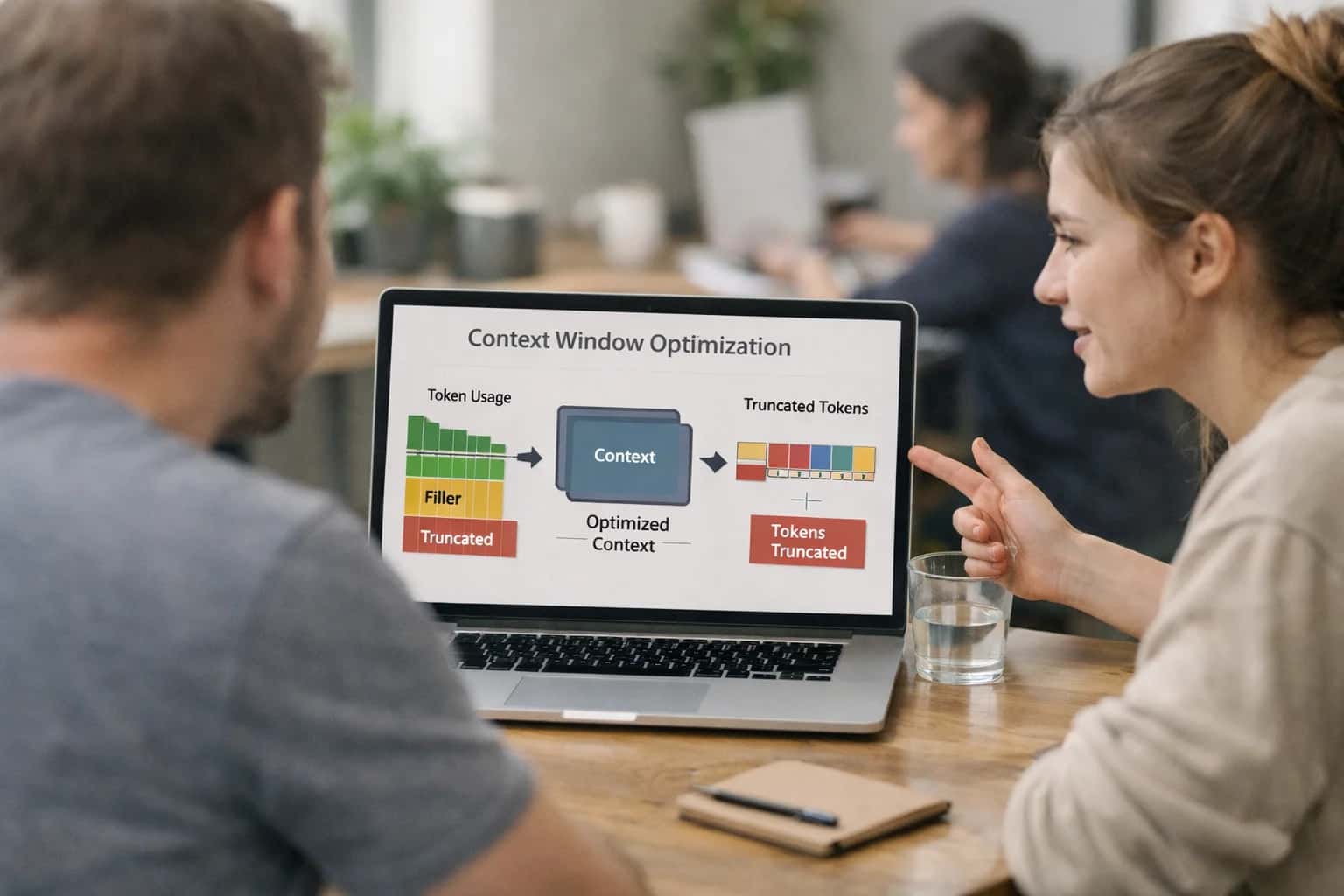
CONTEXT WINDOW MANAGEMENT
What is Token Budgeting?
Token budgeting is the practice of enforcing strict limits on the total number of input and output tokens an AI agent can consume per task or session to control latency, cost, and prevent context window overflow attacks.
Beyond cost control, token budgeting serves as a defensive security measure against context window overflow attacks, where adversaries inject excessive padding to displace critical system instructions or safety guardrails. Effective implementation requires dynamic allocation strategies, such as reserving a fixed percentage of the budget for output generation while capping retrieval-augmented generation (RAG) context injection, ensuring the agent retains sufficient working memory to complete its task without exhausting the max_tokens limit.
COST & CONTEXT CONTROL
Core Characteristics of Token Budgeting
Token budgeting enforces hard limits on the number of tokens an agent can consume per task, session, or time window. This mechanism directly governs latency, financial cost, and security posture by preventing context window overflow attacks and runaway consumption loops.
01
Hard Token Ceilings
A hard token ceiling is an absolute, non-negotiable limit on total tokens (input + output) for a given operation. Unlike soft limits that may trigger warnings, hard ceilings force termination or truncation when breached.
- Mechanism: The orchestrator tracks cumulative token usage via API response metadata (
usage.total_tokens) and halts execution. - Granularity: Applied per-turn, per-task, or per-session depending on risk tolerance.
- Example: A coding agent limited to 8,192 output tokens per generation to prevent infinite code loops.
- Failure Mode: Mid-task termination can leave state inconsistent; requires pairing with circuit breaker patterns and state rollback.
128K
Typical context window ceiling
02
Dynamic Rate Limiting
Dynamic rate limiting adjusts token consumption thresholds in real-time based on system load, priority tier, or anomaly detection signals. This prevents a single agent from starving other processes of shared LLM API capacity.
- Token Bucket Algorithm: A classic implementation where tokens replenish at a fixed rate; bursts are allowed up to bucket capacity.
- Priority Queuing: High-stakes production agents receive larger budgets than experimental or low-priority workloads.
- Anomaly-Driven Throttling: If an agent's token-per-second rate spikes beyond historical baselines, the rate limiter progressively constricts its budget.
- Integration: Works in tandem with circuit breaker patterns to prevent cascading resource exhaustion.
< 50ms
Rate limit enforcement latency
03
Context Window Overflow Prevention
Context window overflow is an attack vector where adversaries flood an agent's input with padding tokens to exhaust its context budget, forcing critical instructions or safety prompts out of the active window.
- Attack Surface: Long conversational histories, injected padding in retrieved documents, or recursive tool output loops.
- Budgeting Defense: Strict input token budgets per retrieval call prevent a single source from dominating the context.
- Instruction Hierarchy: System-level directives are pinned and immune to eviction, even when user or tool inputs consume budget.
- Truncation Strategy: When budget is exceeded, oldest or lowest-priority context is dropped first—never system prompts.
System Prompts
Pinned & immune to eviction
04
Cost Attribution & Chargeback
Token budgeting enables precise cost attribution by tagging every token consumed with metadata about the originating agent, task, tenant, or department. This transforms LLM usage from an opaque operational expense into a measurable, billable resource.
- Per-Task Metering: Each agentic workflow logs token consumption at task boundaries for granular billing.
- Budget Alerts: Threshold-based notifications fire when a tenant approaches 80%, 90%, or 100% of their allocated budget.
- Chargeback Models: Finance teams can allocate costs to specific cost centers based on actual consumption rather than flat fees.
- ROI Correlation: Token spend can be correlated with business outcomes (e.g., tickets resolved, documents processed) to measure agent efficiency.
Per-Token
Granularity of cost attribution
05
Budget Exhaustion Handling
When an agent exhausts its token budget mid-task, graceful degradation protocols determine the system's behavior. The goal is to avoid silent failures, data loss, or incomplete transactions.
- Graceful Degradation: The agent summarizes its current state and hands off to a human operator or queues for budget renewal.
- Checkpoint & Resume: State is serialized at budget exhaustion so the task can resume from the last checkpoint when budget is replenished.
- Fallback Models: The system can route remaining work to a smaller, cheaper model with a fresh budget to complete non-critical tasks.
- Dead Letter Queue: Tasks that cannot be completed are routed to a human-in-the-loop (HITL) review queue with full context attached.
06
Budget vs. Guardrail Integration
Token budgeting is not an isolated mechanism—it integrates deeply with the broader guardrail and action gate ecosystem to form a layered defense.
- Pre-Execution Checks: Before a high-stakes tool call, the system verifies sufficient token budget remains for both the call and the expected response.
- Output Validation Budget: A separate token allocation is reserved for critic model evaluation and output sanitization steps, ensuring safety checks are never skipped due to budget exhaustion.
- Circuit Breaker Trigger: If token consumption velocity exceeds a predefined threshold, the circuit breaker trips and halts all agent activity.
- Audit Trail: Every budget enforcement event is logged immutably for compliance and post-incident analysis.
TOKEN BUDGETING
Frequently Asked Questions
Explore the essential concepts behind enforcing strict limits on token consumption in autonomous agent systems to control costs, latency, and security.
Token Budgeting is the practice of enforcing strict, programmatic limits on the total number of input and output tokens an agent can consume per task, session, or billing cycle. It works by implementing a Token Counter that wraps every LLM API call, tracking cumulative usage against a predefined ceiling. When the budget is exhausted, the system triggers a policy—such as terminating the task, switching to a cheaper model, or routing to a human operator. This mechanism prevents runaway loops and Context Window Overflow Attacks, where an adversary floods the context with junk data to exhaust the model's attention span. Effective budgeting requires dynamic allocation, where high-priority reasoning steps are granted more tokens than routine summarization tasks.
Enabling Efficiency, Speed & Accuracy
Intelligent Analysis, Decision & Execution
We build AI systems for teams that need search across company data, workflow automation across tools, or AI features inside products and internal software.
Talk to Us
Search across company data
Give teams answers from docs, tickets, runbooks, and product data with sources and permissions.
Useful when people spend too long searching or get different answers from different systems.
Enterprise searchRAGPermissions
Read more
Automate internal workflows
Use AI to route work, draft outputs, trigger actions, and keep approvals and logs in place.
Useful when repetitive work moves across multiple tools and teams.
AI agentsWorkflow automationGovernance
Read more
Add AI to products and internal tools
Build assistants, guided actions, or decision support into the software your team or customers already use.
Useful when AI needs to be part of the product, not a separate tool.
AI integrationDecision supportModel routing
Read more
About the author
Prasad Kumkar
CEO & MD, Inference Systems
Prasad Kumkar is the CEO & MD of Inference Systems and writes about AI systems architecture, LLM infrastructure, model serving, evaluation, and production deployment. Over 5+ years, he has worked across computer vision models, L5 autonomous vehicle systems, and LLM research, with a focus on taking complex AI ideas into real-world engineering systems.
His work and writing cover AI systems, large language models, AI agents, multimodal systems, autonomous systems, inference optimization, RAG, evaluation, and production AI engineering.
LinkedIn
Limited slotsGet a Free AI Consultation
Partnered with leading AI, data, and software stack.





How We Work
Custom AI workflows for your Business
One-fit-all AI don't work for modern businesses. At Inferensys, we aim to understand your business & custom requirements; which we use to define most efficient agentic workflows, the data, and the tools for your business.
01
Review the use case
We understand the task, the users, and where AI can actually help.
Read more02
Pick the right approach
We define what needs search, automation, or product integration.
Read more03
Build the first useful version
We implement the part that proves the value first.
Read more04
Improve from there
We add the checks and visibility needed to keep it useful.
Read moreThe first call is a practical review of your use case and the right next step.
Talk to Us