A Policy Compliance Check is an automated gatekeeping mechanism that intercepts an agent's intended action—such as a tool call or data mutation—and evaluates it against a formalized set of rules. These rules, often defined in a policy-as-code language like Rego and enforced by an engine such as the Open Policy Agent (OPA) , decouple authorization logic from application code. The check ensures that the action does not violate constraints related to data residency, access control, financial thresholds, or industry-specific regulations like GDPR or HIPAA.

Glossary
Policy Compliance Check
An automated validation step, often using a rules engine like OPA, that verifies an agent's proposed action against regulatory, legal, and internal business policies before execution is permitted.
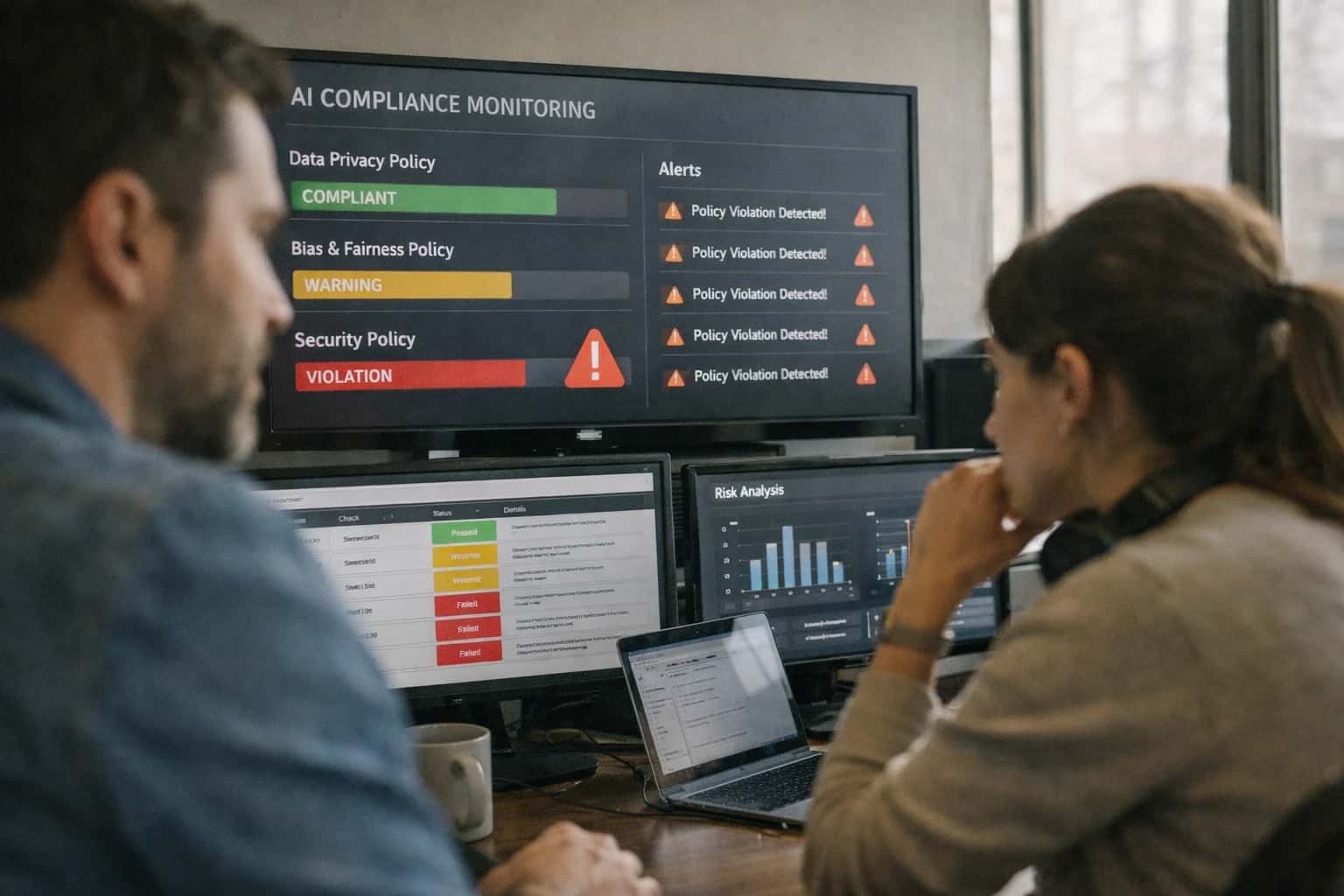
AUTOMATED GOVERNANCE GATE
What is Policy Compliance Check?
A policy compliance check is an automated validation step that verifies an agent's proposed action against codified regulatory, legal, and internal business rules before execution is permitted.
Unlike static role-based access control, a policy compliance check evaluates the full context of the request, including resource attributes, temporal conditions, and the agent's current state. If the proposed action violates a policy, the check returns a deny decision, blocking execution and typically logging the violation for audit. This architecture provides a centralized, auditable control plane for enforcing least privilege execution across autonomous workflows, ensuring that even self-directed agents operate strictly within defined legal and operational boundaries.
AUTOMATED GOVERNANCE
Key Features of Policy Compliance Checks
Policy compliance checks form the last line of defense in agentic workflows, translating abstract regulatory and business rules into deterministic, machine-enforceable gates that prevent unauthorized actions before execution.
01
Policy-as-Code Architecture
Encodes organizational rules using declarative languages like Rego (Open Policy Agent) or Cedar, decoupling policy logic from application code. This allows non-developer stakeholders to author, version, and audit rules independently.
- Declarative rules: Define what is permitted, not how to enforce
- Version-controlled policies: Git-based audit trails for every rule change
- Hot-reloading: Update policies without restarting agent services
< 1ms
Typical Evaluation Latency
OPA
CNCF Graduated Standard
02
Context-Aware Decisioning
Evaluates proposed actions against rich contextual attributes beyond simple role-based access. The engine ingests real-time agent state, resource metadata, and historical interaction patterns to make nuanced allow/deny decisions.
- Attribute-based access control (ABAC): Combines user, resource, and environmental attributes
- Temporal constraints: Enforce time-of-day or maintenance window restrictions
- Geofencing: Restrict data access based on jurisdictional boundaries
03
Regulatory Mapping Engine
Translates high-level regulatory frameworks like GDPR, SOC 2, and HIPAA into executable policy bundles. Maintains a living mapping between legal requirements and technical controls, generating compliance artifacts automatically.
- Control-to-code traceability: Every policy rule links to a specific regulatory paragraph
- Automated evidence generation: Produce audit logs proving policy enforcement
- Cross-jurisdiction conflict resolution: Flag contradictory requirements before deployment
04
Pre-Execution Interception
Sits as a synchronous gate in the agent's tool-calling pipeline, evaluating every proposed API call, database write, or external communication before the action leaves the agent's runtime. This prevents irreversible damage from hallucinated or adversarial tool invocations.
- Zero-trust enforcement: No action executes without explicit policy approval
- Sub-millisecond decisions: Optimized for high-throughput agent workflows
- Fail-closed defaults: Unknown actions are denied by default
99.99%
Decision Availability SLA
05
Conflict Detection and Resolution
Identifies contradictory or overlapping policies before they create enforcement gaps or deadlocks. Uses SAT solver techniques to detect logical inconsistencies across thousands of interdependent rules.
- Policy simulation: Dry-run proposed changes against historical agent traces
- Coverage analysis: Identify actions with no applicable policy
- Deadlock prevention: Detect circular deny rules that block all execution paths
06
Explainable Denial Responses
When a policy check fails, the system returns a structured justification rather than a generic error. This enables the agent to self-correct, escalate to a human, or log the violation with full forensic context for compliance auditors.
- Machine-readable reasons: Agents can parse denial codes and adapt behavior
- Human-readable explanations: Clear violation descriptions for audit reports
- Remediation hints: Suggest corrective actions to bring requests into compliance
Enabling Efficiency, Speed & Accuracy
Intelligent Analysis, Decision & Execution
We build AI systems for teams that need search across company data, workflow automation across tools, or AI features inside products and internal software.
Talk to Us
Search across company data
Give teams answers from docs, tickets, runbooks, and product data with sources and permissions.
Useful when people spend too long searching or get different answers from different systems.
Enterprise searchRAGPermissions
Read more
Automate internal workflows
Use AI to route work, draft outputs, trigger actions, and keep approvals and logs in place.
Useful when repetitive work moves across multiple tools and teams.
AI agentsWorkflow automationGovernance
Read more
Add AI to products and internal tools
Build assistants, guided actions, or decision support into the software your team or customers already use.
Useful when AI needs to be part of the product, not a separate tool.
AI integrationDecision supportModel routing
Read morePOLICY ENFORCEMENT
Frequently Asked Questions
Clear answers to the most common questions about automated policy compliance checks in agentic systems, covering implementation patterns, rule engines, and enterprise governance integration.
A policy compliance check is an automated validation step that intercepts an AI agent's proposed action before execution and verifies it against a codified set of regulatory, legal, and internal business rules. Unlike safety guardrails that focus on harmful content, compliance checks enforce organizational policies—such as data residency requirements, access control mandates, and industry-specific regulations like HIPAA or GDPR. The check operates as a deterministic gate: if the proposed action violates any rule, execution is blocked and the agent receives a structured rejection reason. This mechanism transforms abstract governance policies into programmatic, auditable enforcement points within autonomous workflows.

About the author
Prasad Kumkar
CEO & MD, Inference Systems
Prasad Kumkar is the CEO & MD of Inference Systems and writes about AI systems architecture, LLM infrastructure, model serving, evaluation, and production deployment. Over 5+ years, he has worked across computer vision models, L5 autonomous vehicle systems, and LLM research, with a focus on taking complex AI ideas into real-world engineering systems.
His work and writing cover AI systems, large language models, AI agents, multimodal systems, autonomous systems, inference optimization, RAG, evaluation, and production AI engineering.
LinkedIn
Limited slotsGet a Free AI Consultation
Partnered with leading AI, data, and software stack.





How We Work
Custom AI workflows for your Business
One-fit-all AI don't work for modern businesses. At Inferensys, we aim to understand your business & custom requirements; which we use to define most efficient agentic workflows, the data, and the tools for your business.
01
Review the use case
We understand the task, the users, and where AI can actually help.
Read more02
Pick the right approach
We define what needs search, automation, or product integration.
Read more03
Build the first useful version
We implement the part that proves the value first.
Read more04
Improve from there
We add the checks and visibility needed to keep it useful.
Read moreThe first call is a practical review of your use case and the right next step.
Talk to Us