PII redaction is the automated computational process of identifying, extracting, and irreversibly masking personally identifiable information (PII)—such as names, email addresses, social security numbers, and financial account details—from unstructured text, logs, or agent outputs. The mechanism relies on a combination of named entity recognition (NER) models, regular expression pattern matching, and checksum validation algorithms to locate sensitive data before applying irreversible character-level substitution or tokenization.

Glossary
PII Redaction
The automated process of detecting and masking personally identifiable information, such as names, emails, and social security numbers, from agent outputs to enforce data privacy compliance.
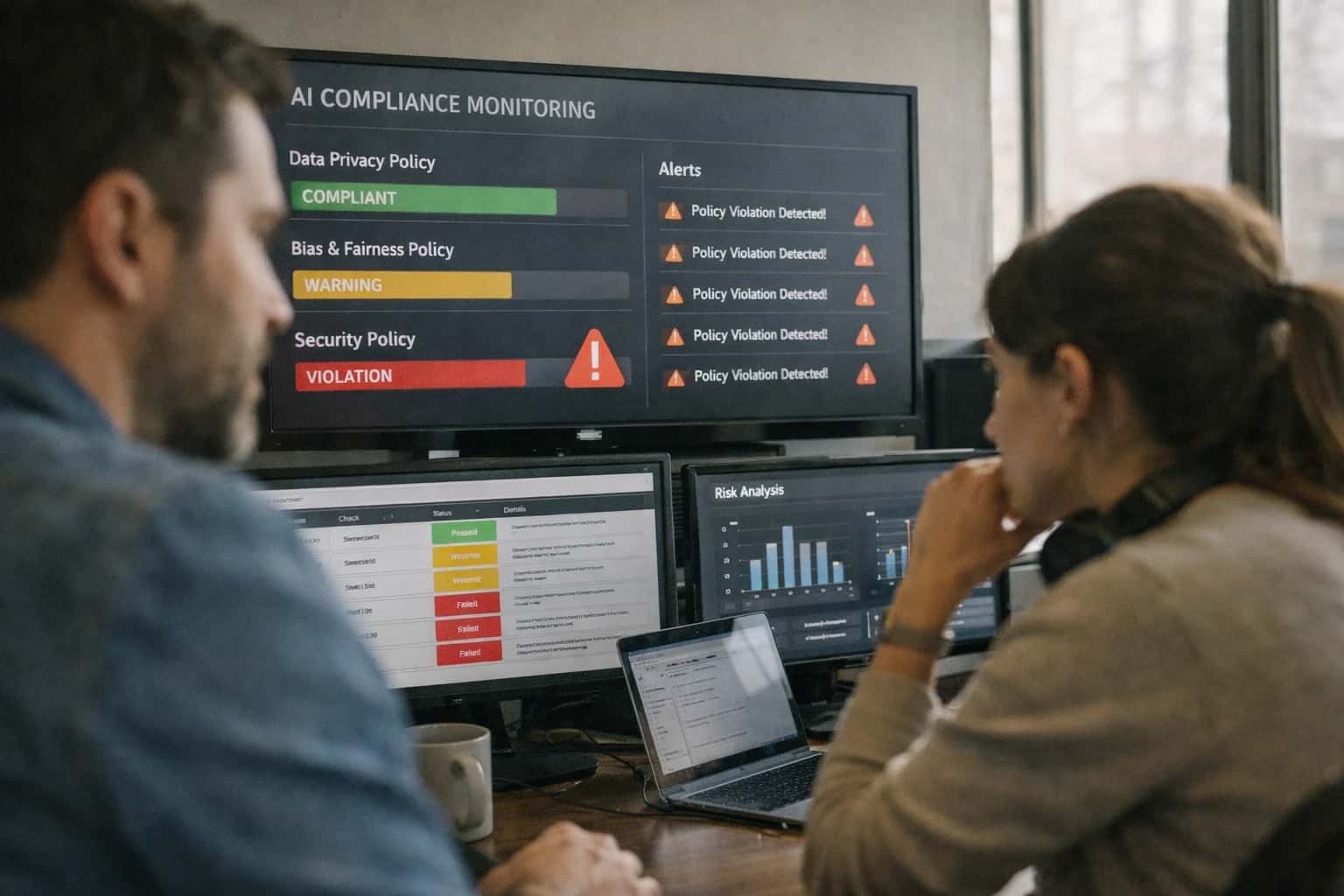
DATA PRIVACY CONTROL
What is PII Redaction?
PII redaction is the automated process of detecting and masking personally identifiable information within unstructured data to enforce privacy compliance and prevent data leakage.
In agentic workflows, PII redaction functions as a critical output validation guardrail, intercepting generated content before it reaches end-users or external APIs. Modern implementations leverage context-aware transformer models to distinguish between benign and sensitive entity mentions, reducing false positives. Redacted outputs are typically replaced with entity type labels or synthetic placeholders, ensuring that downstream systems receive structurally valid but de-identified data, thereby maintaining compliance with regulations such as GDPR, HIPAA, and CCPA.
DATA PRIVACY ENGINEERING
Core Characteristics of Effective PII Redaction
PII redaction is the automated process of detecting and masking personally identifiable information from agent outputs. Effective redaction requires precision, context awareness, and irreversible transformation to ensure compliance with GDPR, HIPAA, and CCPA regulations.
01
Entity Recognition Precision
The foundation of redaction is named entity recognition (NER) tuned for PII categories. Modern systems must detect not just obvious patterns like email addresses, but also contextual entities such as names embedded in unstructured text, medical record numbers, and financial account identifiers.
- Regex patterns catch structured data: SSNs, credit card numbers, phone numbers
- Transformer-based classifiers identify ambiguous entities: names, locations, organizations
- Custom gazetteers match domain-specific identifiers: patient IDs, employee numbers
- Contextual validation reduces false positives by analyzing surrounding tokens
Precision is measured by recall (catching all PII) and precision (not redacting non-PII). A system with 99% recall but 80% precision over-redacts and degrades output utility.
02
Irreversible Masking Techniques
True redaction is destructive and irreversible—unlike encryption, redacted data cannot be recovered. The method of masking must be chosen based on the downstream use case and compliance requirements.
- Full replacement: Replace entity with a category token, e.g.,
[REDACTED-NAME]or[EMAIL] - Character masking: Replace characters with asterisks or hashes, e.g.,
j***@e*****.com - Synthetic substitution: Replace with realistic but fake data, e.g., swap real names with generated pseudonyms
- Format-preserving tokenization: Maintain data structure while destroying original value, e.g., SSN
123-45-6789becomes987-65-4321
Format-preserving redaction is critical when downstream systems expect valid data structures but must never receive actual PII.
03
Context-Aware Boundary Detection
PII rarely exists in isolation. Effective redaction must handle multi-token entities and co-referenced information that spans sentences or paragraphs.
- Multi-token spans: 'John Jacob Smith' must be redacted as a single unit, not three separate tokens
- Co-reference resolution: If 'John' is later referred to as 'he' or 'the patient', those references may also require redaction depending on context
- Adjacent PII clustering: 'John Smith, 123 Main St, Boston, MA 02101' contains multiple linked entities that together re-identify an individual
- Document-level context: A name appearing in a signature block may require different handling than the same name in a narrative paragraph
Failure to handle context boundaries leads to partial redaction failures where residual information enables re-identification.
04
Real-Time Streaming Redaction
In agentic systems, outputs are often streamed token-by-token to users. This creates a temporal challenge: PII must be detected and redacted before the token reaches the user interface.
- Buffering windows: Accumulate tokens until entity boundaries are confirmed before releasing output
- Lookahead scanning: Peek ahead in the generation stream to identify potential PII spans before committing to output
- Rollback mechanisms: If PII is detected after partial emission, immediately retract and replace the exposed tokens
- Latency budgets: Streaming redaction must operate within strict latency constraints—typically under 50ms per token
Streaming redaction is essential for voice agents, chatbots, and real-time transcription where retroactive redaction is impossible.
05
Compliance-Aware Redaction Policies
Different regulatory frameworks mandate different redaction behaviors. A single redaction pipeline must support policy-driven rules that adapt to jurisdiction, data type, and intended use.
- GDPR: Requires redaction of any data that can directly or indirectly identify an EU resident, including IP addresses and cookie identifiers
- HIPAA: Mandates removal of 18 specific protected health information (PHI) identifiers from medical records
- PCI DSS: Requires masking of primary account numbers (PANs), displaying at most the first six and last four digits
- CCPA/CPRA: Extends protection to household data, geolocation, and inferred profiles
Policy engines like Open Policy Agent (OPA) can externalize redaction rules, allowing compliance teams to update policies without modifying the redaction pipeline code.
06
Redaction Audit and Verification
Redaction is not complete without cryptographic proof that PII was removed and a verifiable audit trail. This is critical for legal discovery, compliance reporting, and incident response.
- Before/after diffs: Store the original and redacted versions with a mapping of what was changed
- Cryptographic hashing: Generate a hash of the original PII to detect if the same entity appears elsewhere without storing the actual value
- Redaction coverage reports: Automatically calculate what percentage of known PII categories were detected and redacted
- Human-in-the-loop sampling: Periodically route redacted outputs to human reviewers for quality assurance
Audit trails enable organizations to prove compliance during regulatory investigations and identify systematic redaction failures before they become breaches.
Enabling Efficiency, Speed & Accuracy
Intelligent Analysis, Decision & Execution
We build AI systems for teams that need search across company data, workflow automation across tools, or AI features inside products and internal software.
Talk to Us
Search across company data
Give teams answers from docs, tickets, runbooks, and product data with sources and permissions.
Useful when people spend too long searching or get different answers from different systems.
Enterprise searchRAGPermissions
Read more
Automate internal workflows
Use AI to route work, draft outputs, trigger actions, and keep approvals and logs in place.
Useful when repetitive work moves across multiple tools and teams.
AI agentsWorkflow automationGovernance
Read more
Add AI to products and internal tools
Build assistants, guided actions, or decision support into the software your team or customers already use.
Useful when AI needs to be part of the product, not a separate tool.
AI integrationDecision supportModel routing
Read morePII REDACTION
Frequently Asked Questions
Clear, technical answers to the most common questions about detecting and masking personally identifiable information in agent outputs.
PII redaction is the automated process of detecting and masking personally identifiable information—such as names, email addresses, social security numbers, and phone numbers—from text outputs before they are exposed to users or downstream systems. The mechanism typically involves a multi-stage pipeline: first, a named entity recognition (NER) model or regex pattern matcher scans the text to identify spans containing PII. Second, a classification step verifies the entity type (e.g., distinguishing a person's name from a company name). Finally, a transformation function replaces the detected text with a placeholder token (e.g., [REDACTED]) or a synthetic substitute. Modern implementations often use transformer-based models fine-tuned on privacy datasets like OntoNotes 5.0 with PII annotations, achieving high recall on unstructured free-text while minimizing false positives that would degrade output utility.

About the author
Prasad Kumkar
CEO & MD, Inference Systems
Prasad Kumkar is the CEO & MD of Inference Systems and writes about AI systems architecture, LLM infrastructure, model serving, evaluation, and production deployment. Over 5+ years, he has worked across computer vision models, L5 autonomous vehicle systems, and LLM research, with a focus on taking complex AI ideas into real-world engineering systems.
His work and writing cover AI systems, large language models, AI agents, multimodal systems, autonomous systems, inference optimization, RAG, evaluation, and production AI engineering.
LinkedIn
Limited slotsGet a Free AI Consultation
Partnered with leading AI, data, and software stack.





How We Work
Custom AI workflows for your Business
One-fit-all AI don't work for modern businesses. At Inferensys, we aim to understand your business & custom requirements; which we use to define most efficient agentic workflows, the data, and the tools for your business.
01
Review the use case
We understand the task, the users, and where AI can actually help.
Read more02
Pick the right approach
We define what needs search, automation, or product integration.
Read more03
Build the first useful version
We implement the part that proves the value first.
Read more04
Improve from there
We add the checks and visibility needed to keep it useful.
Read moreThe first call is a practical review of your use case and the right next step.
Talk to Us