A guardrail is a programmatic policy or mechanism that constrains an AI agent's behavior to prevent harmful, off-policy, or unsafe actions and outputs. Unlike model-level alignment, guardrails operate as a runtime enforcement layer, intercepting and validating agent decisions before they manifest as state-changing operations or user-facing content. They implement deterministic rules, classifier-based checks, and structural constraints that the underlying model cannot reliably self-enforce.

Glossary
Guardrail
A programmatic policy or mechanism that constrains an AI agent's behavior to prevent harmful, off-policy, or unsafe actions and outputs.
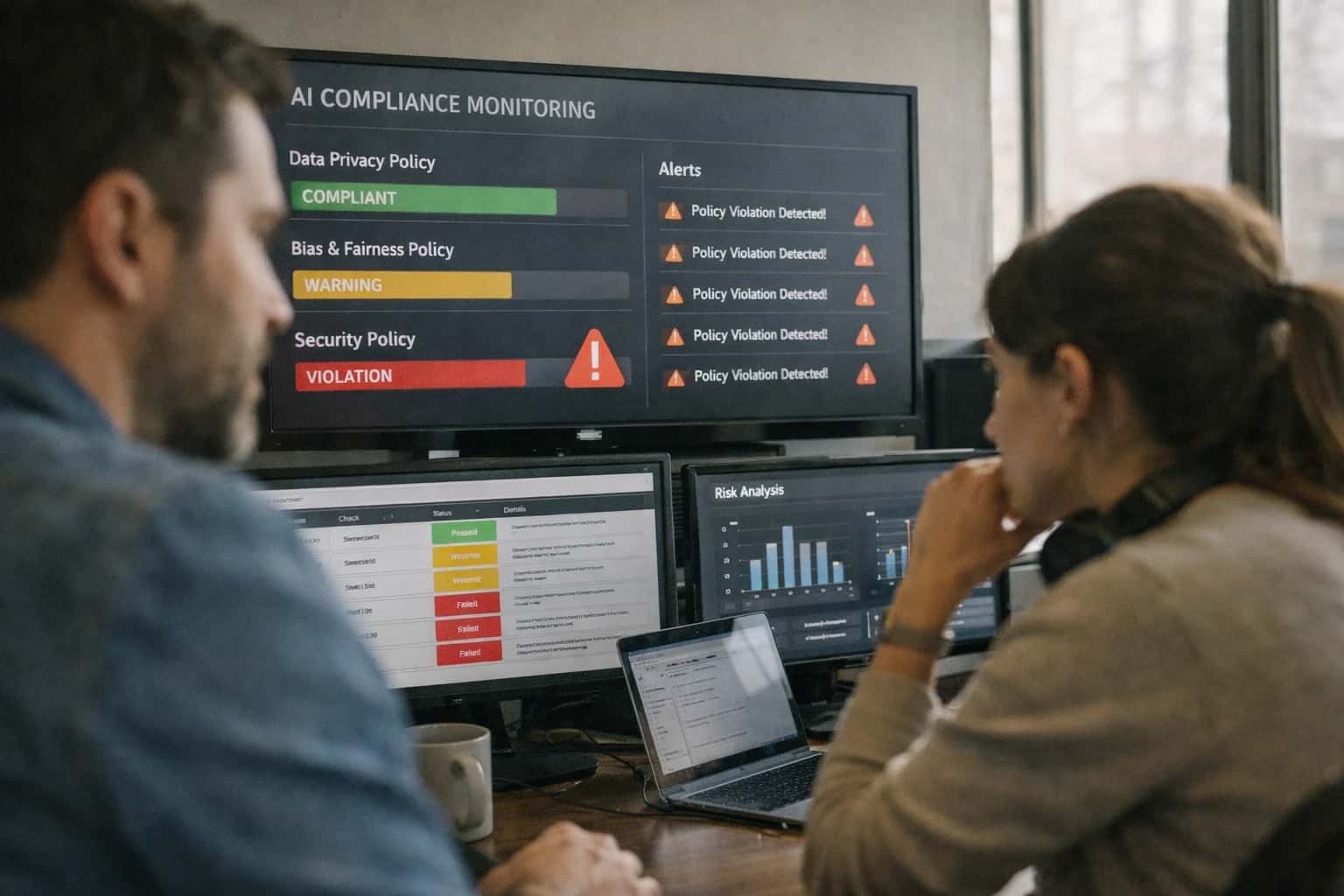
SAFETY MECHANISM
What is a Guardrail?
A guardrail is a programmatic policy or mechanism that constrains an AI agent's behavior to prevent harmful, off-policy, or unsafe actions and outputs, acting as a runtime enforcement layer between generation and execution.
Effective guardrail architectures combine multiple defense layers: input guardrails filter adversarial prompts before they reach the model, while output guardrails sanitize generated content for toxicity, PII leakage, or hallucinated claims. For autonomous agents, action gate mechanisms enforce least-privilege execution by requiring explicit approval for high-stakes tool calls. This defense-in-depth approach ensures that even if one layer is bypassed through prompt injection or jailbreak techniques, subsequent checkpoints can still prevent catastrophic failures.
PROGRAMMATIC CONSTRAINT ARCHITECTURE
Key Characteristics of Guardrails
Guardrails are the deterministic safety envelope surrounding probabilistic AI agents. They translate abstract policies into enforceable, real-time controls that prevent harmful, off-policy, or unsafe actions and outputs.
01
Policy Enforcement Layer
Guardrails function as a programmatic policy enforcement layer that sits between the agent's decision-making core and the external world. They intercept, evaluate, and potentially block actions based on predefined rules.
- Input Guardrails: Validate and sanitize incoming prompts or data before they reach the model
- Output Guardrails: Filter, redact, or restructure generated content before delivery
- Action Guardrails: Gate tool calls and API executions based on permission schemas
A financial agent might be permitted to analyze portfolio data but blocked from executing trades exceeding a $10,000 threshold without explicit human approval.
Pre-execution
Intervention Point
02
Deterministic Safety Envelope
Unlike the probabilistic nature of large language models, guardrails provide deterministic, auditable constraints. They do not rely on model interpretation but on hard-coded rules, classifiers, and formal grammars that execute identically every time.
- Formal grammar enforcement: Constrained decoding ensures outputs match a JSON schema exactly
- Regex-based filtering: Pattern matching catches credit card numbers and social security numbers with 100% recall
- Threshold-based gating: Confidence scores below 0.85 trigger automatic human review
This determinism is critical for compliance with regulations like SOC 2 and the EU AI Act, where stochastic safety guarantees are insufficient.
03
Multi-Layered Defense Architecture
Effective guardrail systems employ a defense-in-depth strategy with multiple independent layers. No single guardrail is considered sufficient for high-stakes deployments.
- Layer 1 - Instruction Hierarchy: System prompts override user prompts, establishing foundational behavioral constraints
- Layer 2 - Input Classifiers: Toxicity and prompt injection detectors screen all incoming content
- Layer 3 - Critic Models: Secondary LLMs evaluate primary outputs for factual consistency and policy compliance
- Layer 4 - Action Gates: Human-in-the-loop approval required for destructive or high-value operations
- Layer 5 - Circuit Breakers: Automatic shutdown when anomaly rates exceed defined thresholds
A compromised layer does not result in system-wide failure because subsequent layers provide redundant protection.
04
Semantic Entropy Monitoring
Advanced guardrails measure semantic entropy to detect when an agent is uncertain or hallucinating. Unlike token-level probability, semantic entropy clusters equivalent meanings and calculates uncertainty across meaning clusters.
- Low semantic entropy indicates the model is confident in a single interpretation
- High semantic entropy signals confusion, often preceding hallucination
- Guardrails can trigger abstention protocols when entropy exceeds calibrated thresholds
This technique is particularly valuable for retrieval-augmented generation systems where factual grounding is paramount. An agent answering medical questions would refuse to respond rather than generate plausible-sounding but incorrect information.
05
Least Privilege Execution
Guardrails enforce the principle of least privilege by restricting an agent's access permissions to the absolute minimum required for its designated task. This limits the blast radius of both errors and adversarial attacks.
- Scoped API keys: Each agent receives credentials with narrowly defined permissions
- Read-only defaults: Write operations require explicit opt-in approval
- Ephemeral sandboxes: Code execution occurs in isolated containers with no network access
- Rate limiting: Maximum actions per time window prevents runaway loops
A customer support agent might query order databases but cannot modify records. A code-generation agent executes in a gVisor sandbox without filesystem access to the host.
06
Real-Time Policy Compliance
Guardrails integrate with policy engines like Open Policy Agent (OPA) to validate every proposed action against regulatory, legal, and internal business rules before execution.
- Regulatory compliance: GDPR data residency rules enforced at the action gate level
- Business logic: Discount approvals capped at authorized percentages per role
- Audit trails: Every gated decision logged with timestamp, rationale, and outcome
This transforms abstract governance requirements into executable code. An insurance claims agent might be authorized to approve claims under $5,000 but must route anything exceeding that threshold to a human adjuster, with every decision recorded for compliance audits.
GUARDRAIL IMPLEMENTATION
Frequently Asked Questions
Clear, technical answers to the most common questions about designing, deploying, and debugging programmatic guardrails for autonomous AI agents.
A guardrail is a programmatic policy or mechanism that constrains an AI agent's behavior to prevent harmful, off-policy, or unsafe actions and outputs. It functions as a deterministic or probabilistic control layer that intercepts an agent's intended action or generated content before execution or user exposure. Guardrails operate by evaluating the agent's output against a predefined schema, policy, or safety classifier. For example, a guardrail might block a generated SQL query containing a DROP TABLE statement, filter toxic language using a toxicity classifier, or enforce that all tool calls conform to a strict JSON schema via constrained decoding. Unlike prompt-based safety instructions, which an agent can ignore or override through prompt injection, programmatic guardrails are enforced at the infrastructure level, making them non-negotiable. They are a critical component of agent output validation, ensuring that autonomous systems remain bounded even when facing adversarial inputs or unexpected environmental states.
COMPARATIVE ANALYSIS
Guardrails vs. Related Safety Mechanisms
How programmatic guardrails differ from other agent output validation and safety enforcement mechanisms in autonomous systems.
| Feature | Guardrail | Content Filter | Action Gate | Circuit Breaker |
|---|---|---|---|---|
Primary Function | Constrains behavior to prevent unsafe actions | Blocks/classifies unsafe content post-generation | Requires approval before high-stakes execution | Halts operation on anomaly threshold breach |
Intervention Point | Pre-generation and during execution | Post-generation, pre-delivery | Pre-execution of tool calls | Runtime, after repeated failures |
Decision Mechanism | Programmatic policy or rule engine | Classifier model scoring | Human approval workflow | Automated threshold monitoring |
Latency Impact | < 10 ms | 50-200 ms | Seconds to minutes | < 5 ms |
State Awareness | ||||
Reversible Action Support | ||||
Typical Implementation | OPA rules, JSON schema validation | Perspective API, toxicity classifiers | HITL queue, approval dashboard | Prometheus alert, kill switch trigger |
Failure Mode | Overly restrictive policy blocks legitimate actions | False negatives allow harmful content through | Approval bottleneck stalls workflows | False positives halt healthy operations |
Enabling Efficiency, Speed & Accuracy
Intelligent Analysis, Decision & Execution
We build AI systems for teams that need search across company data, workflow automation across tools, or AI features inside products and internal software.
Talk to Us
Search across company data
Give teams answers from docs, tickets, runbooks, and product data with sources and permissions.
Useful when people spend too long searching or get different answers from different systems.
Enterprise searchRAGPermissions
Read more
Automate internal workflows
Use AI to route work, draft outputs, trigger actions, and keep approvals and logs in place.
Useful when repetitive work moves across multiple tools and teams.
AI agentsWorkflow automationGovernance
Read more
Add AI to products and internal tools
Build assistants, guided actions, or decision support into the software your team or customers already use.
Useful when AI needs to be part of the product, not a separate tool.
AI integrationDecision supportModel routing
Read more
About the author
Prasad Kumkar
CEO & MD, Inference Systems
Prasad Kumkar is the CEO & MD of Inference Systems and writes about AI systems architecture, LLM infrastructure, model serving, evaluation, and production deployment. Over 5+ years, he has worked across computer vision models, L5 autonomous vehicle systems, and LLM research, with a focus on taking complex AI ideas into real-world engineering systems.
His work and writing cover AI systems, large language models, AI agents, multimodal systems, autonomous systems, inference optimization, RAG, evaluation, and production AI engineering.
LinkedIn
Limited slotsGet a Free AI Consultation
Partnered with leading AI, data, and software stack.





How We Work
Custom AI workflows for your Business
One-fit-all AI don't work for modern businesses. At Inferensys, we aim to understand your business & custom requirements; which we use to define most efficient agentic workflows, the data, and the tools for your business.
01
Review the use case
We understand the task, the users, and where AI can actually help.
Read more02
Pick the right approach
We define what needs search, automation, or product integration.
Read more03
Build the first useful version
We implement the part that proves the value first.
Read more04
Improve from there
We add the checks and visibility needed to keep it useful.
Read moreThe first call is a practical review of your use case and the right next step.
Talk to Us