OpenTelemetry Instrumentation is the automated insertion of observability code into an application's runtime to generate telemetry data like spans, metrics, and logs. For agentic systems, this specifically targets tool calls and API executions, capturing critical signals such as latency, error rates, and token usage without requiring manual code changes. The instrumentation libraries follow the vendor-neutral OpenTelemetry specification, ensuring data can be exported to any compatible backend.

Glossary
OpenTelemetry Instrumentation
OpenTelemetry Instrumentation is the process of adding observability code to an application to automatically generate traces, metrics, and logs compliant with the OpenTelemetry standard.
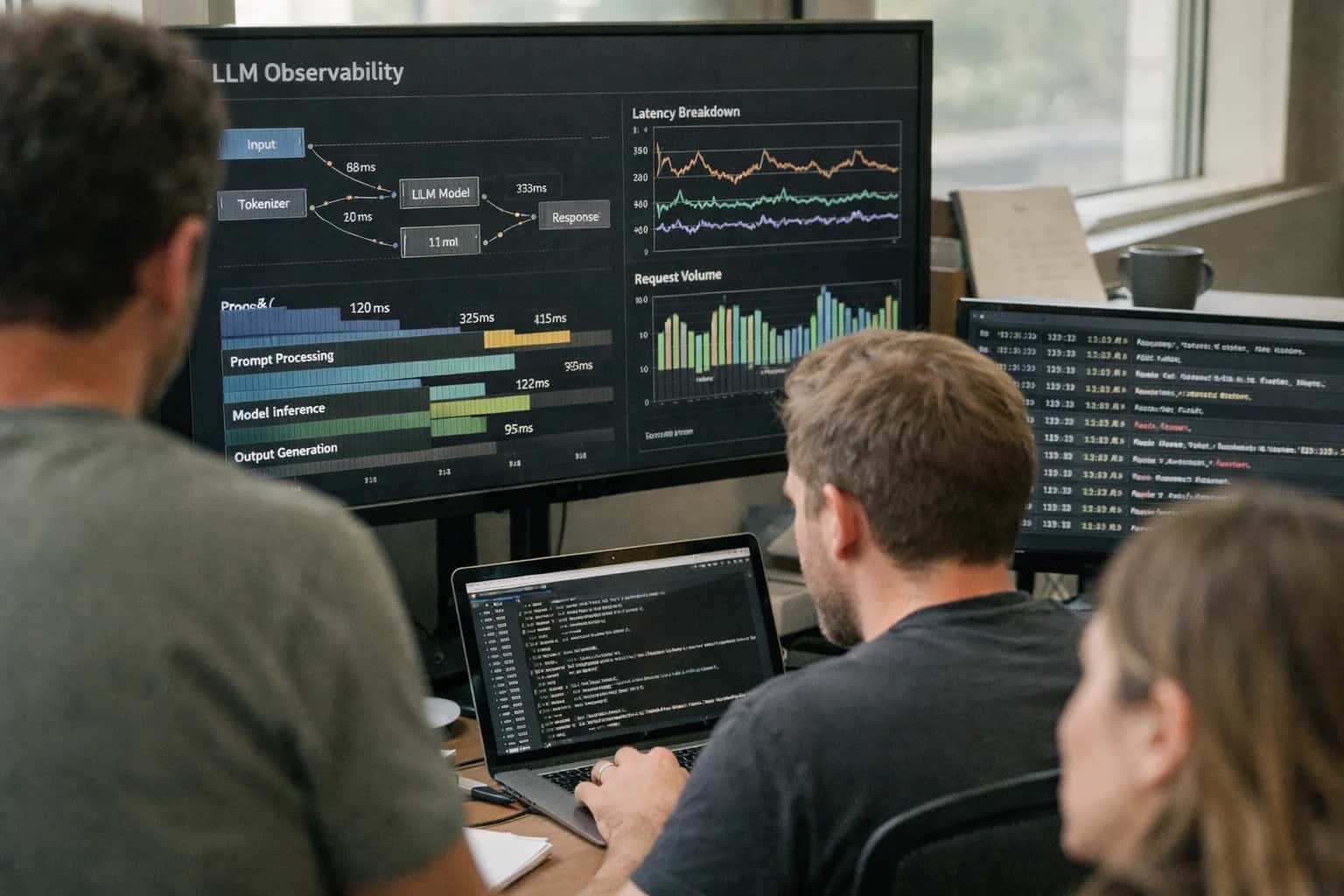
TOOL CALL INSTRUMENTATION
What is OpenTelemetry Instrumentation?
OpenTelemetry Instrumentation is the process of adding observability code to an application, specifically for tool calls, to automatically generate traces, metrics, and logs that are compliant with the OpenTelemetry standard.
The process involves using language-specific SDKs and auto-instrumentation agents that hook into common frameworks and libraries. This creates a distributed trace for each agent task, linking spans from internal reasoning to external API calls. The collected span attributes and events provide granular context for performance benchmarking and anomaly detection, forming the data foundation for agentic SLIs/SLOs and reliable dependency tracking.
OPEN TELEMETRY
Key Components of Instrumentation
OpenTelemetry Instrumentation involves embedding code to automatically generate standardized telemetry data. For agentic systems, this focuses on capturing the execution of external tool calls.
01
Span: The Unit of Work
A Span is the fundamental building block of a trace, representing a single, timed operation. In tool call instrumentation, each external API request (e.g., a database query, a payment API call, or a vector search) is encapsulated as its own span.
- Key Properties: Name, start/end timestamps, status (OK/Error), and a unique ID.
- Purpose: Provides granular timing and success/failure data for each discrete step in an agent's workflow.
02
Trace: The End-to-End Journey
A Trace is a directed acyclic graph of spans that represents the complete lifecycle of a request. For an agent, a trace visualizes the entire task execution, from the initial user prompt, through internal planning, to each sequential or parallel tool call, and finally to the agent's response.
- Trace Context: A unique Trace ID is propagated across all services and tool calls via headers (e.g.,
traceparent), enabling correlation. - Value: Offers a holistic view of performance bottlenecks and failure points across the agent's dependency chain.
03
Attributes: Descriptive Metadata
Span Attributes are key-value pairs attached to a span that provide essential context about the operation. For tool calls, these are critical for filtering, grouping, and debugging.
Common Tool Call Attributes:
tool.name: "StripeChargeAPI"http.method: "POST"http.status_code: 429agent.session_id: "sess_abc123"tool.call.parameters: "{amount: 5000, currency: 'usd'}" (truncated)
Attributes transform raw spans into queryable, meaningful events.
04
Events: Structured Logs within Spans
Span Events are timestamped records of notable occurrences during a span's lifetime. They provide a detailed, sequential log of the tool call's internal flow without requiring separate logging statements.
Example Events for a Tool Call Span:
"cache.miss"at t=5ms"request.sent"at t=10ms"retry.attempted"at t=210ms (with attributes:retry.count=1)"response.received"at t=315ms
Events are ideal for tracking retries, cache interactions, and milestone states.
05
Metrics: Quantitative Measurements
OpenTelemetry Metrics capture quantitative data about tool call behavior over time, complementing trace-based latency data. These are aggregated measurements, not per-request details.
Key Tool Call Metrics:
- Counter:
tool.calls.total(incremented on each call). - Histogram:
tool.call.duration(records latency distribution for P95, P99 analysis). - UpDownCounter:
tool.concurrent.calls(tracks active requests).
Metrics enable alerting on SLO breaches, like error rate exceeding 1% or latency P95 surpassing 2 seconds.
06
Context Propagation & Correlation
Context Propagation is the mechanism that carries the trace context (Trace ID, Span ID) across process and network boundaries. For agents calling external tools, this is typically done via HTTP headers (the W3C TraceContext standard).
Correlation uses this propagated context to link related signals:
- The agent's trace is linked to the external service's trace.
- All logs emitted during a tool call can be tagged with the Span ID.
- Execution Context IDs for agent sessions can be added as a span attribute, grouping all traces from a single user interaction.
This creates a unified, queryable view of the entire system.
INSTRUMENTATION PROCESS
How It Works for Agent Tool Calls
OpenTelemetry Instrumentation for agent tool calls involves automatically injecting observability code to generate standardized telemetry data, providing a complete technical audit trail of external API executions.
OpenTelemetry Instrumentation is the automated process of adding observability hooks to an agent's codebase to generate traces, metrics, and logs for its external tool and API calls. For an agent, this typically means instrumenting the client libraries or SDKs used to make HTTP requests, database queries, or other external operations. The instrumentation automatically creates Spans for each tool call, capturing timing, success status, and contextual Span Attributes like the endpoint and parameters.
The instrumentation libraries propagate a unique Trace Correlation identifier (often via HTTP headers) to external services, enabling Distributed Tracing across service boundaries. Generated telemetry is processed by the OpenTelemetry SDK and sent via a Span Exporter to a backend analysis system. This creates a unified view of an agent's execution path, linking internal reasoning steps with external API dependencies for comprehensive performance monitoring and debugging.
TOOL CALL INSTRUMENTATION
Frequently Asked Questions
Essential questions and answers about instrumenting agent tool calls with OpenTelemetry for comprehensive observability.
OpenTelemetry Instrumentation for tool calls is the process of automatically injecting observability code into an application to generate traces, metrics, and logs for every external API or software interaction performed by an autonomous agent. It works by using language-specific instrumentation libraries that hook into common HTTP clients, gRPC stubs, or database drivers to create spans for each outbound request. These spans capture critical metadata like the target endpoint, request parameters, HTTP status code, and latency, which are then exported to an observability backend. This provides a complete, vendor-neutral record of an agent's external actions, enabling performance debugging, cost attribution, and reliability assurance.
Enabling Efficiency, Speed & Accuracy
Intelligent Analysis, Decision & Execution
We build AI systems for teams that need search across company data, workflow automation across tools, or AI features inside products and internal software.
Talk to Us
Search across company data
Give teams answers from docs, tickets, runbooks, and product data with sources and permissions.
Useful when people spend too long searching or get different answers from different systems.
Enterprise searchRAGPermissions
Read more
Automate internal workflows
Use AI to route work, draft outputs, trigger actions, and keep approvals and logs in place.
Useful when repetitive work moves across multiple tools and teams.
AI agentsWorkflow automationGovernance
Read more
Add AI to products and internal tools
Build assistants, guided actions, or decision support into the software your team or customers already use.
Useful when AI needs to be part of the product, not a separate tool.
AI integrationDecision supportModel routing
Read more
About the author
Prasad Kumkar
CEO & MD, Inference Systems
Prasad Kumkar is the CEO & MD of Inference Systems and writes about AI systems architecture, LLM infrastructure, model serving, evaluation, and production deployment. Over 5+ years, he has worked across computer vision models, L5 autonomous vehicle systems, and LLM research, with a focus on taking complex AI ideas into real-world engineering systems.
His work and writing cover AI systems, large language models, AI agents, multimodal systems, autonomous systems, inference optimization, RAG, evaluation, and production AI engineering.
LinkedIn
Limited slotsGet a Free AI Consultation
Partnered with leading AI, data, and software stack.





How We Work
Custom AI workflows for your Business
One-fit-all AI don't work for modern businesses. At Inferensys, we aim to understand your business & custom requirements; which we use to define most efficient agentic workflows, the data, and the tools for your business.
01
Review the use case
We understand the task, the users, and where AI can actually help.
Read more02
Pick the right approach
We define what needs search, automation, or product integration.
Read more03
Build the first useful version
We implement the part that proves the value first.
Read more04
Improve from there
We add the checks and visibility needed to keep it useful.
Read moreThe first call is a practical review of your use case and the right next step.
Talk to Us