A Task Delegation Trace is an observability record that logs the complete lifecycle of a task as it is decomposed, assigned, and executed across different agents in a system. It captures the causal chain of delegation decisions, handoffs, and results, providing a deterministic audit trail for complex, collaborative workflows. This trace is essential for debugging, performance analysis, and verifying that a system's execution aligns with its designed orchestration logic.

Glossary
Task Delegation Trace
A Task Delegation Trace is an observability record that logs the complete lifecycle of a task as it is decomposed, assigned, and executed across different agents, including delegation decisions and result handoffs.
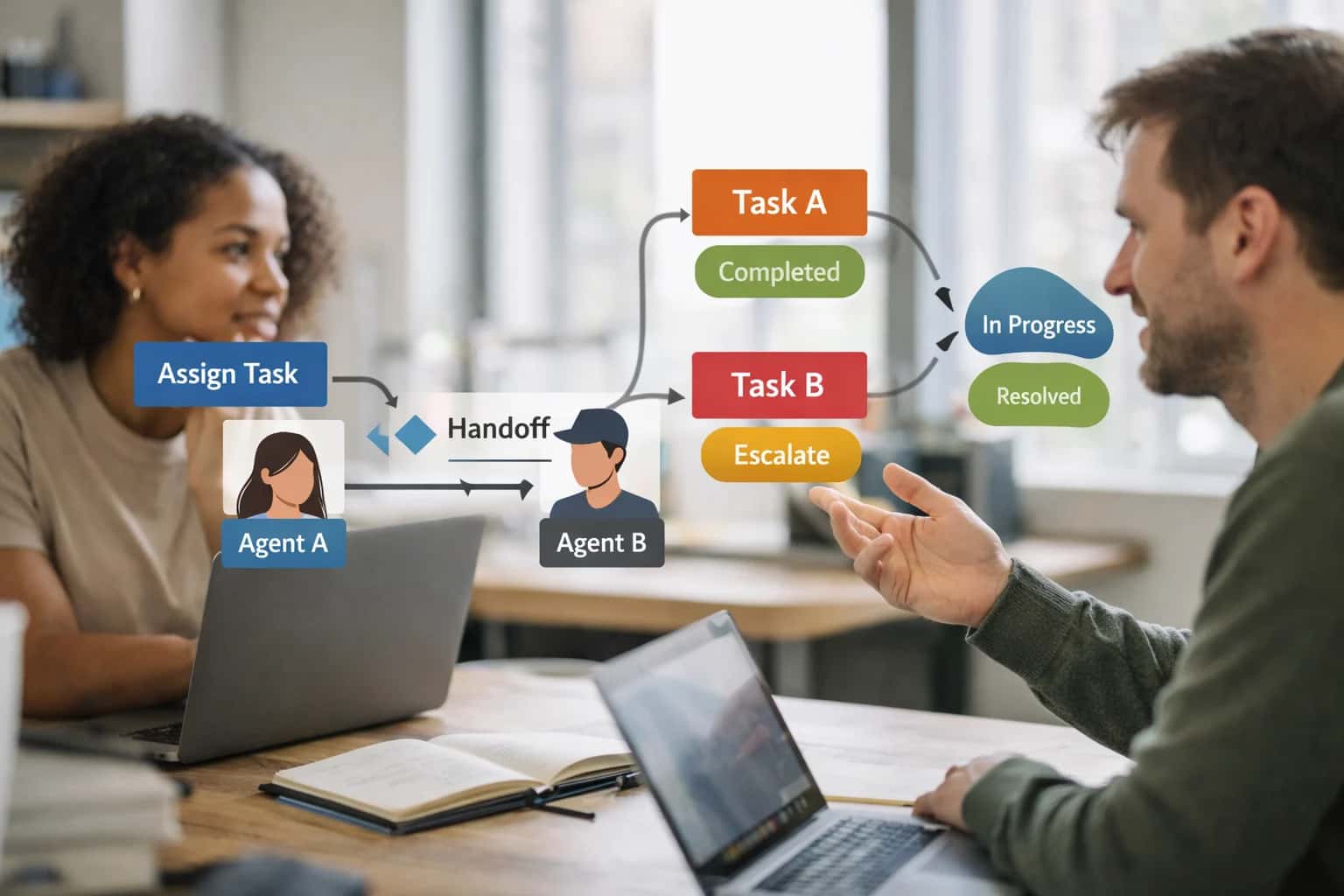
MULTI-AGENT OBSERVABILITY
What is Task Delegation Trace?
A Task Delegation Trace is a core observability primitive for auditing autonomous multi-agent systems.
The trace typically includes metadata such as the delegating agent, the recipient agent, the task specification, timestamps for delegation and completion, and the final result or error state. By instrumenting the orchestration layer, it enables engineers to pinpoint bottlenecks, identify miscoordination, and validate Service Level Objectives (SLOs) for multi-agent collaboration. It is a foundational component of agentic observability, transforming opaque autonomous behavior into an inspectable, chronological log.
MULTI-AGENT OBSERVABILITY
Key Components of a Task Delegation Trace
A Task Delegation Trace is a comprehensive observability record that logs the complete lifecycle of a task as it is decomposed, assigned, and executed across different agents. It is the foundational data structure for auditing autonomous workflows.
01
Task Decomposition Log
This component records the initial breakdown of a high-level objective into atomic sub-tasks. It captures the planning agent's reasoning for the chosen decomposition strategy, the generated task hierarchy (often a tree or DAG), and the estimated resource requirements for each leaf node. This log is critical for debugging flawed planning logic and understanding the system's initial intent.
- Example: An objective to 'Generate Q4 Market Report' is decomposed into:
Research Competitor News,Analyze Internal Sales Data,Create Data Visualizations,Draft Executive Summary. - Key Data: Parent task ID, child task IDs, decomposition timestamp, planning rationale, estimated cost/complexity.
02
Delegation Decision Record
This record documents the moment a task is assigned to a specific agent. It includes the delegation criteria used (e.g., agent capability matching, current load, specialization), the selected agent's identifier, and any constraints or instructions passed with the assignment. This is essential for analyzing the efficiency and fairness of the orchestration layer's scheduling algorithms.
- Key Metrics: Decision latency, agent selection score, alternative agents considered.
- Links to: Orchestration Telemetry and Agent Interaction Graphs, as delegation decisions define the edges in the agent communication network.
03
Agent Execution Span
A span is the core unit of work within the trace, representing a single agent's handling of an assigned task. Each span contains:
- Timing Data: Start time, end time, and duration.
- Agent Context: Agent ID, role, and internal state snapshot.
- Action Log: A sequential record of internal steps, including tool calls, data retrievals, and reasoning cycles.
- Input/Output: The task parameters received and the final result or artifact produced.
These spans are the building blocks for constructing a Distributed Agent Trace, linking work across the system.
04
Result Handoff & Validation
This component logs the transfer of a task's output from the executing agent back to the delegating agent or a final aggregator. It captures the handoff protocol, data format, and crucially, any validation or verification steps applied to the result. Failed validations trigger re-delegation or error correction loops, which are logged here.
- Monitors for: Data corruption during transfer, schema mismatches, quality threshold failures.
- Critical for: Enforcing Multi-Agent SLOs related to task success rate and output accuracy.
05
Causality & Dependency Links
The trace is not a simple log but a connected graph. This component explicitly defines the causal and data-dependency relationships between different spans and delegation events. It answers why a task was executed, showing which prior task's output was its input. This is vital for root-cause analysis and reconstructing the exact workflow path.
- Manifests as: Span parent-child relationships, trace identifiers propagated across agent boundaries.
- Enables: Construction of a Causal Influence Graph to understand how one agent's action affected the overall system outcome.
06
Context & Artifact References
A task delegation trace must reference the external context and artifacts that influenced execution. This includes pointers to:
- Shared Memory/Blackboard: Reads from and writes to a Collective State Vector or shared knowledge base.
- Tool & API Calls: Detailed records of external operations, linked to Tool Call Instrumentation.
- Retrieved Documents: IDs or embeddings of documents fetched via RAG.
- Conversation History: Relevant prior messages in a session.
These references prevent the trace from being a disconnected silo, integrating it with the broader Agentic Observability ecosystem.
MULTI-AGENT OBSERVABILITY
How Task Delegation Tracing Works
Task Delegation Tracing is a core observability practice for multi-agent systems, providing a deterministic audit trail of how complex tasks are broken down and assigned.
A Task Delegation Trace is an end-to-end observability record that logs the complete lifecycle of a task as it is decomposed, assigned, and executed across different autonomous agents. It captures the causal chain of delegation decisions, handoffs, and result aggregations, forming a unified timeline. This trace is essential for debugging coordination failures, verifying workflow correctness, and attributing performance or cost to specific agents and their decisions.
The trace is constructed by instrumenting the orchestration framework and individual agents to emit structured events. Key logged data includes the initial task specification, decomposition logic, bid/assignment protocols (e.g., Contract Net), execution spans per agent, message passing between agents, and final result synthesis. By correlating these events into a single Distributed Agent Trace, engineers gain visibility into coordination overhead, bottleneck identification, and the validation of collective goal progress against defined Multi-Agent SLOs.
TASK DELEGATION TRACE
Frequently Asked Questions
Task Delegation Trace is a core concept in multi-agent observability, providing the audit trail for how complex tasks are broken down and executed across a team of autonomous agents. These FAQs address its definition, mechanics, and role in enterprise-grade AI systems.
A Task Delegation Trace is an observability record that logs the complete lifecycle of a task as it is decomposed, assigned, and executed across different agents in a multi-agent system. It captures the causal chain of delegation decisions, handoffs, and results, providing a deterministic audit trail for collaborative workflows. This trace is essential for debugging, performance analysis, and verifying that a system's execution aligns with its designed orchestration logic, especially in environments requiring compliance and reproducibility.
Key components logged in a trace typically include:
- Task Genesis: The initial user request or high-level goal.
- Decomposition Steps: How a parent task is broken into sub-tasks by a planner or orchestrator agent.
- Assignment Events: Records of which agent was assigned which sub-task, including the rationale (e.g., capability matching, load balancing).
- Execution Spans: The internal processing and tool calls performed by each agent to complete its assigned work.
- Result Propagation: The handoff of results between agents, including success/failure states and any transformed data.
- Temporal Metadata: Precise timestamps for all events, enabling latency analysis and the construction of a Distributed Agent Trace.
Enabling Efficiency, Speed & Accuracy
Intelligent Analysis, Decision & Execution
We build AI systems for teams that need search across company data, workflow automation across tools, or AI features inside products and internal software.
Talk to Us
Search across company data
Give teams answers from docs, tickets, runbooks, and product data with sources and permissions.
Useful when people spend too long searching or get different answers from different systems.
Enterprise searchRAGPermissions
Read more
Automate internal workflows
Use AI to route work, draft outputs, trigger actions, and keep approvals and logs in place.
Useful when repetitive work moves across multiple tools and teams.
AI agentsWorkflow automationGovernance
Read more
Add AI to products and internal tools
Build assistants, guided actions, or decision support into the software your team or customers already use.
Useful when AI needs to be part of the product, not a separate tool.
AI integrationDecision supportModel routing
Read more
About the author
Prasad Kumkar
CEO & MD, Inference Systems
Prasad Kumkar is the CEO & MD of Inference Systems and writes about AI systems architecture, LLM infrastructure, model serving, evaluation, and production deployment. Over 5+ years, he has worked across computer vision models, L5 autonomous vehicle systems, and LLM research, with a focus on taking complex AI ideas into real-world engineering systems.
His work and writing cover AI systems, large language models, AI agents, multimodal systems, autonomous systems, inference optimization, RAG, evaluation, and production AI engineering.
LinkedIn
Limited slotsGet a Free AI Consultation
Partnered with leading AI, data, and software stack.





How We Work
Custom AI workflows for your Business
One-fit-all AI don't work for modern businesses. At Inferensys, we aim to understand your business & custom requirements; which we use to define most efficient agentic workflows, the data, and the tools for your business.
01
Review the use case
We understand the task, the users, and where AI can actually help.
Read more02
Pick the right approach
We define what needs search, automation, or product integration.
Read more03
Build the first useful version
We implement the part that proves the value first.
Read more04
Improve from there
We add the checks and visibility needed to keep it useful.
Read moreThe first call is a practical review of your use case and the right next step.
Talk to Us