Orchestration Telemetry provides the foundational observability data for multi-agent systems, capturing the central controller's decisions, state transitions, and communication patterns. It answers critical operational questions about task delegation, workflow progression, and resource allocation across the agent collective. This data is essential for detecting coordination failures, bottlenecks, and performance degradation at the system level, rather than within individual agents.

Glossary
Orchestration Telemetry
Orchestration Telemetry is the collection of metrics, logs, and traces generated by a central controller or framework responsible for coordinating the workflow and task allocation among multiple autonomous agents.
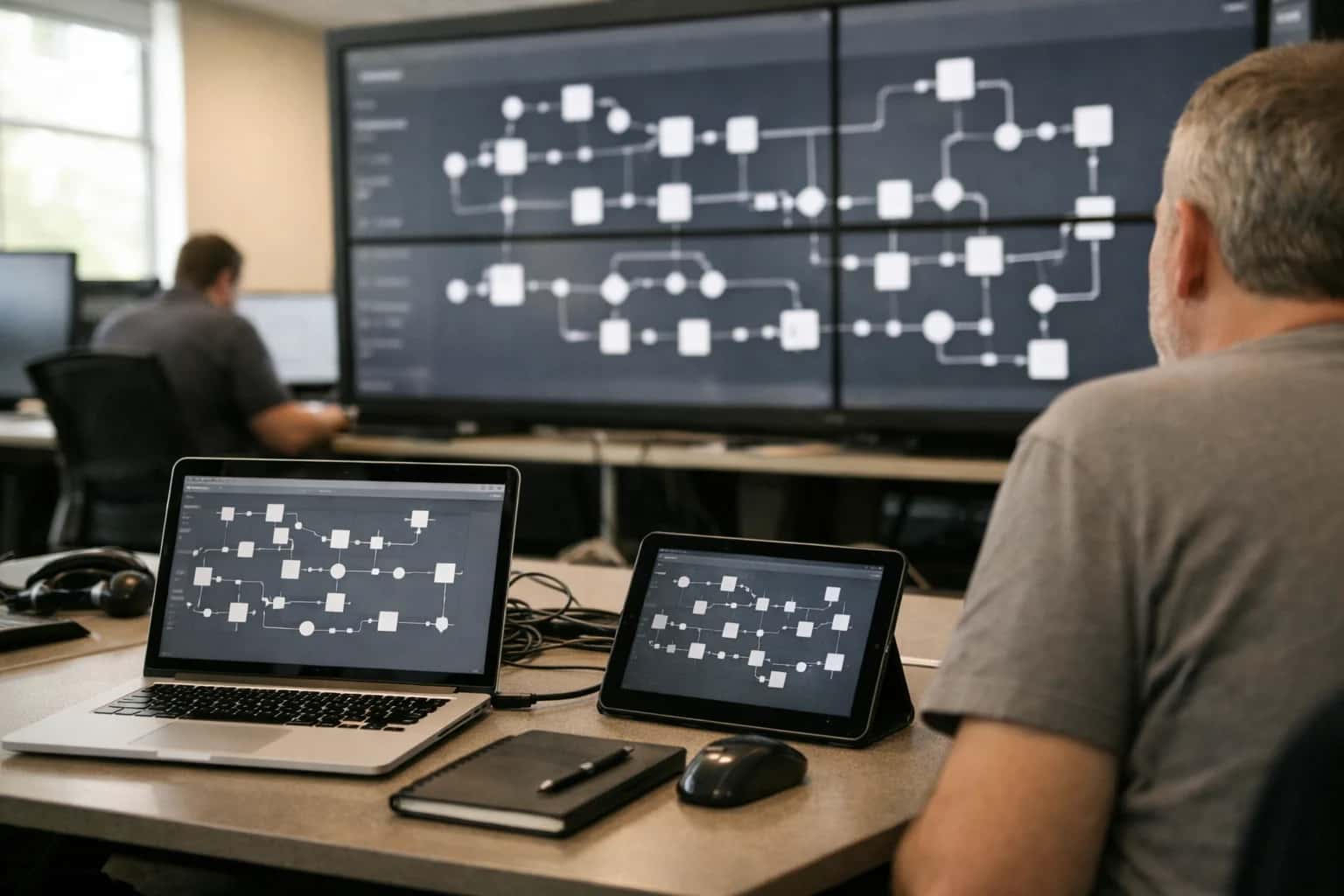
MULTI-AGENT OBSERVABILITY
What is Orchestration Telemetry?
Orchestration Telemetry is the collection of metrics, logs, and traces generated by a central controller or framework responsible for coordinating the workflow and task allocation among multiple autonomous agents.
Key telemetry signals include orchestrator latency, task queue depth, agent assignment logs, and workflow state traces. This data feeds into Multi-Agent SLOs and enables bottleneck identification and cascading failure signal detection. By instrumenting the orchestrator, engineers gain a top-down view of system health, complementing the bottom-up perspective from Agent Telemetry Pipelines and Distributed Agent Traces for full-stack observability.
MULTI-AGENT OBSERVABILITY
Key Data Signals in Orchestration Telemetry
Orchestration Telemetry provides the foundational data for understanding and optimizing multi-agent systems. These key signals reveal the health, performance, and coordination dynamics of the entire collective.
01
Coordination Overhead
The aggregate computational cost and latency incurred by agents to communicate, negotiate, and synchronize, distinct from primary task work. This is a critical efficiency metric.
- Components: Includes message serialization/deserialization time, network latency for inter-agent calls, consensus protocol rounds, and lock acquisition wait times.
- Impact: High overhead reduces system throughput and increases operational cost. It is a primary target for optimization in synchronous agent workflows.
- Example: In a Contract Net Protocol, overhead includes the time for task announcement, bid evaluation, and award communication before work begins.
02
Collective State Vector
A composite, time-stamped snapshot aggregating the internal operational states of all agents in a system. It provides a global view for debugging and state recovery.
- Contents: Typically includes each agent's current goal, working memory contents, tool call history, and belief states.
- Use Case: Essential for root-cause analysis during failures, as it captures the precise system-wide conditions leading to an incident. It enables replaying a scenario from a known point.
- Implementation: Often derived by aggregating individual agent telemetry or querying a shared blackboard system.
03
Distributed Agent Trace
An end-to-end, causally-linked record of a request's execution as it propagates across multiple agents. It is the multi-agent equivalent of a distributed trace in microservices.
- Structure: Composed of multiple Multi-Agent Spans, each representing one agent's contribution, linked by correlation IDs passed in inter-agent messages.
- Visualization: Reveals the critical path of execution, showing which agents were involved, how long each took, and where bottlenecks or errors occurred.
- Value: Fundamental for performance debugging (identifying slow agents) and understanding the flow of complex, emergent workflows.
04
Consensus Monitoring
The observability practice of tracking the process by which a group of distributed agents reaches agreement. It measures the reliability and performance of coordination protocols.
- Key Metrics: Time-to-agreement, number of communication rounds required, participant vote distribution, and leader election duration.
- Protocols Observed: Includes Paxos, Raft, practical Byzantine Fault Tolerance (PBFT), and simpler voting mechanisms.
- Failure Detection: Alerts on metrics like prolonged rounds or failure to reach a quorum, which can indicate network partitions or Byzantine faults.
05
Cascading Failure Signal
An alert or metric indicating that a fault or performance degradation in one agent is propagating through dependencies, causing systemic failure.
- Detection: Requires monitoring dependency graphs and establishing baselines for normal inter-agent error rates. A spike in downstream agent failures following an upstream agent's issue is a key signal.
- Mitigation: Triggers circuit breakers, task re-delegation, or failover procedures to isolate the fault and prevent total system collapse.
- Related Concept: Tightly coupled to Bottleneck Identification and Deadlock Detection, as these conditions often precipitate cascades.
06
Collaboration Metrics
Quantitative indicators that measure the effectiveness and efficiency of agent teamwork, moving beyond individual agent performance.
- Common Metrics:
- Task Completion Rate: Percentage of collaborative workflows finished successfully.
- Shared Knowledge Utilization: How often agents access and build upon information posted by others (e.g., in a blackboard).
- Conflict Resolution Speed: Time taken to resolve a goal or resource conflict between agents.
- Collective Goal Progress: Advancement toward a shared objective, measured as sub-task completion.
- Purpose: These metrics feed into Multi-Agent SLOs and guide architectural improvements to enhance cooperation.
ORCHESTRATION TELEMETRY
Frequently Asked Questions
Orchestration Telemetry is the collection of metrics, logs, and traces generated by a central controller or framework responsible for coordinating the workflow and task allocation among multiple autonomous agents. This FAQ addresses key concepts for monitoring and debugging these complex systems.
Orchestration Telemetry is the comprehensive observability data—including metrics, logs, and distributed traces—generated by the central controller or framework that manages the workflow, communication, and task allocation in a multi-agent system. It is critical because it provides the only coherent, system-wide view of a decentralized process, allowing engineers to debug failures, optimize performance, and verify that the collective goal is being pursued efficiently. Without it, you have siloed agent logs with no visibility into the coordination logic, making root cause analysis for stalled workflows or resource contention nearly impossible.
Enabling Efficiency, Speed & Accuracy
Intelligent Analysis, Decision & Execution
We build AI systems for teams that need search across company data, workflow automation across tools, or AI features inside products and internal software.
Talk to Us
Search across company data
Give teams answers from docs, tickets, runbooks, and product data with sources and permissions.
Useful when people spend too long searching or get different answers from different systems.
Enterprise searchRAGPermissions
Read more
Automate internal workflows
Use AI to route work, draft outputs, trigger actions, and keep approvals and logs in place.
Useful when repetitive work moves across multiple tools and teams.
AI agentsWorkflow automationGovernance
Read more
Add AI to products and internal tools
Build assistants, guided actions, or decision support into the software your team or customers already use.
Useful when AI needs to be part of the product, not a separate tool.
AI integrationDecision supportModel routing
Read more
About the author
Prasad Kumkar
CEO & MD, Inference Systems
Prasad Kumkar is the CEO & MD of Inference Systems and writes about AI systems architecture, LLM infrastructure, model serving, evaluation, and production deployment. Over 5+ years, he has worked across computer vision models, L5 autonomous vehicle systems, and LLM research, with a focus on taking complex AI ideas into real-world engineering systems.
His work and writing cover AI systems, large language models, AI agents, multimodal systems, autonomous systems, inference optimization, RAG, evaluation, and production AI engineering.
LinkedIn
Limited slotsGet a Free AI Consultation
Partnered with leading AI, data, and software stack.





How We Work
Custom AI workflows for your Business
One-fit-all AI don't work for modern businesses. At Inferensys, we aim to understand your business & custom requirements; which we use to define most efficient agentic workflows, the data, and the tools for your business.
01
Review the use case
We understand the task, the users, and where AI can actually help.
Read more02
Pick the right approach
We define what needs search, automation, or product integration.
Read more03
Build the first useful version
We implement the part that proves the value first.
Read more04
Improve from there
We add the checks and visibility needed to keep it useful.
Read moreThe first call is a practical review of your use case and the right next step.
Talk to Us