Instrumentation is the process of adding observability code to an application to generate telemetry data such as traces, metrics, and logs. It involves strategically placing hooks within the codebase to capture data about operations, performance, and state. This practice is essential for distributed tracing, allowing engineers to follow a request's path across services. Without instrumentation, systems are opaque, making debugging and performance optimization nearly impossible in complex, agentic architectures.

Glossary
Instrumentation
Instrumentation is the process of adding observability code to an application to generate telemetry data such as traces, metrics, and logs.
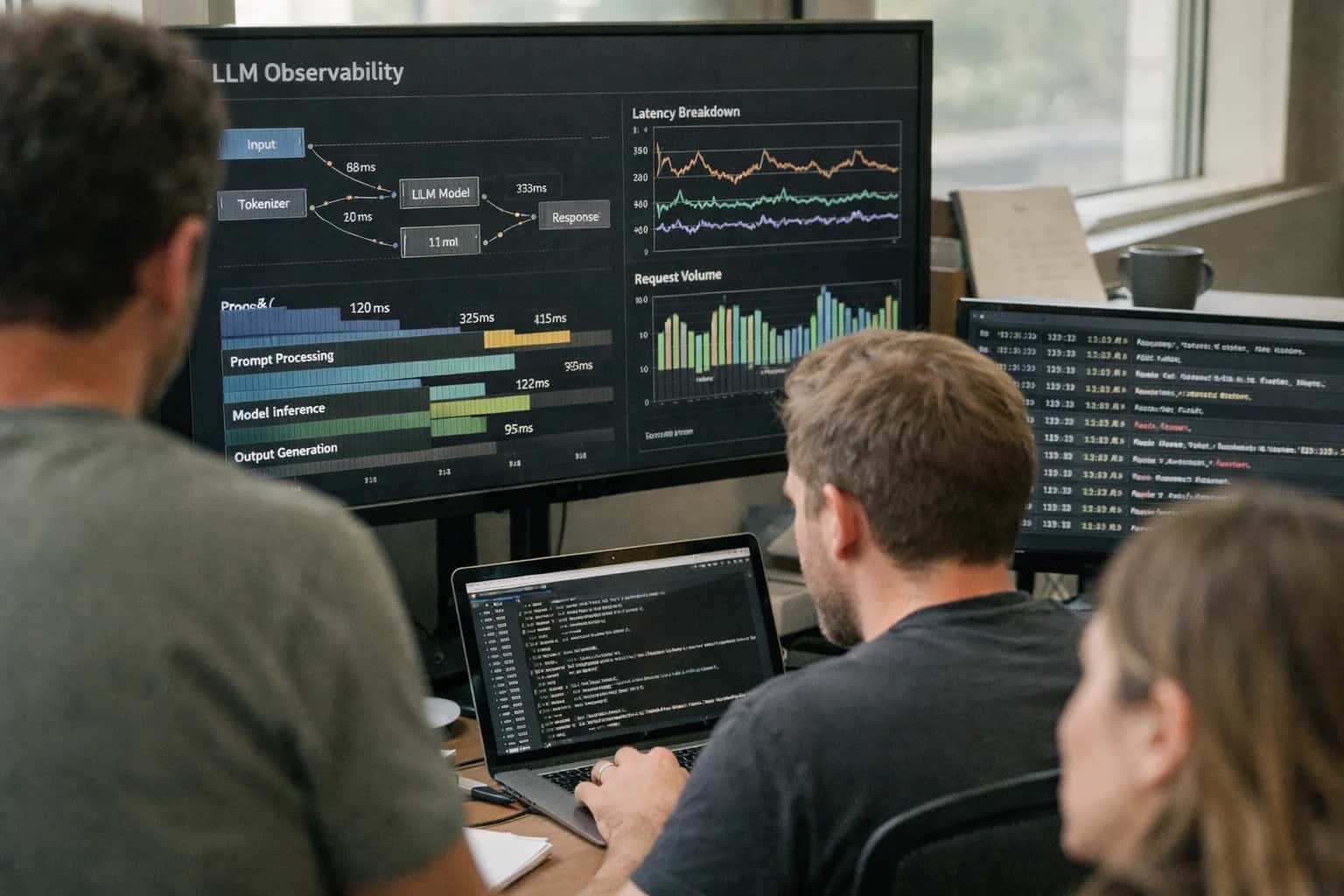
DISTRIBUTED TRACE COLLECTION
What is Instrumentation?
Instrumentation is the foundational engineering practice of embedding code into a software application to generate telemetry data, enabling observability into its internal operations and external interactions.
Implementation can be manual, where developers explicitly add code using SDKs like OpenTelemetry, or auto-instrumentation, where agents inject tracing automatically. The generated data, structured into spans and traces, flows through a trace pipeline to monitoring backends. Effective instrumentation is non-invasive, low-overhead, and provides the span context necessary for distributed context propagation, forming the raw material for all agentic observability and analysis.
DISTRIBUTED TRACE COLLECTION
Key Characteristics of Instrumentation
Instrumentation is the foundational engineering practice of embedding code to generate telemetry. In distributed systems, its characteristics define the quality, granularity, and utility of the resulting observability data.
01
Granularity and Context
Instrumentation defines the resolution at which a system is observed. Effective instrumentation creates spans that are neither too coarse (missing critical steps) nor too fine (creating excessive overhead). Each span must be enriched with span attributes (key-value metadata) that provide essential context, such as:
- HTTP method and status code for API calls
- Database query strings and connection parameters
- Business identifiers like user ID, transaction ID, or order number
- Environmental tags like deployment version and hostname This contextual data transforms raw timing data into actionable insights, enabling precise root cause analysis.
02
Propagation and Correlation
A core characteristic of distributed tracing instrumentation is its ability to propagate context across service boundaries. This involves:
- Injecting a span context (containing trace ID, span ID, and sampling flags) into outbound requests (e.g., as HTTP headers).
- Extracting that context from inbound requests to create child spans. This mechanism, performed by a propagator, is what enables trace correlation, stitching together the work of disparate services into a single, coherent trace. Standards like W3C Trace Context ensure interoperability between different programming languages and observability vendors.
03
Minimal Performance Overhead
Instrumentation must be designed to impose a negligible performance tax on the host application. Key techniques to achieve this include:
- Asynchronous data export to prevent blocking the application's critical path.
- Efficient in-memory data structures for span creation and attribute storage.
- Strategic sampling (head or tail sampling) to control data volume without losing insights into errors or slow requests.
- Compiled-in instrumentation that avoids expensive runtime reflection. The goal is to gain deep observability while maintaining sub-millisecond latency overhead for instrumented operations.
04
Semantic Conventions
High-quality instrumentation adheres to shared semantic conventions. These are standardized names and values for span attributes, span kinds, and status codes that ensure consistency and meaning across different services and teams. For example:
- A span for an HTTP client call should use the attribute
http.method="GET"andhttp.status_code=200. - A span representing the server-side handling of that request should have its span kind set to
Server. - A database call span should use attributes like
db.system="postgresql"anddb.statement. Conventions, primarily defined by OpenTelemetry, enable automated analysis, aggregation, and the creation of universal service graphs.
05
Vendor Agnosticism
Modern instrumentation is built to be independent of any specific observability backend. This is achieved through:
- Using open standards and APIs like OpenTelemetry (OTel).
- Exporting data via the OpenTelemetry Protocol (OTLP) to a collector.
- Decoupling the instrumentation code from the vendor's SDK. This characteristic provides crucial flexibility, allowing organizations to change their analysis tools (e.g., from Jaeger to a commercial APM) without re-instrumenting their applications. The OpenTelemetry Collector then handles vendor-specific formatting and routing.
06
Deployment Modalities
Instrumentation can be applied to an application through different methods, each with trade-offs:
- Manual Instrumentation: Developers explicitly write code to create spans and add attributes using a library API. This offers maximum control and customization for business logic.
- Auto-Instrumentation: Libraries, agents, or compilers automatically inject tracing code for common frameworks (e.g., Django, Express.js, Spring Boot). This provides immediate, zero-code observability but may lack deep business context.
- Hybrid Approach: Combining auto-instrumentation for infrastructure layers (HTTP servers, database clients) with manual instrumentation for core business workflows is the most effective strategy for comprehensive observability.
DISTRIBUTED TRACE COLLECTION
How Instrumentation Works
Instrumentation is the foundational engineering process of embedding code into an application to generate telemetry data, enabling observability into its internal operations and external interactions.
Instrumentation is the process of adding observability code to an application to generate telemetry data such as traces, metrics, and logs. This involves strategically placing probes—small code segments—at critical execution points like function entries, database calls, and API requests. For tracing, instrumentation creates spans that record the timing and context of these operations. The primary goal is to make the internal state and performance of a system externally visible without disrupting its core business logic.
Instrumentation can be implemented manually by developers or automatically via agents and SDKs, a practice known as auto-instrumentation. Libraries like OpenTelemetry provide standardized APIs to instrument code once and export data to any backend. The instrumented code captures span context—including trace IDs and span IDs—and uses propagators to inject this context into outbound requests, enabling distributed tracing across service boundaries. This creates a complete, correlated record of a request's journey for performance analysis and debugging.
IMPLEMENTATION APPROACH
Manual vs. Auto-Instrumentation
A comparison of the two primary methods for adding distributed tracing to an application, detailing their trade-offs in control, effort, coverage, and maintenance.
| Feature / Consideration | Manual Instrumentation | Auto-Instrumentation |
|---|---|---|
Implementation Effort | High. Requires developers to write and maintain explicit tracing code (e.g., span creation, context propagation) throughout the codebase. | Low to None. Code is injected automatically at runtime via language agents, bytecode manipulation, or SDK wrappers. |
Code Control & Precision | Full control. Spans can be precisely placed around business logic, and attributes can be enriched with exact application context. | Limited control. Span placement and granularity are determined by the instrumentation library's heuristics for common frameworks. |
Framework & Library Coverage | Requires explicit instrumentation for each library, framework, and database client. Gaps are common without diligent effort. | Broad. Pre-built instrumentation is available for popular web frameworks, HTTP clients, gRPC, SQL drivers, and messaging libraries. |
Custom Business Logic Visibility | Excellent. Developers can instrument specific functions, loops, or algorithms critical to business operations. | Poor. Auto-instrumentation typically only covers infrastructure calls (HTTP, DB) and not the custom code between them. |
Maintenance Overhead | High. Instrumentation code must be updated alongside application changes and reviewed for drift or breakage. | Low. The instrumentation provider maintains and updates the library, often transparently to the developer. |
Initial Time-to-Value | Slow. Significant development time is required before useful traces are available. | Fast (< 5 minutes). Traces are often available immediately after deploying an agent or adding a dependency. |
Vendor Lock-in Risk | Low when using open standards (e.g., OpenTelemetry API). The instrumentation logic is portable. | High. Auto-instrumentation agents are often tightly coupled to a specific APM vendor's backend and data model. |
Runtime Performance Impact | Predictable and minimal. Overhead is directly proportional to the explicit instrumentation added. | Variable. Depends on the agent's efficiency; can introduce unexpected overhead from bytecode weaving or excessive span creation. |
DISTRIBUTED TRACE COLLECTION
Common Instrumentation Examples
Instrumentation is the process of adding code to an application to generate telemetry data. These examples illustrate common patterns for capturing traces across different architectural components.
INSTRUMENTATION
Frequently Asked Questions
Instrumentation is the foundational engineering practice of embedding observability code into an application to generate telemetry data. This FAQ addresses core concepts for developers and SREs implementing distributed trace collection.
Instrumentation is the process of adding specialized code to an application to generate telemetry data such as traces, metrics, and logs. It works by inserting observability hooks at critical points in the codebase—like function entries/exits, network calls, or database queries—which record timing, context, and metadata about each operation.
For distributed tracing, instrumentation creates spans that represent units of work. These spans are linked via a propagated trace context (containing a Trace ID and Span ID), forming a complete trace of a request's journey. This is typically implemented using an SDK like OpenTelemetry, which provides APIs to manually instrument code or leverages auto-instrumentation agents to inject tracing automatically.
Enabling Efficiency, Speed & Accuracy
Intelligent Analysis, Decision & Execution
We build AI systems for teams that need search across company data, workflow automation across tools, or AI features inside products and internal software.
Talk to Us
Search across company data
Give teams answers from docs, tickets, runbooks, and product data with sources and permissions.
Useful when people spend too long searching or get different answers from different systems.
Enterprise searchRAGPermissions
Read more
Automate internal workflows
Use AI to route work, draft outputs, trigger actions, and keep approvals and logs in place.
Useful when repetitive work moves across multiple tools and teams.
AI agentsWorkflow automationGovernance
Read more
Add AI to products and internal tools
Build assistants, guided actions, or decision support into the software your team or customers already use.
Useful when AI needs to be part of the product, not a separate tool.
AI integrationDecision supportModel routing
Read more
About the author
Prasad Kumkar
CEO & MD, Inference Systems
Prasad Kumkar is the CEO & MD of Inference Systems and writes about AI systems architecture, LLM infrastructure, model serving, evaluation, and production deployment. Over 5+ years, he has worked across computer vision models, L5 autonomous vehicle systems, and LLM research, with a focus on taking complex AI ideas into real-world engineering systems.
His work and writing cover AI systems, large language models, AI agents, multimodal systems, autonomous systems, inference optimization, RAG, evaluation, and production AI engineering.
LinkedIn
Limited slotsGet a Free AI Consultation
Partnered with leading AI, data, and software stack.





How We Work
Custom AI workflows for your Business
One-fit-all AI don't work for modern businesses. At Inferensys, we aim to understand your business & custom requirements; which we use to define most efficient agentic workflows, the data, and the tools for your business.
01
Review the use case
We understand the task, the users, and where AI can actually help.
Read more02
Pick the right approach
We define what needs search, automation, or product integration.
Read more03
Build the first useful version
We implement the part that proves the value first.
Read more04
Improve from there
We add the checks and visibility needed to keep it useful.
Read moreThe first call is a practical review of your use case and the right next step.
Talk to Us